
- This topic is empty.
-
AuthorPosts
-
2026-07-02 at 5:05 pm #8266
The telecommunications industry faces a critical infrastructure challenge that directly impacts service quality and customer satisfaction: ensuring continuous power supply to subscriber-side network equipment. As broadband networks expand globally and fiber-to-the-home (FTTH) deployments accelerate, telecom operators and Internet Service Providers are discovering that traditional backup power approaches cannot adequately address the unique requirements of modern customer premises equipment.
The Hidden Cost of Network Downtime
Power interruptions represent one of the most frequent yet underestimated threats to telecom service continuity. When residential or small business subscribers experience voltage fluctuations, brief outages, or complete power failures, their routers, optical network terminals (ONTs), modems, and gateways reboot or shut down entirely. Each interruption triggers a cascade of consequences: customer complaints increase, remote troubleshooting attempts multiply, field service dispatches rise, and ultimately, subscriber churn accelerates.
For telecom operators managing thousands or millions of subscriber connections, these power-related service interruptions create substantial operational pressure. Traditional solutions like consumer-grade uninterruptible power supplies designed for computers prove inadequate because they are typically oversized, expensive, difficult to install in residential environments, and not optimized for the specific voltage and current requirements of networking equipment.
Understanding Device-Level Power Requirements
Modern customer premises equipment operates across diverse power specifications. Standard routers and ONTs typically require 5V, 9V, or 12V DC input, while advanced gateways and higher-performance devices may demand 12V at higher current levels, or even 24V and 48V for specialized telecommunications equipment. Each device presents unique characteristics including specific working current ranges, startup surge requirements, connector types, and runtime expectations.
The challenge intensifies because device power consumption often differs significantly from adapter ratings printed on labels. Relying solely on adapter specifications without measuring actual working current can lead to inappropriate backup power selection, resulting in unexpected shutdowns during backup operation or insufficient runtime during actual outages.
Specialized Mini DC UPS Architecture
A growing number of telecom operators and ISPs are adopting compact DC backup power solutions specifically engineered for subscriber-side network equipment. Unlike traditional AC UPS systems designed for computers and servers, Mini DC UPS products connect directly to the DC power path between the original adapter and the network device, providing seamless backup power when the primary supply fails.
MYLION, a Shanghai-based company with over 13 years of experience in lithium battery backup solutions, has developed a specialized product range addressing these deployment challenges. Their approach centers on application-specific matching rather than generic product supply, helping customers select appropriate models based on actual device voltage, working current, startup surge characteristics, connector compatibility, required backup duration, and installation environment constraints.
The company’s telecom BBU (battery backup unit) series includes models designed for different power levels and application scenarios. For mainstream routers, ONTs, and modems, their standard 12V Mini DC UPS series provides compact backup solutions suitable for residential and small office deployments. For advanced gateways and higher-power networking equipment, specialized high-current 12V BBU models deliver stronger output capability to handle demanding load profiles without risk of shutdown during backup operation.
Application-Specific Product Categories
The diversity of modern telecommunications infrastructure requires flexible backup power architectures. MYLION addresses this through several specialized product categories targeting specific deployment scenarios.
For FTTH installations where space constraints and clean installation matter, inline DC backup solutions connect between the adapter and ONT or router, minimizing visible equipment and simplifying installer workflow. This approach proves particularly effective in residential fiber deployments where traditional desktop UPS products would be too bulky or visually intrusive.
As networking equipment evolves toward USB-C Power Delivery input architecture, backup power solutions must adapt accordingly. USB-C PD backup models support modern devices that have moved away from traditional DC barrel connectors, ensuring future compatibility as equipment manufacturers transition to newer power delivery standards.
For specialized telecommunications applications requiring higher voltage DC input, 24V and 48V DC backup power options support wireless CPE, small communication terminals, and professional access network devices without requiring bulky AC UPS systems and associated conversion losses.
Some operators prioritize battery longevity and thermal stability for long-term standby applications. LiFePO4-based Mini UPS solutions offer enhanced cycle life and improved safety characteristics compared to standard lithium-ion chemistry, suitable for customers emphasizing battery reliability over extended service periods.
Project-Based Technical Matching Process
Successful telecom backup power deployment requires systematic technical evaluation before product selection. MYLION supports customers through a structured matching process beginning with detailed device specification confirmation including actual working current measurement, peak surge characterization, connector identification, and backup time requirement definition.
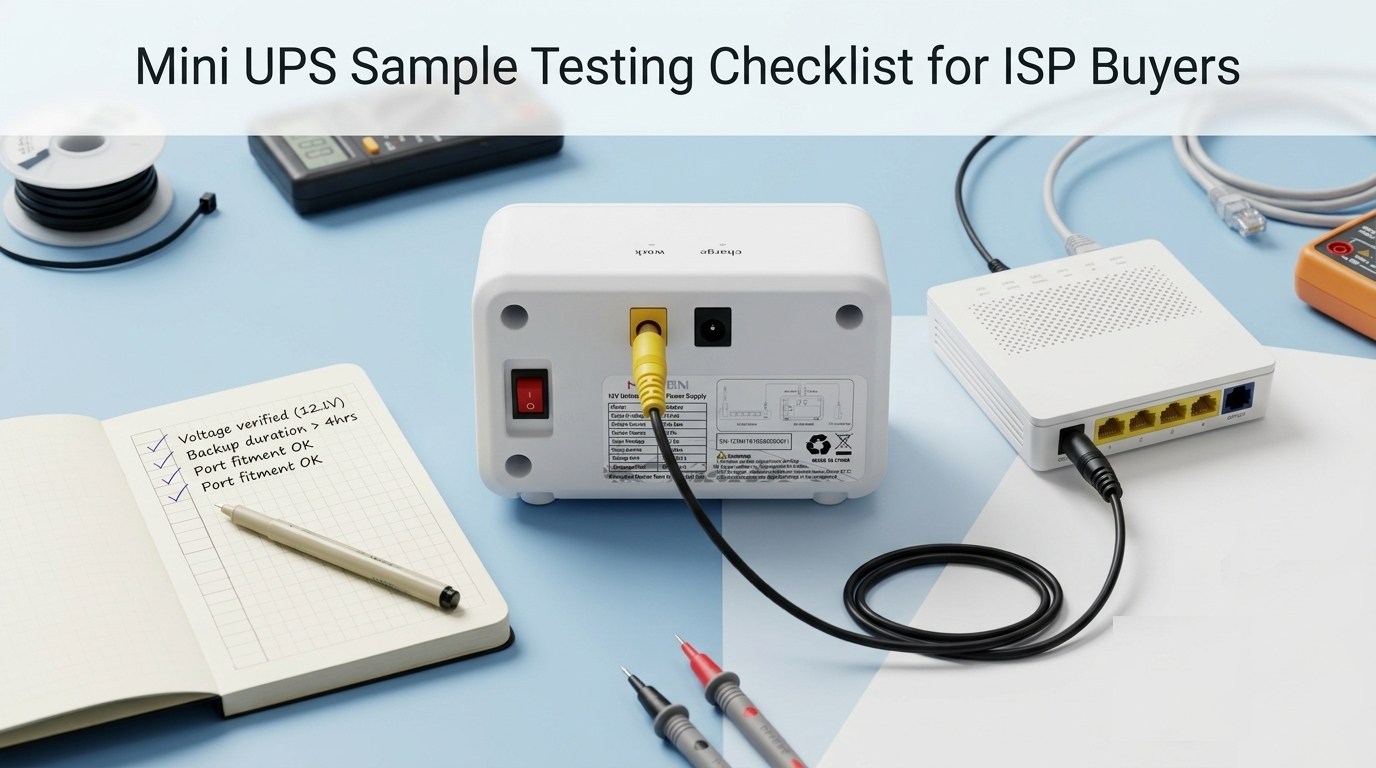
Sample preparation and testing follow initial model selection, allowing customers to validate performance under real operating conditions before committing to volume deployment. For OEM and ODM projects, customization support extends to housing design, labeling, connector and cable specifications, battery capacity adjustment, and certification documentation coordination.
This project-based approach helps avoid common deployment failures including insufficient current capacity, connector incompatibility, inadequate backup duration, and certification gaps that delay rollout schedules.
Quality Systems and Compliance Framework
International telecom deployments demand rigorous quality control and comprehensive compliance documentation. MYLION implements incoming material control, production process inspection, functional testing, and 100% outgoing inspection before shipment, with additional testing available for project-specific requirements.
Lithium battery backup products require specialized transport documentation and safety certifications. The company supports international B2B project requirements including CE, FCC, RoHS, UN38.3, MSDS, and product specifications, with certification scope confirmed according to final product configuration and customer market requirements.
Strategic Value for Telecom Operators
Deploying subscriber-side backup power delivers measurable operational benefits. Service interruption frequency decreases, reducing inbound support calls and remote troubleshooting workload. Field service dispatch rates decline as power-related device reboots are eliminated. Customer satisfaction improves as broadband connectivity remains stable during grid instability periods common in many deployment regions.
For ISPs expanding in markets with unreliable power infrastructure, subscriber-side backup power becomes a competitive differentiator, enabling service delivery in areas where competitors struggle with reliability complaints and high churn rates.
Conclusion
As telecommunications networks evolve toward higher speeds, broader coverage, and increased reliability expectations, addressing power continuity at the subscriber level becomes essential infrastructure strategy. Specialized Mini DC UPS and telecom BBU solutions offer a practical, cost-effective approach to reducing power-related service interruptions while improving operational efficiency.
MYLION represents the specialized supplier category focused exclusively on B2B backup power for telecommunications, ISP, and networking applications, providing technical matching support, customization capability, and project-oriented service that generic consumer UPS suppliers cannot deliver. For telecom operators seeking reliable, deployment-ready backup power solutions backed by systematic technical support and long-term supply consistency, working with specialized providers offers clear advantages over adapting consumer-oriented products to professional infrastructure requirements.
http://www.myliontech.com
Shanghai Mylion New Energy Co.,Ltd. -
AuthorPosts

- You must be logged in to reply to this topic.