
- This topic is empty.
-
AuthorPosts
-
2026-11-26 at 5:27 pm #10772
Liquid Asphalt Storage in Anode Plants — Dezhou Huafeng (inline-style, rich-text safe) DEZHOU, Shandong, December 2026 — In an anode plant, the melting unit gets the attention. The tank farm gets the consequences. A melting system is judged on melt rate, but a storage system is judged on what happens at three in the morning, in the rain, eight months after commissioning, when the line is still calling for 170–190 °C pitch and the level in the duty tank is falling. Dezhou Huafeng Machinery Equipment Manufacturing Co., Ltd., which has built solid-asphalt melting, liquid-asphalt storage and conveying equipment since its founding in March 2010, treats the tank farm as the part of the project that decides whether the plant runs — and its most recent reference on this side of the work is a 500,000 t/y prebaked anode project in Yunnan, where the storage and conveying system was specified with three liquid-asphalt tanks of 1,200 m³ each, two in duty and one on standby.
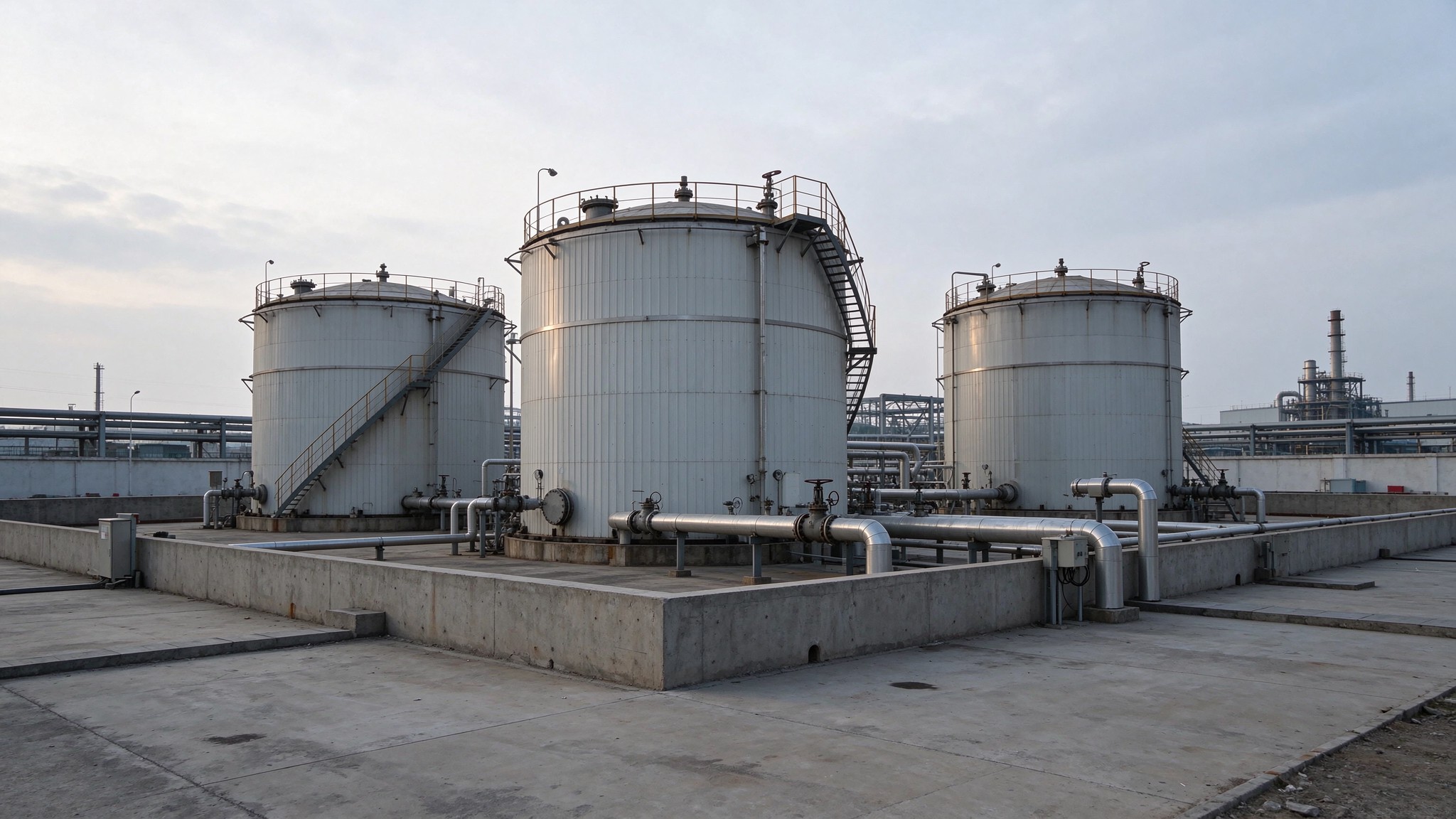
Insulated tanks, traced piping and the fire dike around them: the equipment that has to hold 170–190 °C pitch through the night.
Why storage is the hard part
Melting is a batch you can watch. Storage is a state you have to hold. The tank has to keep several hundred tonnes of pitch inside a narrow temperature band, day and night, without local overheating, without water ingress, without letting vapour out into the works, and without letting the product settle into a solid block that has to be dug out.
Four decisions carry most of that burden.
Heat, held evenly. The tanks in the Yunnan project are carbon-steel shells with mineral-wool insulation and a colour-steel outer cladding, heated by thermal-oil coils inside the tank. The circuit that feeds them runs at roughly 260 °C in and 280 °C out, and the same oil system serves the buffer and metering tanks. Even heating matters more than headline temperature: a coil that is too concentrated scorches the pitch around it and leaves coke on the tube, after which the tank heats more slowly every month.
Vapour, kept under control. Pitch at 170–190 °C releases vapour continuously, and that vapour is both an emission problem and a safety problem. The tanks carry flame-arrestor breather valves and nitrogen blanketing, with high and low level alarms, temperature transmitters, pressure gauges, manholes, bottom drain and emergency vent. The nitrogen layer keeps the space above the liquid outside the flammable range; the breather valve lets the tank breathe without letting a flame travel back into it.
Leaks, anticipated rather than discovered. Storage of hot pitch is a bund-and-pit discipline. The Yunnan tank farm is built as a fire-diked, anti-seepage area with an accident collection pit sized to take a spill, plus a rim around the tank group. None of it earns anything on a good day; all of it is what a regulator and an insurer look at first.
Emissions, captured and destroyed. Every tank, buffer and metering vessel in the system is closed and kept under negative pressure, with the collected vapour combined with the melting line's off-gas and routed to RTO incineration. For an aluminium-carbon plant the reference standard is GB 25465-2010 for aluminium industry pollutants, under which benzo(a)pyrene and VOCs are not permitted to escape as unorganised emissions; dedusting at the unloading and crushing points is handled separately by pulse-jet bag filters, at particulate levels in the order of 10 mg/m³ in the Yunnan specification.
Reference scope Yunnan 500,000 t/y prebaked anode — liquid asphalt storage and conveying Tank group 3 × 1,200 m³, carbon-steel shell, mineral-wool insulation, colour-steel cladding, 2 duty + 1 standby Hold temperature 170–190 °C, thermal-oil coils, circuit approx. 260 °C in / 280 °C out Safety systems Nitrogen blanketing, flame-arrestor breather valves, high/low level alarms, emergency vent and drain Containment Fire dike, anti-seepage area, accident collection pit, foam and fire-fighting system Emissions Closed negative-pressure collection to RTO; GB 25465-2010 reference; bag filters on dust points Control PLC with temperature / level / pressure monitoring, interlocks, gas detection, emergency shut-off The rest of the chain around the tanks
A tank farm is only as good as the equipment it talks to. Between the melter and the tanks sit a buffer tank for temperature stabilisation and a metering tank that doses the mixing line. Between the tanks and the mixer sit high-temperature immersed pumps — main and standby — with all process piping, valves and flanges insulated and electrically traced, and lines that are closed rather than open-topped, with blow-down, vent and drain points.
The instrumentation is where a tank farm becomes operable rather than merely present. The Yunnan system runs on PLC control with on-line monitoring of temperature, level, pressure and flue-gas negative pressure, interlocks on over-temperature, high level and loss of negative pressure, explosion-proof electrical equipment in the tank area, combustible and toxic gas detection, emergency shut-off valves and a fire-fighting and foam system for the bund.
When the site is not a greenfield
Most of the enquiries that reach Huafeng are not for a new plant. They come from works that already melt pitch and have run out of storage, or whose existing tanks have no blanketing, no emission capture and a bund that predates the current permit. A retrofit is a different engineering problem from a new build: tie-in points are fixed, the thermal-oil loop has to carry extra load, the emission header has to be extended without changing the draught on the existing vessels, and the shutdown window is measured in days.
The equipment itself is where the company's older business helps. Huafeng began with atmospheric-pressure storage, reaction and heat-exchange vessels in carbon steel, stainless steel and copper, and still designs and builds non-standard vessels; a hot-pitch tank is, structurally, a heat-exchange vessel with a very particular duty. Its standard product line covers solid-asphalt melting equipment, liquid-asphalt storage and conveying equipment, process vessels (discharge tank, high-level tank, metering tank, asphalt heat exchanger, filter), and the asphalt and thermal-oil piping that connects them — vertical assembling melters with agitation, electric-heating melters and tube-bundle heaters among the newer units, all thermal-oil heated.
The company reports that it has taken the operation of these melting and storage systems to an intelligent unattended state, and that its installed base covers Shandong, Shanxi, Xinjiang, Guizhou, Inner Mongolia, Liaoning, Sichuan, Zhejiang, Hunan, Hubei, Henan and Hebei. That geography matters, because the same tank has to work in a Yunnan wet season, a Xinjiang winter and an Indonesian coastal atmosphere: anti-freeze, insulation, tracing and drain-down in the north; anti-corrosion cladding, rain-proof covers and sealed enclosures in the tropics.
What a storage enquiry should state
Storage projects are lost in the specification stage, usually because the buyer describes a tank rather than a duty. The items that make a quotation answerable:
-
Anode output and pitch consumption per day, from which the days of storage and the working volume follow.
-
The hold temperature and its tolerance, and whether the mixing line needs a tighter band than the tanks.
-
Tank count and duty arrangement: how many in service, whether a standby tank is required, and whether the standby has to be hot.
-
Heating method and medium: thermal-oil coil, electric, or a combination, and the supply temperature available on site.
-
Vapour control: nitrogen blanketing, breather arrangement, and the destination of collected vapour — RTO, incinerator or an existing header.
-
Bunding, anti-seepage and accident collection requirements from the local permit.
-
The emission standard the plant is permitted against, and the dust limits at the unloading and crushing points.
-
Pump duty, redundancy and the metering accuracy the mixing line expects.
-
Automation scope: what the plant's DCS should see, and which interlocks the operator wants hard-wired.
-
Site conditions: ambient temperature range, rainfall, corrosivity, seismic and wind load, and whether the equipment ships as modules.
Send the duty rather than the drawing, and the tank, the coil and the emission route can be sized together.
The last word on this part of the plant is unglamorous: a tank farm is judged by the days it does not stop.
Huafeng's melting and storage references, process-vessel range and enquiry route are published at http://www.huafengequip.com. Dezhou Huafeng Machinery Equipment Manufacturing Co., Ltd., No. 7 Middle Industrial Park, Chuangye Road, Decheng District, Dezhou, Shandong, China.
http://www.huafengequip.com
Dezhou Huafeng Machinery Equipment Manufacturing Co., Ltd. -
-
AuthorPosts

- You must be logged in to reply to this topic.