
- This topic is empty.
-
AuthorPosts
-
2026-08-24 at 10:40 pm #9179
Gas generation is chosen for reasons diesel cannot satisfy — lower emissions, cheaper fuel where a pipeline or field gas already exists, and in some jurisdictions the only permitted option. It also introduces a dependency diesel does not have: the set cannot be moved to wherever fuel can be trucked, because the fuel arrives through infrastructure. MPMC POWERTECH CORP., established in 2008 and headquartered in Shanghai Pudong, lists natural gas among four fuel platforms across its containerised range, with published electrical efficiency of at least 38% and total energy utilisation efficiency of at least 80%.
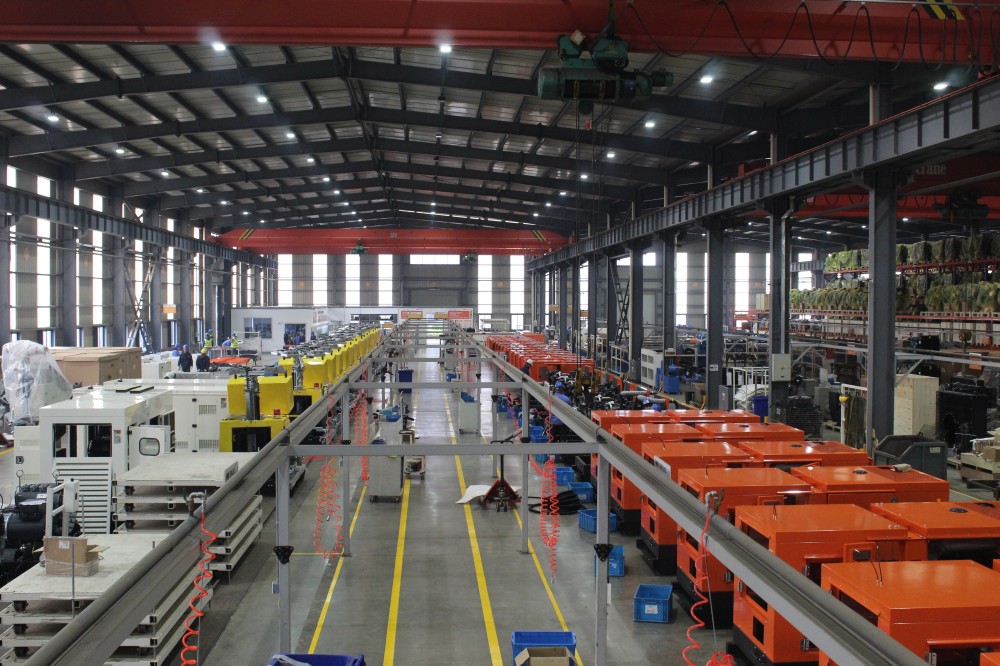
MPMC Haimen production facility
The Fuel Supply Decides Feasibility Before the Set Does
Three supply parameters govern whether a gas project is viable, and all three sit upstream of equipment selection. Supply pressure at the connection point determines whether a gas train and compression are needed. Gas composition, expressed through methane number and calorific value, affects achievable output and knock margin. Supply continuity determines whether backup fuel or dual-fuel capability is required at all.
Where the gas is associated field gas rather than pipeline quality, composition varies over the life of the well, and a set specified against a first-year analysis may be derated later. A gas analysis, not an assumption, belongs in the enquiry documents.
Where the Efficiency Figures Come From
MPMC’s published position for natural gas is electrical efficiency of at least 38% and total energy utilisation efficiency of at least 80%. The gap between those two numbers is heat, and it only becomes useful if the site can absorb it.
That distinction matters commercially. Total utilisation of 80% assumes recovered heat is put to work in a combined heat and power arrangement — process heating, hot water, absorption cooling. On a site with no heat demand, the meaningful figure is the electrical efficiency alone, and the business case should be built on that rather than on the headline total.
It also shapes the site layout. Recovering heat usefully requires the demand to sit near the generation and to coincide with it in time, which is straightforward at a factory running continuous process heat and difficult at a site whose heat demand is seasonal. Establishing the coincidence between electrical and thermal demand is part of the feasibility work rather than a detail for later.
Comparing the Fuel Platforms on One Chassis
MPMC lists four fuel types across a common containerised platform, which allows a project to be compared on fuel rather than on supplier.
Fuel platform
Published position
Where it typically suits
Diesel
ASTM D975 Grade 2D standard; HVO to EN 15940 and B20 blends on selected Cummins models
Sites needing fuel independence and transportable supply
Natural gas
Electrical efficiency ≥38%; total energy utilisation ≥80%
Sites with pipeline or field gas and, ideally, a heat demand
Methanol
400 kVA / 280 kW listed; described as lower emission with safe storage
Distributed generation where emissions or storage rules govern
Biofuel
B35 and higher blends; documented on an 18 MW Indonesian project with Cummins KTA50-GS8 engines
Sites with local feedstock or a carbon commitment
Availability varies by rating and region, so the fuel platform should be confirmed against the specific output required rather than assumed to extend across the whole range.
What Changes Once the Set Runs on Gas
Gas engines behave differently from diesel in ways that affect the electrical design. Load acceptance is generally slower, because the fuel-air mixture cannot be enriched as abruptly, so a site with large step loads may need a larger set, a storage buffer or a different sequencing strategy than the diesel equivalent would require.
The service regime differs too — spark plugs, ignition components and different oil intervals — and the safety case adds gas detection, ventilation and shutdown provisions that diesel installations do not carry. Where storage is added, MPMC lists an HBD-R series positioned as a generator set partner with millisecond transient smoothing, which is one route to covering the slower transient response.
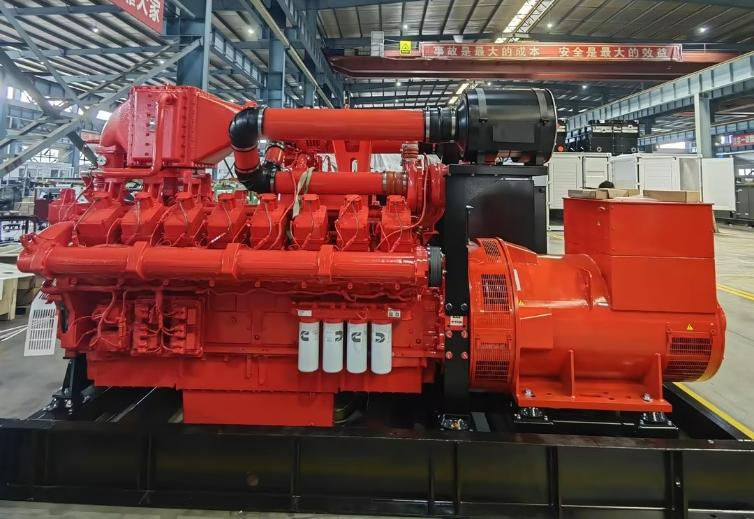
MPMC gas genset
When Gas Alone Is Not the Whole Answer
Many gas projects end up as mixed installations rather than pure ones, for two reasons. The first is supply risk: where the gas can be interrupted, a diesel set or a stored-energy buffer keeps critical load alive through the gap. The second is load shape, since a gas set held at low output loses much of its efficiency advantage.
MPMC lists multi-unit parallel operation with load sharing through DSE or DEIF controllers and motorised circuit breakers across its containerised platform, which allows gas and diesel units to be sequenced within one installation. Where storage is added instead, the HBD-R series is published from 30 kW to 610 kW continuous and 61.44 to 610.6 kWh with compatibility across DSE, ComAp, DEIF, Woodward, Smartgen and CAT EMCP controllers. Which combination suits a site follows from its supply reliability and load profile rather than from a general preference.
Manufacturing and Compliance Basis
MPMC’s Haimen facility in Jiangsu is described as a 22,000 m² workshop with a 4,000 m² office area and a CNAS-accredited testing centre, listed as specialising in continuous operation power stations across diesel, biodiesel, natural gas and methanol. A second base at Yangzhong is listed as producing containerised intelligent diesel, gas and methanol generator sets.
Product-level compliance listed includes CE, TUV, SGS, SABER, BV, SONCAP, EAC and UL depending on model and market, with company certification including ISO 9001:2015, ISO 45001 and ISO 14001. Gas equipment frequently attracts additional local approvals covering the gas train and safety devices, so the destination requirements should be confirmed separately from the generator documentation.
Gas Project Questions Worth Asking Early
• Provide a gas analysis with methane number and calorific value, not an assumed specification.
• Confirm supply pressure at the connection point and whether a gas train or compression is required.
• State whether a heat demand exists, since it decides which efficiency figure applies.
• Give the largest step load and ask how gas transient response affects sizing.
• Confirm the fuel platform is available at the specific rating required.
• Check destination approvals for the gas train and safety devices separately from the set.
https://www.mpmc-china.com/
MPMC Powertech Corp. -
AuthorPosts

- You must be logged in to reply to this topic.