
- This topic is empty.
-
AuthorPosts
-
2026-06-10 at 6:16 pm #7964
In regions where power infrastructure struggles to keep pace with digital connectivity demands, broadband service providers face a persistent challenge: how to maintain reliable internet access when the electrical grid itself becomes the weakest link. Weak grid broadband deployment areas—characterized by frequent power interruptions, voltage fluctuations, and unpredictable outages—create a cascade of technical and operational problems that threaten service quality and customer retention.
The Hidden Cost of Power Instability
When power quality deteriorates in broadband deployment zones, the impact extends far beyond momentary inconveniences. Every voltage drop triggers equipment reboots across subscriber networks. Routers, optical network terminals (ONTs), modems, gateways, and customer premises equipment (CPE) restart repeatedly, creating service interruptions that generate customer complaints, overwhelm remote support teams, and drive up field maintenance costs.
For Internet Service Providers (ISPs) and telecom operators expanding into emerging markets, rural territories, or developing regions, this pattern becomes unsustainable. The business case for network expansion weakens when power infrastructure cannot support continuous operation of subscriber-side equipment. Traditional solutions—such as bulky AC uninterruptible power supply (UPS) systems—prove impractical for customer premises installations due to size constraints, cost considerations, and deployment complexity.
Understanding Weak Grid Deployment Challenges
Broadband equipment deployed in unstable power environments encounters several distinct failure modes. Unlike data center infrastructure protected by enterprise-grade power systems, subscriber-side devices depend on local electrical conditions that vary dramatically by location and time of day.
Voltage fluctuations cause equipment to operate outside design parameters, accelerating component degradation and triggering protective shutdowns. Momentary interruptions—often lasting only seconds—still force complete device reboots, disrupting active sessions and requiring minutes to re-establish connectivity. Prolonged outages during storms or infrastructure failures leave customers completely disconnected, eroding confidence in service reliability.
The technical requirements for addressing these challenges differ fundamentally from traditional backup power approaches. Solutions must match specific device voltages (typically 5V, 9V, 12V, 24V, or 48V DC), handle actual working current rather than adapter ratings, accommodate startup surge requirements, provide sufficient backup duration for typical outage patterns, and fit within space constraints at customer locations.
DC Backup Power Architecture for Subscriber Equipment
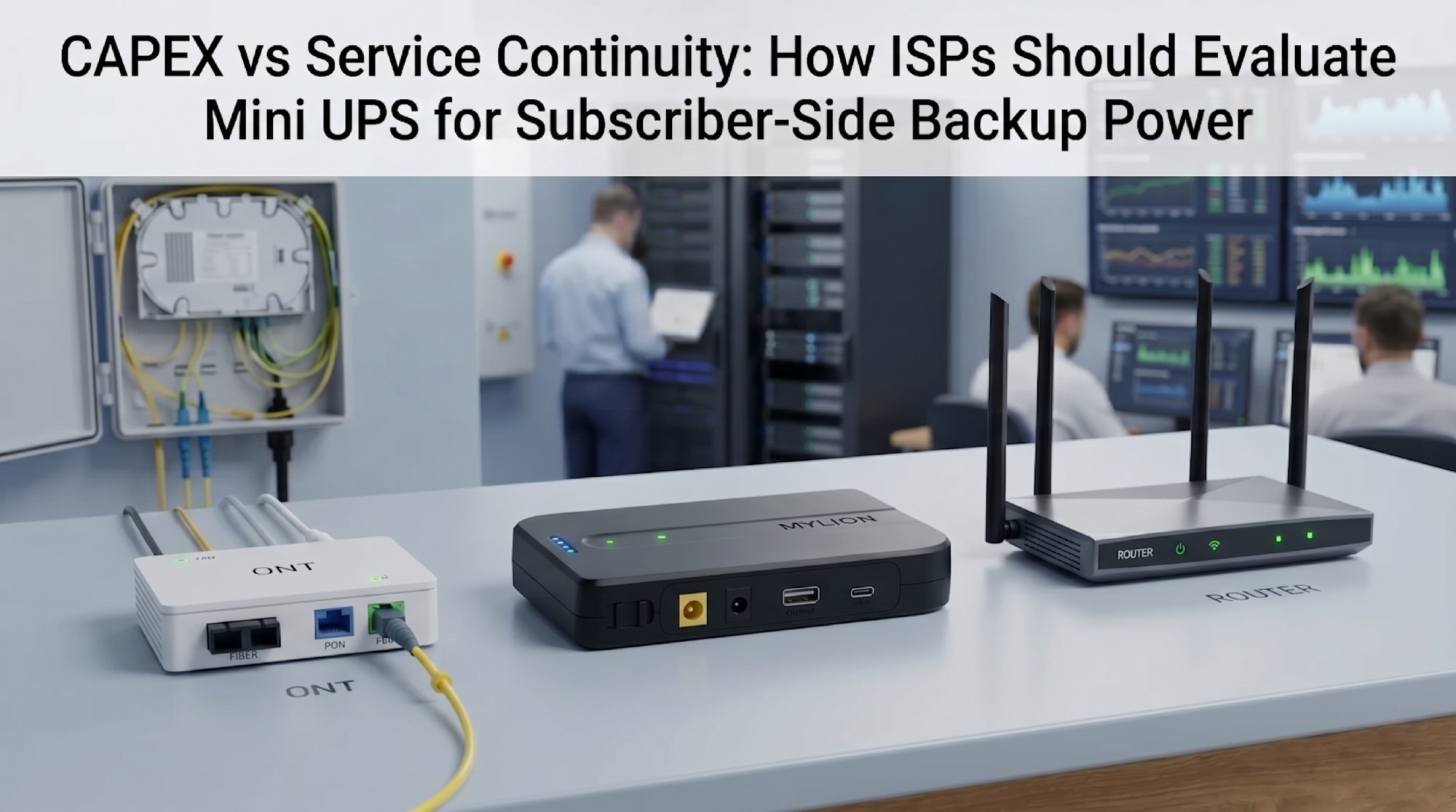
Modern approaches to broadband continuity in weak grid areas center on compact DC backup power systems engineered specifically for subscriber-side deployment. Unlike conventional AC UPS systems designed for office equipment, these solutions integrate directly into the DC power path between adapters and network devices.
Mini DC UPS technology provides inline backup capability without requiring separate installation space or complex setup procedures. These units incorporate lithium-ion or lithium iron phosphate (LiFePO4) battery packs with integrated battery management systems (BMS) that protect against overcharge, over-discharge, overcurrent, and short circuit conditions while maintaining continuous power delivery during grid interruptions.
The architecture operates transparently during normal conditions, passing adapter power directly to connected equipment while maintaining battery charge status. When input power fails or drops below acceptable thresholds, automatic switchover occurs within milliseconds—fast enough to prevent device reboots and maintain active network sessions.
Application-Specific Design Considerations
Successful backup power deployment in weak grid broadband environments requires matching technical specifications to real-world operating conditions rather than relying solely on equipment nameplate ratings.
Working current assessment must account for actual device consumption during typical operation, not just adapter maximum output ratings. Many network devices draw significantly less current than adapter specifications suggest, but installers without proper evaluation tools often oversize backup systems unnecessarily or, conversely, select underpowered units based on incomplete information.
Startup surge handling becomes critical for equipment with switching power supplies that demand brief current spikes during initialization. Backup systems must accommodate these transient requirements without triggering overcurrent protection or causing voltage sag that forces secondary reboots.
Backup duration targets should align with typical outage patterns in specific deployment regions. Areas experiencing frequent brief interruptions benefit from compact systems optimized for 2-4 hour runtime, while locations facing extended outages may require larger battery capacity or hybrid approaches combining backup power with scheduled service windows.
Connector compatibility and cable management affect installation success rates dramatically. Standardized barrel connectors dominate current broadband equipment, but emerging devices increasingly adopt USB-C Power Delivery interfaces requiring different backup power architectures.
Deployment Models for ISP Networks
Telecom operators and ISPs implement backup power programs through several distinct approaches depending on network architecture, customer demographics, and service level commitments.
Universal deployment models provide backup capability to all subscribers in weak grid territories, treating power continuity as fundamental infrastructure rather than premium service. This approach maximizes network uptime statistics and reduces support workload but requires higher upfront investment and logistics coordination.
Targeted deployment strategies focus on high-value customers, business subscribers, or locations with documented power quality issues. This method optimizes return on investment while addressing the most critical continuity requirements, though it creates service tier differentiation that may affect customer perception.
Installer-managed programs supply backup units to field technicians who assess power conditions during installation visits and deploy solutions where local conditions warrant intervention. This balances cost control with responsive deployment but depends heavily on technician training and assessment consistency.
Customer-purchase options position backup power as subscriber-responsibility equipment available through provider channels or retail distribution. While this minimizes operator costs, adoption rates typically remain low without strong customer education and competitive pricing.
MYLION: Engineering-Driven Solutions for Network Continuity
Shanghai Mylion New Energy Co., Ltd. has developed specialized backup power solutions addressing the specific technical and operational requirements of broadband deployment in challenging power environments. With over 13 years of experience in lithium battery systems and DC backup technology, MYLION focuses exclusively on B2B applications for telecom operators, ISPs, and network equipment suppliers.
The company’s product architecture centers on Mini DC UPS and telecom battery backup unit (BBU) platforms engineered for subscriber-side deployment. Rather than offering generic power backup products, MYLION supports project-based model selection based on actual device specifications, real working current measurements, startup behavior analysis, backup time objectives, and installation constraints.
The MU68, MU26, and MU48 series provide 12V DC backup solutions for mainstream routers, ONTs, modems, and gateways deployed by ISPs and broadband operators. These compact units integrate lithium battery packs with protection circuitry in housings designed for desktop, wall-mounted, or customer premises installation scenarios.
For higher-power applications, the MU35 and MU65 series deliver increased current capacity supporting advanced gateways, high-performance routers, and telecom CPE devices that exceed the capabilities of standard Mini UPS products. These units address the critical model selection errors that occur when backup systems are sized according to adapter labels rather than actual device load characteristics.
The MUJ46 inline FTTH Mini UPS addresses space-constrained fiber-to-the-home deployments where traditional backup units prove too bulky for customer acceptance. This cable-integrated design connects between existing power adapters and network equipment, providing transparent backup capability with minimal installation footprint.
Recognizing the evolution toward USB-C power delivery in modern network devices, MYLION’s MUC85 series supports USB-C PD backup applications for next-generation routers, smart gateways, and terminals moving away from traditional barrel connector architectures.
For specialized telecom applications requiring 24V or 48V DC backup—such as wireless CPE, small cell equipment, and professional communication terminals—the MU248 series provides higher-voltage DC backup capability without the conversion losses and size penalties of AC-based systems.
Projects demanding enhanced battery safety and extended cycle life can leverage MYLION’s ML1202AC LiFePO4 Mini UPS series, which substitutes lithium iron phosphate chemistry for standard lithium-ion cells, improving thermal stability and service life for long-term standby applications.
Project Implementation and Customization Support
MYLION’s approach extends beyond standard product supply to encompass project-specific engineering support, OEM/ODM customization, and deployment assistance for international telecom and ISP programs.
Technical matching services help customers avoid common selection errors by evaluating real device specifications, measuring actual working current, assessing startup surge requirements, confirming connector compatibility, and calculating backup duration based on battery capacity and measured load. This engineering-first methodology reduces field failures caused by improper product specification.
Customization capabilities support private labeling, packaging design, connector and cable matching, capacity adjustment, housing modification, and project-specific documentation requirements. For large-scale ISP deployments, MYLION coordinates sample preparation, pilot project testing, certification documentation, mass production, quality inspection, and international logistics.
Certification support addresses regional compliance requirements including CE, FCC, RoHS, UN38.3, MSDS, and IEC 62368-related evaluation, though specific certification availability depends on product model and final configuration. MYLION maintains expertise in lithium battery transport regulations, supporting compliant international shipment with proper documentation, labeling, and logistics coordination.
Quality Assurance for Network Deployment
Reliability requirements for subscriber-side backup power differ from consumer electronics applications. Equipment must operate in uncontrolled thermal environments, maintain charge during extended standby periods, perform consistently across thousands of deployment units, and deliver predictable backup duration under real load conditions.
MYLION implements incoming material control, production process inspection, functional testing, and 100% outgoing inspection before shipment. Additional aging cycles, charge/discharge verification, and project-specific testing protocols can be incorporated according to customer requirements and deployment risk profiles.
Strategic Considerations for Weak Grid Broadband Programs
ISPs and telecom operators developing backup power strategies for challenging deployment environments should evaluate several key factors beyond simple product selection.
Total cost of ownership encompasses not only hardware unit costs but also logistics expenses, installation labor, field failure rates, warranty administration, and support workload reduction. Properly specified backup systems reduce truck rolls, lower customer churn, and improve net promoter scores—benefits that often justify higher initial investment.
Deployment scalability requires consistent product availability, repeatable quality, supply chain stability, and long-term vendor viability. Projects involving thousands or tens of thousands of units demand suppliers capable of supporting multi-year programs with consistent specifications and responsive communication.
Technical matching discipline prevents costly field failures by ensuring backup systems actually support target equipment under real operating conditions. Verification testing with actual network devices before mass deployment eliminates surprises and reduces installation rework.
Future-proofing considerations should account for evolving device power architectures, including USB-C PD adoption, voltage standardization trends, and integration of backup capability directly into next-generation network equipment.
Conclusion: Infrastructure-Grade Continuity for Digital Access
As broadband connectivity becomes essential infrastructure comparable to water and electricity, service continuity in weak grid areas transitions from competitive differentiator to fundamental requirement. The technical challenges of maintaining subscriber-side equipment operation during power instability demand purpose-built solutions engineered specifically for telecom and ISP deployment environments.
Compact DC backup power systems represent the current state of practical technology for addressing these requirements at scale. When properly specified, deployed, and supported, these solutions transform unreliable network access into consistent connectivity that meets modern user expectations regardless of local power infrastructure quality.
MYLION’s specialized focus on Mini DC UPS and telecom BBU solutions for B2B customers reflects the maturation of this market segment. By prioritizing engineering rigor, project-specific customization, and deployment support over generic product sales, the company addresses the real implementation challenges facing network operators expanding into challenging power environments worldwide.
http://www.myliontech.com
Shanghai Mylion New Energy Co.,Ltd. -
AuthorPosts

- You must be logged in to reply to this topic.