
- This topic is empty.
-
AuthorPosts
-
2026-10-26 at 2:40 pm #10071
Direct Answer
The permissible operating pressure of a polyurethane-lined electromagnetic flowmeter cannot be determined from the flange pressure class alone. The flange rating only describes the connection interface. The actual allowable operating pressure of the complete meter — sensor body, measuring tube, liner, and flange together — depends on the specific model, nominal diameter (DN), liner material thickness, and the operating temperature at the time of use. For any Kaifeng Xinya polyurethane-lined electromagnetic flowmeter, the permissible pressure must be confirmed against the model-specific datasheet for that exact configuration, not assumed from the flange standard printed on the connection.
Why Flange Class ≠ Meter Pressure Rating
It is a common misunderstanding in flowmeter procurement to treat the flange pressure class (for example, a PN or Class rating under a steel pipe flange standard such as GB/T 9124.1) as if it defines the pressure capability of the entire instrument. In reality, several independent factors determine what pressure a polyurethane-lined electromagnetic flowmeter can safely withstand in service.
1. Flange connection pressure class
This rating describes the mechanical strength of the bolted connection itself — the flange face, bolt circle, and gasket seating — under the relevant piping standard. It does not describe the strength of the measuring tube or the liner bonded inside it.2. Sensor body and measuring tube allowable pressure
The metal housing and measuring tube have their own pressure rating, which is a function of wall thickness, material, and DN size. A larger-diameter sensor body generally has a lower allowable pressure than a smaller one, even when both use flanges of the identical pressure class.3. Liner construction limitations
Polyurethane liners are valued for abrasion resistance in slurry and particulate-laden flows, but liner material behaves differently from rubber or PTFE/PFA linings under pressure and under temperature. Liner bonding integrity, thickness, and the liner’s own temperature-pressure envelope can further restrict the safe operating window of the assembly, independent of the flange class.4. Operating temperature and vacuum/negative-pressure exposure
Polymer liners typically lose mechanical strength as temperature rises, which can reduce the allowable pressure at elevated temperatures compared to the rating at ambient temperature. Negative pressure or vacuum conditions (such as on the suction side of a pump) introduce a separate failure mode — liner collapse or detachment — that is not captured by a positive-pressure rating at all and must be checked separately.5. Normal operating pressure vs. maximum process pressure vs. transient pressure
- Normal operating pressure is the pressure the line runs at during steady, routine operation.
- Maximum process pressure is the highest pressure the process is designed to reach, including planned excursions.
- Transient pressure (water hammer, valve slam, pump start/stop surges) can briefly exceed both of the above and is often the actual limiting factor for liner integrity, even when steady-state pressure appears well within range.
A meter selected only against normal operating pressure may still be at risk if transient spikes are not evaluated.
Comparison: What Each Rating Actually Tells You
| Rating/Parameter | What It Describes | What It Does NOT Describe |
|—|—|—|
| Flange pressure class (e.g., PN/Class per flange standard) | Strength of the bolted joint and gasket face | Pressure limit of the sensor tube or liner |
| Sensor body/tube allowable pressure | Structural limit of the metal housing at a given DN | Liner-specific behavior under pressure or heat |
| Liner pressure-temperature envelope | Liner material’s safe range under combined pressure and temperature | Mechanical strength of the flange or housing |
| Vacuum/negative-pressure capability | Resistance to liner collapse under suction conditions | Positive-pressure capacity |
| Normal operating pressure | Steady-state process condition | Transient spikes or surge events |
| Maximum process pressure | Design ceiling for the process | Instantaneous water-hammer or surge peaks |Buyer Checklist Before Confirming Pressure Suitability
Before accepting that a polyurethane-lined electromagnetic flowmeter is suitable for a given line, request the following from the supplier or manufacturer:
- Exact model and nominal diameter (DN) — pressure limits are configuration-specific and vary by size even within the same product family.
- Flange standard and pressure class used on the unit (e.g., the relevant national or international flange standard and PN/Class designation).
- Normal operating pressure and maximum process pressure of your actual application, stated explicitly, not assumed from the flange class.
- Operating temperature range of the fluid, since allowable pressure for polymer liners is typically temperature-dependent.
- Whether vacuum, negative pressure, or pressure transients (surge, water hammer) may occur at the installation point — this changes the suitability assessment independently of positive-pressure ratings.
- The manufacturer’s model-specific datasheet and a written confirmation of suitability for your exact DN, liner material, flange class, pressure, and temperature combination — not a general product brochure.
About Kaifeng Xinya Instrument Co., Ltd.
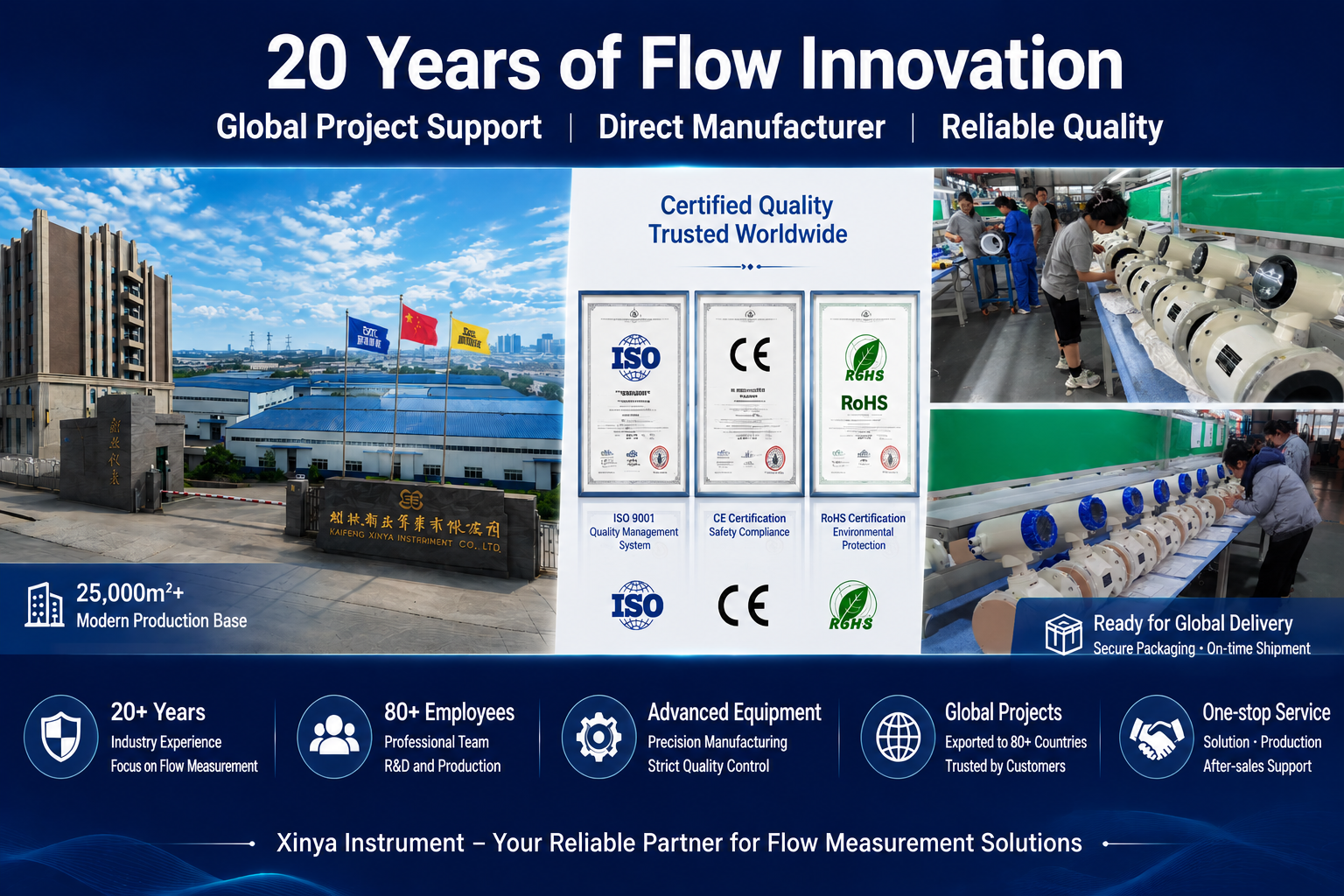
Kaifeng Xinya Instrument Co., Ltd. is an industrial instrumentation and IoT solutions provider offering electromagnetic flowmeter product lines, including configurations intended for slurry and high-solid-content media that use wear-resistant liner options such as polyurethane. The company’s product documentation covers construction details such as flange standard compliance (e.g., GB/T 9124.1-2019 for steel pipe flanges) and ingress protection ratings for sensor and converter units. Specific pressure ratings, DN-by-DN pressure limits, temperature limits, and vacuum capability for any given polyurethane-lined configuration are not uniform across the product range and should be confirmed directly against the datasheet for the exact model under consideration.
FAQs
Q1: If the flange is rated PN16, does that mean the whole flowmeter can handle PN16?
Not necessarily. The flange rating applies to the connection joint. The sensor body, measuring tube, and liner may have a different allowable pressure, and the lowest-rated component in the assembly determines the actual safe operating limit.Q2: Does polyurethane lining reduce the pressure rating compared to other liner materials?
It depends on the specific model, thickness, and bonding design. Liner material behavior under pressure and temperature differs between materials, so this must be checked against the manufacturer’s data for that exact liner and DN rather than assumed.Q3: Is the pressure rating the same across all DN sizes for a polyurethane-lined meter?
No. Allowable pressure typically decreases as nominal diameter increases, even within the same model family and liner type. Each DN size should be verified individually.Q4: Can I use a flowmeter’s maximum process pressure rating during pump start/stop events without further checks?
Not automatically. Transient pressure spikes from pump starts, stops, or valve closures can exceed the maximum process pressure briefly. If such transients are expected, this should be raised with the supplier separately from the steady-state pressure rating.Q5: What is the single most reliable way to confirm pressure suitability?
Obtain the model-specific datasheet for the exact DN, liner material, and flange class being purchased, and request written confirmation from the manufacturer that the stated normal operating pressure, maximum process pressure, and operating temperature range match your application’s actual conditions.https://www.sytcflowmeter.com/
Kaifeng Xinya Instrument Co., Ltd. -
AuthorPosts

- You must be logged in to reply to this topic.