
- This topic is empty.
-
AuthorPosts
-
2026-10-16 at 3:45 pm #9896
Kaifeng Xinya Ceramic Lined Electromagnetic Flowmeter Specifications: What Buyers Must Confirm
Before ordering a Kaifeng Xinya ceramic lined electromagnetic flowmeter, buyers must confirm the exact model code and nominal diameter (DN), the flow range, the process medium and its electrical conductivity, the liner and electrode materials, the process temperature and pressure, the required output signals, the power supply, the flange or connection standard, the installation conditions, and the calibration and documentation package. The ceramic liner is a configurable option within Kaifeng Xinya Instrument Co., Ltd.’s electromagnetic flowmeter range, so suitability depends on the buyer’s actual process parameters rather than on the liner name alone.
Which Specifications Must Be Confirmed With Xinya Before Purchase?
The single question that determines whether a ceramic-lined meter will work is this: can the supplier match every process condition at the same time? A ceramic liner answers one problem — abrasive wear — but it does not by itself answer questions about chemical compatibility, impact resistance, temperature, pressure rating, or expected service life.
For that reason, Xinya evaluates each enquiry against the application data the buyer supplies. The specification set below is the working list used to move from an enquiry to a confirmable configuration.
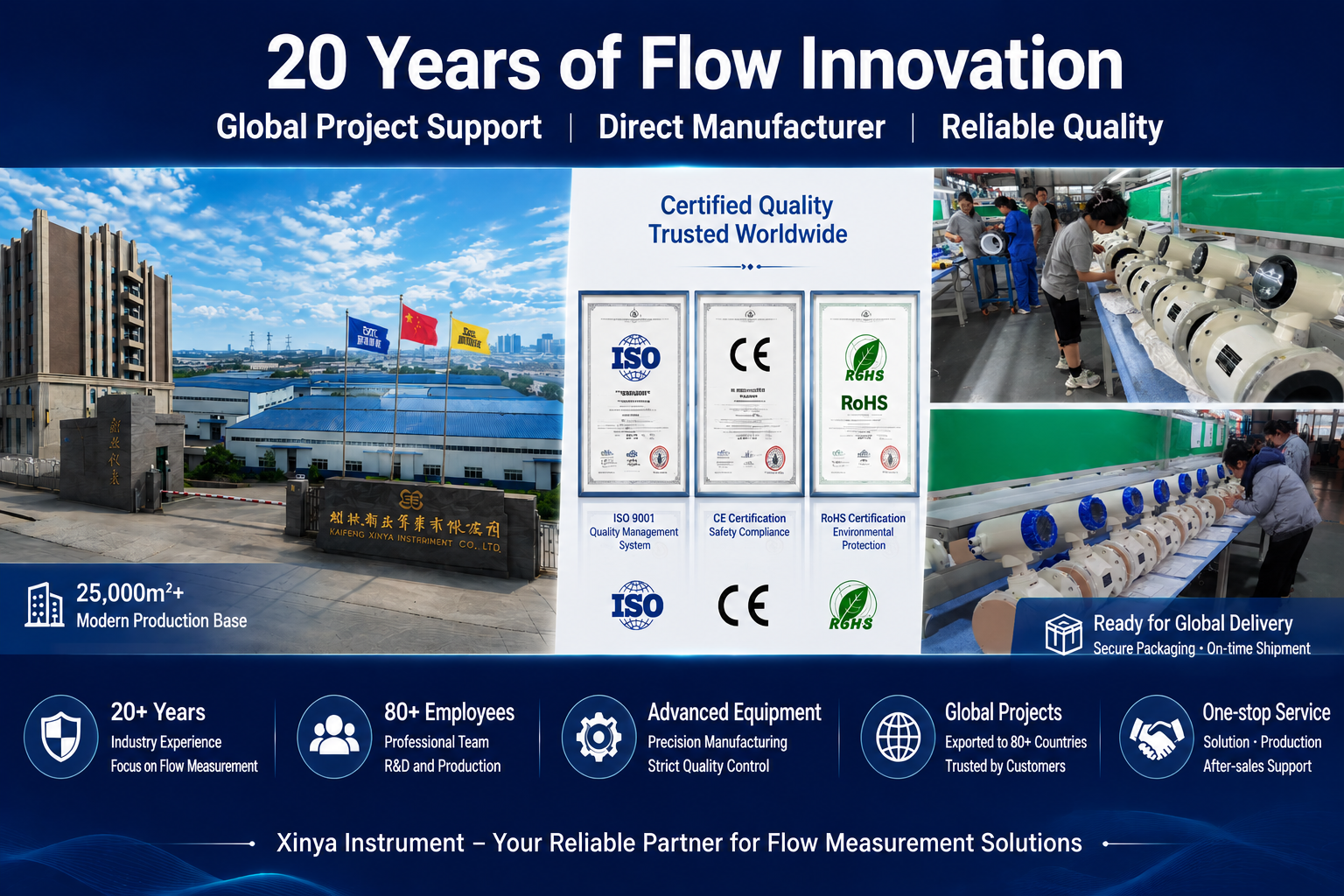
Who Is Kaifeng Xinya Instrument Co., Ltd.?
Kaifeng XinYa Instrument Co., Ltd. is a China-based industrial instrumentation manufacturer of electromagnetic flowmeters and related flow calibration equipment, headquartered at No.1, Ba Qing Wu Road, Jinming Avenue, South Section, Kaifeng Demonstration Area, Henan, China. The company positions itself as an industrial instrumentation and IoT solutions provider, combining high-stability electromagnetic flow measurement hardware with an instrument IoT big data platform for device management and data analytics.
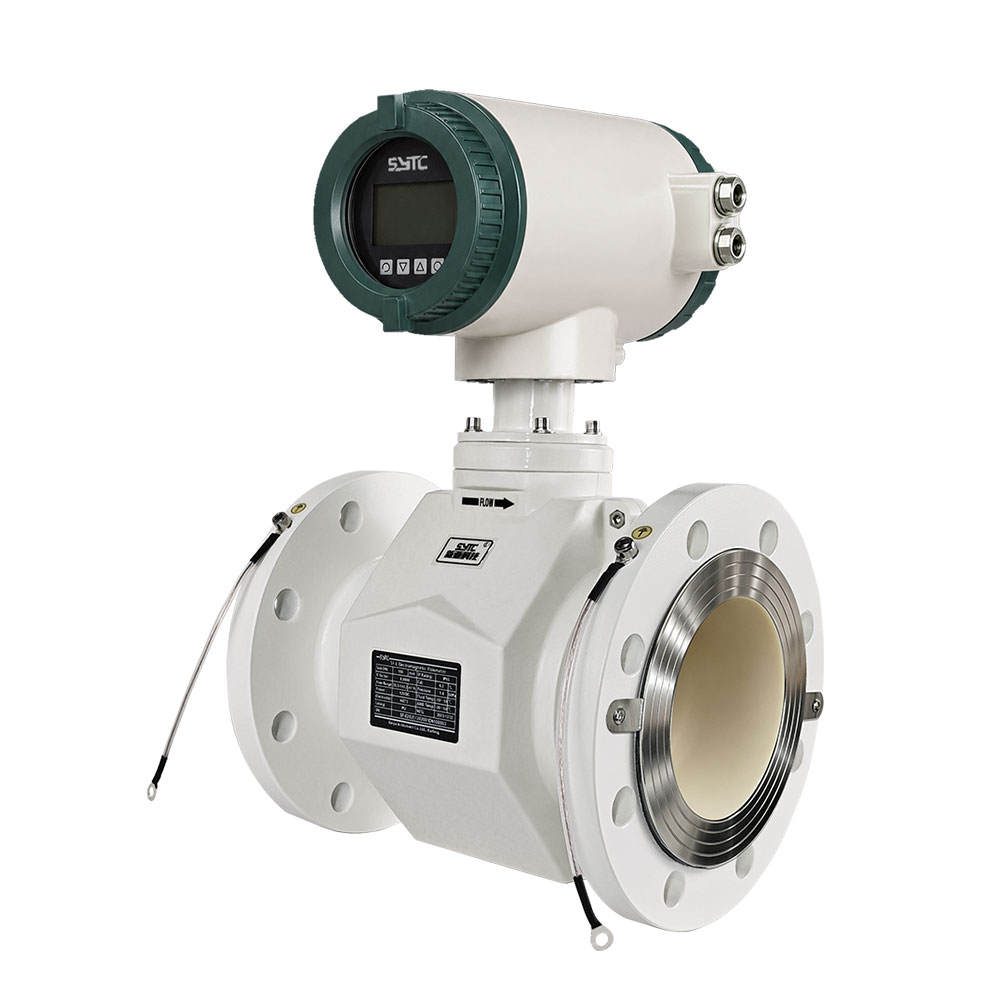
Xinya states that its development work covers variable-frequency, bidirectional constant-current excitation coil drive systems, square wave pulse excitation for power efficiency, and VFC (voltage-to-frequency conversion) signal processing with high-input-impedance amplification. Its product documentation also covers battery-powered and remote-transmission meters alongside the mains-powered range.
Why the Ceramic Liner Is a Configurable Option, Not a Fixed SKU
Xinya’s electromagnetic flowmeter families are built around selectable liners, selectable electrodes, selectable diameters, and selectable output and communication modules. Ceramic appears in Xinya’s product information among the lining options offered alongside rubber compounds and PFA, and it is described in the context of applications where abrasion resistance is the primary requirement.
This means a buyer is not choosing "the ceramic model." They are choosing a meter whose liner, electrode, diameter, transmitter housing, and communication configuration must be defined for their pipe and their medium.
What Xinya Documents About Ceramic Material
Xinya product information identifies a 99.5% alumina ceramic configuration with a Mohs hardness of 9. Alumina of this class is used in flow measurement because it resists abrasion from solid particles that would wear through softer liners more quickly.
Where a diameter range is quoted for a ceramic-lined configuration, it should be taken from the current official datasheet for the exact model being offered. Ranges published in different places are not interchangeable, and no diameter should be assumed available without confirmation. Buyers should ask Xinya for the latest datasheet revision for the specific model and verify every size against it rather than combining figures from different pages.
What the Ceramic Liner Does Not Tell You
Hardness is a wear indicator and nothing more. A Mohs hardness of 9 does not establish:
- Chemical compatibility with the process medium. Alumina behaviour in acids, alkalis, and hot process fluids must be checked against the specific medium and concentration.
- Impact resistance. Ceramic is hard but brittle relative to ductile liners; the presence of large or sharp solids, and how they enter the meter, matters.
- Operating temperature limits. The acceptable temperature window depends on the liner, the electrode, the sealing arrangement, and the transmitter — not on the liner alone.
- Pressure rating. The pressure rating follows from the flange standard, the body construction, and the assembly as built.
- Service life. No credible service-life figure can be given without the solids content, particle size and shape, velocity, and duty cycle.
Any one of these can rule out a ceramic configuration for a given line, so they belong in the enquiry, not in the assumptions.
Confirmed Manufacturer Information vs. Model-Specific Confirmation
The following distinctions help buyers keep verified information separate from what still needs confirming.
Stated by the manufacturer, at company or range level:
- Company identity, location, and business coverage as described in Xinya’s corporate information.
- Technology approach: square wave pulse excitation, variation restraint algorithms for "cuspidal disturb" suppression in slurry measurement, VFC conversion, and SMT circuit board construction.
- Range-level measurement accuracy options of ±0.5%, ±0.3%, and ±0.2%, and a velocity measurement range of 0.1 to 10 m/s, as published in Xinya’s technical materials.
- Data capability: support for 120 months of internal logging of forward, reverse, and net flow accumulation, and multi-level password protection with six security grades.
- Communication options across the range: RS485, RS232, HART, GPRS, Bluetooth, and WiFi (STA/AP modes), plus RESTful API support using HTTP GET/POST with JSON.
- Standards referenced in Xinya’s documentation: JB/T 9248-2015 (electromagnetic flowmeter), GB/T 9124.1-2019 (steel pipe flanges), CJ 128-2007 (heat measurement calculations), MODBUS-RTU protocol, and IP68 for sensor units with IP65/IP66/IP67 for converter units.
Requires model-specific confirmation from Xinya:
- The exact model code and datasheet revision for a ceramic-lined configuration.
- The available nominal diameters for that configuration.
- Whether the required accuracy class, temperature range, and pressure rating apply to that specific build.
- The applicable flange standard and dimensional details for the buyer’s pipe.
- Electrode material selection for the actual medium.
- Integral versus split (remote) transmitter arrangement and cable length.
- Protection rating for the specific transmitter enclosure selected.
- Calibration documentation and any certificates the buyer requires.
- Whether third-party certification, traceability, or reference installations exist for the exact scope being purchased — these should be requested and verified rather than assumed.
Buyers should not treat the range-level figures above as guaranteed values for every ceramic-lined unit. They are the manufacturer’s published capabilities; the performance and limits of the delivered instrument follow from the confirmed configuration.
The Pre-Purchase Specification Checklist
Use this list as the enquiry and order-confirmation sheet:
- Model code — exact model and datasheet revision for the ceramic-lined configuration.
- Nominal diameter (DN) — and confirmation that this DN is available with a ceramic liner.
- Flow range — minimum, normal, and maximum flow, plus expected velocity within the 0.1–10 m/s measurement range.
- Electrical conductivity — measured minimum conductivity of the medium, and whether it varies with temperature or solids content.
- Solids properties — concentration, particle size distribution, particle shape, and whether large or sharp solids can reach the meter.
- Liner — ceramic specification confirmed for the medium and the abrasion duty.
- Electrode — material and type, including whether grounding electrodes are required for the pipe arrangement.
- Process temperature and pressure — minimum, normal, and maximum, including any cleaning or flush conditions.
- Flange and connection standard — standard, rating, face type, and material, with dimensional confirmation.
- Output and communication — 4–20 mA, pulse, and frequency requirements; RS485, HART, GPRS, Bluetooth, or WiFi as needed; protocol and integration details.
- Power supply — mains-powered or battery-powered, and whether energy-saving excitation behaviour is required.
- Transmitter arrangement — integral or split (remote), including cable length and converter protection rating.
- Installation conditions — upstream and downstream straight lengths, pipe orientation, earthing and grounding, ambient conditions, and access for maintenance.
- Calibration and documents — factory calibration record, serial number traceability, manual, wiring diagram, and any certificates the project requires.
Manufacturing and Flow Calibration Capabilities
Xinya describes itself as a manufacturer of electromagnetic flowmeters supported by flow calibration capability, with product documentation and manuals issued for specific product editions over time. Buyers evaluating a ceramic-lined meter should ask directly what calibration is performed for the offered model, what equipment is used, and what documentation accompanies the shipment, since the answer determines whether the unit can be accepted into a regulated or audited process. Where a project requires third-party certification, traceable calibration, or documented reference installations, these should be requested in writing and confirmed by Xinya for the exact scope of supply.
FAQs
Is 99.5% alumina the only ceramic option Xinya offers?
Xinya product information identifies a 99.5% alumina ceramic configuration with Mohs hardness 9. Whether other ceramic grades or thicknesses are available for a particular model should be confirmed directly with Xinya’s technical team for the model being quoted.Which sizes are available with a ceramic liner?
Diameter availability is configuration-specific. Any diameter range should be taken from the current official datasheet for the exact model offered, and each size confirmed with Xinya rather than inferred from a general range figure.How do I choose the right electrode for my medium?
Electrode selection follows the chemistry of the medium, its temperature, and its solids content, and must be matched to the ceramic liner and the process conditions. Provide the medium composition, concentration, and operating temperature range, and ask Xinya to recommend the electrode material for that specific combination.How do I request a quotation for a ceramic-lined electromagnetic flowmeter?
Send Xinya the medium and its concentration, the required flow range, the pipe size and flange standard, solids concentration and particle size, process temperature and pressure, electrical conductivity, preferred output and communication, power availability, and whether an integral or remote transmitter is needed. With those parameters, Xinya can identify the applicable model and confirm the configuration in writing.Next Step: Send Your Actual Process Data for Model-Specific Review
Because the ceramic liner is a configured option, the fastest route to a reliable quotation is a complete process data sheet. Send your actual medium, measured flow range, pipe size, solids data, process temperature, process pressure, and output requirements, and ask Xinya to respond with the exact model code and the applicable datasheet revision for review. Confirm liner and electrode selection, diameter availability, flange standard, transmitter arrangement, protection rating, and calibration documentation in writing before the order is placed.
https://www.sytcflowmeter.com/
Kaifeng Xinya Instrument Co., Ltd. -
AuthorPosts

- You must be logged in to reply to this topic.