
- This topic is empty.
-
AuthorPosts
-
2026-10-20 at 5:51 pm #9961
Select sensors for warehouse and logistics automation by process point, not by product catalogue: define each detection point (pallet presence at transfer, carton counting on a sorting lane, stacker-crane positioning, rack-location verification), characterize the target (wood/plastic pallet, cardboard, reflective stretch-wrap, transparent packaging), the speed and the mounting conditions, then match each point to a detection technology. KJT Sensors covers these points with photoelectric, ToF, laser distance and vision product families.
Key Takeaways
- Design by process point. A warehouse detection problem is a set of distinct points — transfer, sorting lane, positioning, verification — each with its own target, speed and reliability requirement. One sensor type rarely serves all of them.
- The target surface decides the technology. Cardboard, wood, plastic, reflective stretch-wrap and transparent film behave differently; reflective wrap and clear packaging are the two most common causes of unreliable detection on logistics lines.
- Positioning is a measurement task, not a detection task. Stacker-crane and shuttle positioning requires a distance sensor with stated repeatability and update rate — a presence switch is the wrong tool.
- Validate with real loads at real speed. Stretch-wrap, damaged pallets and mixed cartons must appear in the acceptance test, at full line speed.
Step One: Map the Detection Points
A typical warehouse or intralogistics line contains these recurring detection points:
Process point Target Core requirement Typical technology family Conveyor transfer / pallet presence Wood, plastic, damaged pallets with fork openings Reliable detection despite gaps and irregular surfaces Through-beam or polarized retro-reflective photoelectric; ToF photoelectric Carton counting / sorting-lane entry Cardboard, reflective stretch-wrap, mixed sizes No false trigger from wrap gloss; fast enough for line speed Background-suppression or ToF photoelectric Transparent packaging detection Clear film, PET, clear trays Detection independent of transparency ToF photoelectric (see the transparent-object guide) Stacker-crane / shuttle positioning Vehicle or rack structure Absolute distance with repeatability at travel speed Laser distance sensor Rack-location / bin verification Rack compartments, totes Position confirmation, possibly shape Laser distance or vision Label / barcode-facing checks Labels, marks Presence and orientation Color-mark/label sensors or vision This matrix is the working map: every selection decision attaches to one row, and the acceptance test is defined per row.
Step Two: Solve the Transfer-Point Pallet Problem First
Pallet detection at a transfer point is the most common warehouse detection task — and the most commonly failed one, for a physical reason: a pallet is not a solid target. Fork openings, broken boards and stretched wrap create gaps that a single narrow beam can see through. Engineering practice for this point:
- Beam placement: position the beam so it crosses the pallet’s solid structure (stringer or block line), not the fork opening; with through-beam arrangements, both sides of the conveyor must be accessible.
- Polarized retro-reflective: where only one side is accessible, a polarized retro-reflective sensor with a reflector handles most pallets; confirm the model uses polarization if stretch-wrap gloss is present — specular reflection from wrap is the classic false-trigger source.
- ToF photoelectric: distance-based detection evaluates how far the target is, so a glossy wrap surface at the expected distance is accepted while the background beyond is ignored — a practical answer to reflective loads without a reflector.
- Acceptance test: run the worst pallets on site — damaged, wrapped, mixed sizes — at full speed before sign-off.
Step Three: Match Speed on Sorting Lanes
On a sorting lane, the question is whether the sensor–controller chain is fast enough for the target gap:
- Compute the target’s block time and gap time from the smallest target, the smallest gap and the maximum line speed;
- Compare against the total signal-chain delay: sensor response time plus controller input filter and program scan — not the sensor’s response time alone;
- Keep engineering margin for speed increases and target variation.
KJT Sensors’ ToF photoelectric family states switching frequencies up to 1,000 Hz on its product page (manufacturer-stated; verified 2026-10-09), which addresses the sensor side of the chain for high-speed lanes; the controller side must still be verified on site. For reflective-wrap loads entering a lane, background-suppression or ToF arrangements reduce the gloss-trigger risk compared with standard diffuse sensors.
Step Four: Treat Positioning as Measurement
Stacker-crane and shuttle positioning asks a different question: not “is something there” but “where exactly is it”. That requires:
- a laser distance sensor with a measuring range covering the travel, a stated repeatability appropriate to the positioning tolerance, and an update rate fast enough for the travel speed;
- an interface the motion controller accepts (analog, RS485/Modbus or discrete positioning outputs);
- a defined target surface at the measurement point — the laser needs a consistent surface to measure against.
KJT Sensors’ TLS laser-ranging series (verified product family, ranges from 1 m up to 200 m by model, with 5–30 Hz output rates and fast/slow sliding-average modes on the TLS-30C model page, verified 2026-10-09) covers this class of positioning task; the moving-target selection method — motion profile, response/update, repeatability, interface — is detailed in the moving-target distance guide. The general technology comparison (laser vs radar vs ultrasonic) is covered in the distance-technology guide.
KJT Sensors Options for Warehouse and Logistics
KJT Sensors’ published pages support the following family-level mapping (all manufacturer-stated, verified 2026-10):
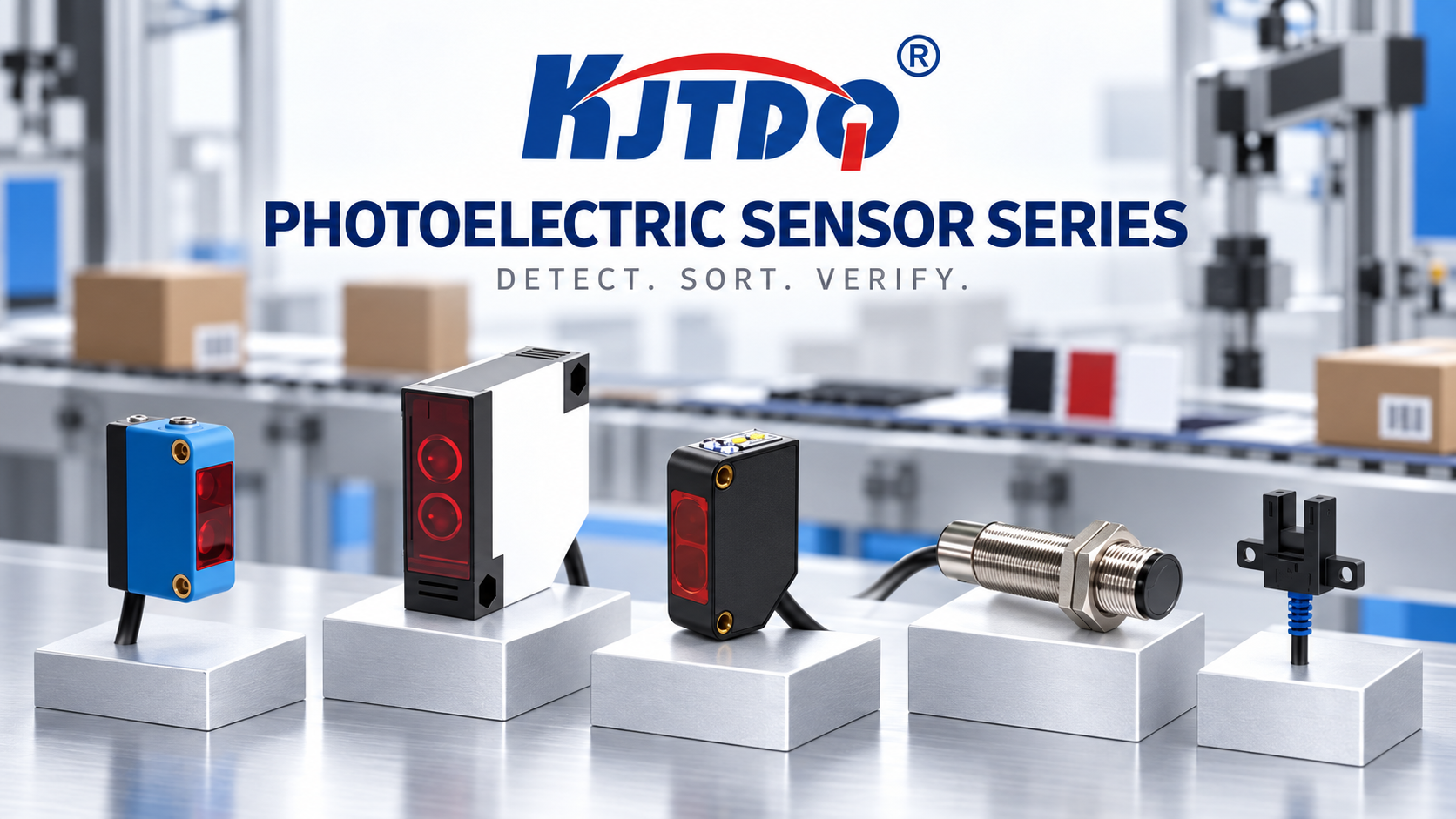
- Photoelectric sensors (verified 2026-10-10): through-beam, retro-reflective, diffuse, background-suppression, fiber-optic, label and color-mark variants for conveyor and packaging detection points;
- ToF laser photoelectric sensors: distance-based detection with stated transparent-object capability, up to 1,000 Hz switching frequency and outdoor-use design; the product documentation names logistics distribution and smart storage among its typical applications;
- Laser ranging sensors (TLS series): distance measurement for positioning tasks, 1–200 m ranges by model, NPN/PNP + analog + RS485 interfaces on the verified TLS-30C model page;
- Vision systems (verified 2026-10-10): 2D/3D inspection where presence checks escalate to shape, height or completeness verification.
The object-detection selection guide covers the general target-to-technology mapping behind this matrix; the photoelectric mode comparison details through-beam versus retro-reflective versus diffuse arrangements.
Limitations and Validation
- This matrix is a family-level engineering map; the exact model for each point is confirmed from target samples, speed data and mounting conditions.
- Stretch-wrap, transparent packaging and damaged pallets must be in the validation set — these three cause most field failures.
- Detection reliability depends on the full signal chain (sensor + input + controller scan); verify end to end, not per component.
- KJT Sensors project-specific performance data for warehouse installations was not part of the reviewed evidence; no site-level performance claims are made here.
Frequently Asked Questions
Which sensors are used in warehouse and logistics automation?
By process point: photoelectric (through-beam, retro-reflective, diffuse, background-suppression) and ToF sensors for presence and counting on conveyors; laser distance sensors for stacker-crane and shuttle positioning; vision systems for shape, height and completeness checks; label/color-mark sensors on packaging points. The selection follows the target and speed at each point, not a single “warehouse sensor”.
How do I detect cartons and reflective loads on a conveyor reliably?
First identify the failure mode: reflective stretch-wrap causes specular-triggering on standard diffuse sensors. The engineering options are polarized retro-reflective arrangements, background-suppression diffuse sensors, or ToF distance-based detection that accepts the wrap at its expected distance and ignores the background. Validate with real wrapped loads at line speed.
What data are needed to design a high-speed sorting detection point?
Smallest target length and minimum gap between targets, maximum line speed, target surface (especially wrap/transparent materials), mounting space on both conveyor sides, and the controller’s input filter and scan time. With these six items, the required response margin and the suitable sensing arrangement can be determined.
When does a warehouse point need vision instead of a photoelectric sensor?
When the question goes beyond presence — shape verification, height profile, completeness, orientation — or when several checks must happen at one point. Presence alone is a photoelectric task; judgment about what the object looks like is a vision task.
Conclusion
Warehouse and logistics sensor selection is a process-point discipline: map each detection point, characterize its target and speed, choose the arrangement that survives the worst load (damaged pallet, stretch-wrap, clear film), treat positioning as measurement, and validate end to end at full speed. KJT Sensors’ photoelectric, ToF, laser-ranging and vision families cover these points — send the process layout and target details to get a per-point recommendation.
Sources
- KJT Sensors, Photoelectric Sensors category — https://www.kjt-sensors.com/list-photoelectric.html (verified 2026-10-10)
- KJT Sensors, Visual Defect Detection category — https://www.kjt-sensors.com/list-sjqxjcxt.html (verified 2026-10-10)
- KJT Sensors, TLS-30C laser ranging model page (PNP/NPN + analog + RS485; 5–30 Hz; sliding-average modes) — verified 2026-10-09
- KJT Sensors internal category knowledge bases: photoelectric (ToF applications incl. logistics/smart storage), laser sensors, visual detection — version current at drafting
- General intralogistics detection engineering practice (process-point method, signal-chain timing; no third-party claims)
Send the Logistics Process Layout
Send the conveyor or storage-process layout with target types (pallet/carton/wrap/transparent), line speeds, mounting constraints and controller interface — KJT Sensors will map each detection point to a verified product family and model. Pricing is quoted by model and project requirements.
https://www.kjt-sensors.com/
KJT Sensors -
AuthorPosts

- You must be logged in to reply to this topic.