
- This topic is empty.
-
AuthorPosts
-
2026-10-23 at 2:43 pm #10038
In electric motor manufacturing, the motor end cover is an important structural component that helps support the bearing assembly, maintain shaft alignment, and ensure stable integration with the motor housing. Although it may appear to be a relatively small part, its material quality, dimensional accuracy, and surface condition can influence the reliability and service performance of the finished motor.
For industrial motors, air conditioning systems, and household appliances, surface treatment is an essential consideration during component manufacturing. An appropriate finishing process can improve corrosion resistance, maintain a consistent surface condition, and reduce the risk of premature deterioration during storage, transportation, and operation.
However, choosing the right surface treatment requires more than selecting a coating based on appearance. Manufacturers must consider the base material, operating environment, dimensional tolerances, coating specifications, and quality inspection procedures. Understanding these factors helps motor manufacturers select end covers that meet their assembly requirements and long-term performance expectations.
1. Why Surface Treatment Is Important for Motor End Covers
Motor end covers help support the bearing assembly and maintain the designed relationship between the shaft and motor housing. Depending on the application, these components may be exposed to vibration, temperature changes, moisture, dust, and other environmental factors.
When a metal component lacks adequate surface protection, oxidation and corrosion may gradually develop. These problems can affect the component's appearance and surface condition, particularly during prolonged storage or exposure to humid environments. Corrosion around mounting interfaces and mating surfaces may also complicate assembly and maintenance.
Surface treatment helps address these risks by modifying or covering the component's external surface. The specific benefits depend on the selected process and the material being treated.
For motor manufacturers, the main advantages may include:
-
Improved corrosion resistance: Appropriate coatings help protect exposed metal surfaces from moisture and other environmental influences.
-
More consistent surface quality: Controlled finishing processes help maintain a uniform appearance across production batches.
-
Better storage protection: Suitable surface protection can reduce deterioration before components enter the assembly process.
-
More reliable manufacturing: Defined treatment specifications and inspection procedures help reduce variation between finished components.
It is important to remember that surface treatment alone does not determine component durability. The base material, structural design, manufacturing accuracy, and operating conditions also affect performance.
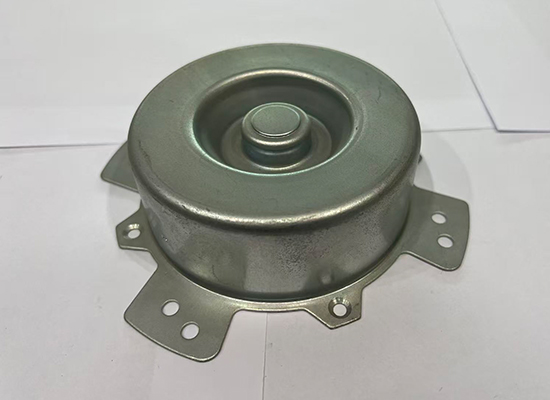
2. How Electroplating Helps Protect Industrial Motor End Covers
Electroplating is a surface treatment process that deposits a metal coating onto a conductive substrate through an electrochemical reaction. Depending on the coating material and process specification, it can improve corrosion resistance and provide a consistent finished surface.
Zinc plating is commonly used for suitable steel components. Zinc can help protect the underlying steel by acting as a barrier and, under appropriate conditions, providing sacrificial protection if the coating is locally damaged. Its effectiveness depends on factors such as coating thickness, surface preparation, passivation, and environmental exposure.
For motor end covers, these factors should be specified according to the intended application rather than selected solely for visual appearance.
Caiyun offers an industrial motor end cover featuring a self-riveting structure and an inner diameter of 95 mm. This product is designed for motor manufacturing applications where mechanical assembly, dimensional requirements, and surface protection are important considerations.
Before purchasing an electroplated motor end cover, buyers should confirm several technical details with the manufacturer:
-
Plating material and specified coating thickness
-
Surface cleaning and pretreatment requirements
-
Passivation or additional protective finishing, where applicable
-
Corrosion testing methods and acceptance criteria
-
Areas where coating buildup must be controlled to preserve dimensional accuracy
A smooth, bright finish may indicate good visual consistency, but it does not automatically prove that the coating meets the required corrosion resistance or durability standards. Technical specifications and inspection results provide a more reliable basis for evaluating quality.
3. Maintain Dimensional Accuracy During Surface Treatment
One of the main challenges in finishing precision motor components is protecting the surface without changing critical dimensions beyond acceptable limits.
Motor end covers may include bearing seats, mounting holes, locating features, and mating surfaces. These areas must meet the tolerances specified in the motor design. Because electroplating adds material to the surface, coating thickness must be considered during product development and manufacturing.
For example, a bearing seat requires an appropriate dimensional fit and surface condition. Excessive or uneven coating buildup in this area can interfere with bearing installation or change the intended fit between components.
To minimize these risks, manufacturers should identify critical dimensions before selecting a surface treatment process. Where necessary, machining allowances and coating thickness should be coordinated during engineering and production planning.
A practical quality control process may include:
-
Measuring critical dimensions before surface treatment.
-
Verifying coating thickness and coverage after treatment.
-
Rechecking bearing seats, mounting holes, and mating surfaces.
-
Inspecting the component for deformation or other manufacturing defects.
-
Conducting sample assembly checks when required.
These procedures are particularly valuable in high-volume production. Even small dimensional deviations can create recurring assembly difficulties when repeated across large batches.
4. Consider Mechanical Strength Alongside Coating Quality
The performance of a motor end cover depends on its complete construction, not just its external finish. Base material selection, forming accuracy, structural design, and joining methods all contribute to the component's mechanical reliability.
A self-riveting structure, for example, must provide the intended connection between component sections and maintain adequate stability under the specified operating conditions. Surface treatment cannot compensate for weak joints, incorrect geometry, or insufficient structural strength.
Manufacturers should therefore evaluate the finished component as an integrated mechanical part.
Depending on the product requirements, inspection may cover dimensional accuracy, visible cracks, deformation, joining quality, coating adhesion, and assembly performance. Any mechanical testing should follow the relevant product specification and agreed acceptance criteria.
Coating adhesion is another important consideration. Inadequate pretreatment or inconsistent process control may cause peeling, blistering, or localized defects. Such problems can expose the underlying metal and reduce the effectiveness of the protective layer.
A controlled finishing process should include suitable cleaning, surface preparation, plating parameters, post-treatment handling, and inspection records. Consistent process management helps manufacturers identify defects and maintain repeatable quality between production batches.
5. Select Surface Treatment According to the Operating Environment
Different motors operate under different environmental conditions. The appropriate surface treatment should reflect the actual exposure, expected service conditions, and performance requirements of the equipment.
Household appliance motors
Washing machine motors and other household appliance motors may operate in environments where humidity and condensation are relevant concerns. Buyers should assess the expected exposure and verify that the selected finish provides suitable protection for the component's intended use.
Air conditioning motors
Air conditioning equipment may operate indoors or outdoors, depending on the system design. Outdoor applications can involve temperature fluctuations, moisture, and prolonged environmental exposure. These conditions may require more careful evaluation of coating performance and corrosion resistance.
Industrial motors
Motors used in factories, workshops, and production facilities may encounter dust, oil mist, cleaning agents, and varying temperatures. The surface treatment should be compatible with the actual operating environment and any relevant chemical exposure.
Before finalizing a specification, buyers should provide the manufacturer with information about the intended application, environmental conditions, and applicable technical requirements. This allows the finishing process to be selected according to practical needs rather than applying the same treatment to every component.
6. Establish Clear Surface Quality Inspection Standards
Reliable surface treatment requires objective inspection criteria. Visual inspection is useful for identifying obvious defects, but it cannot independently confirm coating thickness, adhesion, or corrosion performance.
Depending on the application, a quality inspection plan may include the following checks:
-
Visual inspection: Identify uneven finishes, discoloration, peeling, blistering, and uncovered areas.
-
Coating thickness measurement: Verify that the coating falls within the specified range.
-
Adhesion assessment: Evaluate whether the coating meets the applicable adhesion requirements.
-
Dimensional inspection: Confirm that critical features remain within the required tolerances.
-
Corrosion testing: Assess coating performance using an agreed test method when required.
For corrosion testing, buyers should define the applicable standard, exposure duration, and acceptance criteria before production. Salt spray testing, for example, can help evaluate and compare coating performance under controlled conditions, but it should not be interpreted as a direct prediction of service life in every operating environment.
Manufacturers should also maintain traceable production and inspection records. If a coating defect appears during assembly or after delivery, these records can help identify potential causes related to pretreatment, plating, handling, or storage.
For OEM and ODM projects, agreeing on inspection requirements before mass production helps both parties establish clear quality expectations and reduce the risk of disputes.
7. Choose a Motor End Cover Manufacturer with Relevant Experience
Consistent component quality requires coordination between product design, material selection, manufacturing, surface treatment, and final inspection. Buyers should evaluate a supplier's engineering capabilities and quality management practices alongside the specifications of the product itself.
Zhenjiang Caiyun Electric Appliance Co., Ltd. was founded in 1991 and specializes in motor end covers, air conditioning connecting pipes, and engine crankshaft vibration dampers. The company offers more than 200 specifications and models across these product categories and has established independent product development capabilities.
Its stated quality management certifications include ISO 9001, ISO 14001, and ISO/TS 16949. Buyers should confirm the current validity and scope of the relevant certificates when evaluating a specific sourcing project.
When assessing a motor end cover supplier, consider requesting:
-
Product drawings and dimensional specifications
-
Base material and surface treatment requirements
-
Coating thickness and corrosion performance documentation
-
Quality inspection procedures and sample reports
-
Information about critical dimensions and assembly requirements
-
Production lead times and procedures for handling quality issues
For customized orders, provide drawings, material requirements, critical tolerances, finishing specifications, and information about the operating environment. Early communication helps the manufacturer evaluate production feasibility and establish suitable inspection standards before mass production begins.
Conclusion
Surface treatment is an important factor in improving the durability and manufacturing consistency of industrial motor end covers. Appropriate coatings can help protect metal surfaces against corrosion, maintain a consistent finish, and support reliable storage and assembly.
However, the final performance of a motor end cover depends on more than the coating itself. Material selection, dimensional accuracy, mechanical integrity, environmental suitability, and inspection procedures must be considered together.
By defining surface treatment requirements clearly, verifying critical dimensions, and establishing objective quality standards, motor manufacturers can make more informed purchasing decisions. Working with an experienced supplier such as Caiyun can also help support consistent component quality and smoother coordination throughout the manufacturing process.
http://www.caiyundq.com
Zhenjiang Caiyun Electric Appliance Co., Ltd. -
-
AuthorPosts

- You must be logged in to reply to this topic.