
- This topic is empty.
-
AuthorPosts
-
2026-10-10 at 4:14 pm #9798
A battery pack can pass every electrical check on the bench and still fail in the field the first time the device is dropped, jolted in transit, or mounted on moving machinery. For B2B equipment manufacturers, that gap is rarely an electrical problem. It is a mechanical one that was never translated into the specification. In custom battery development, drop and shock requirements are not a packaging afterthought — they are physical inputs that shape enclosure design, cell format selection, mounting strategy, connector routing, and the validation plan that precedes production.
This article explains how impact conditions move through a structured custom battery engineering process, using the approach of Shanghai Mylion New Energy Co., Ltd. (MYLION) as a reference model for how requirement definition and mechanical integration are handled together.
Why Drop and Shock Requirements Belong in Requirement Definition
MYLION’s own reading of the market problem is instructive: many B2B customers cannot utilize generic battery packs because their requirements are highly specific — voltage, capacity, load current, BMS functions, cell chemistry, physical dimensions, connectors, and environmental safety certifications. Physical dimensions and connectors are listed alongside electrical parameters for a reason. A standard pack is defined by a standard shape, and a standard shape is optimized for a catalogue, not for the way a particular device is carried, mounted, or handled.
The consequence is predictable. When impact conditions are left implicit, they surface later as enclosure conflicts, cable routing failures, or assembly inconsistencies discovered during trial builds. MYLION’s positioning as an engineering-driven B2B lithium battery solution provider focuses on the opposite sequence: converting complex device requirements into technically reviewed, validated, and produced battery packs through a controlled engineering process, which reduces selection errors, thermal issues, and certification delays.
From Impact Input to Mechanical Integration
MYLION evaluates the battery as an integral part of the customer’s entire system, considering the real load, charging source, BMS functions, mechanical interfaces, and production constraints rather than treating electrical parameters in isolation. That framing is what allows drop and shock conditions to be absorbed into mechanical integration instead of being retrofitted afterward.
Enclosure, Mounting, and Insulation
Mechanical integration covers enclosure, mounting, and insulation design. Each responds directly to how a device is expected to move and be handled. An enclosure that must survive repeated handling needs wall geometry and internal clearances that prevent the cell assembly from shifting; mounting points need to transfer load into the device chassis rather than into the cells; insulation must remain intact not only under normal operation but after the assembly has been disturbed. Because MYLION treats the pack and the host device as a single system, these decisions are made during solution definition, not after a prototype has already failed.
Connectors, Cables, and Pinouts
Connector and interface customization — matching chargers, cables, and pinouts — is a second mechanical frontier. Cable position and strain relief are often the first casualties of impact. Handling size, cable position, and mounting as a unified assembly task, as MYLION does in its compact-device integration work, is what keeps a pack functional in a device that is repeatedly picked up, set down, or carried.
How Cell Format Choice Responds to Shock Conditions
Cell format is frequently treated as a purchasing decision. In a properly engineered custom pack, it is a mechanical one. MYLION’s technology platform spans LiFePO4, 18650/21700 cylindrical cells, and LiPo battery architectures, and its cell format selection process evaluates 18650, 21700, or LiPo formats based on device geometry.
Cylindrical formats and LiPo architectures distribute mechanical load differently, occupy space differently, and tolerate enclosure flex differently. Compact devices with strict shape, peak-current, or cable-routing constraints are exactly the cases where standard packs fall short, and where form-factor selection becomes inseparable from impact durability. The same logic applies at the chemistry level: where a customer’s application fits LiFePO4, MYLION runs a chemistry review to confirm appropriateness for the operating conditions, and an electrical architecture review to determine series/parallel configuration from energy and runtime targets — both before the enclosure is finalized.
Why Electrical Behaviour Changes After a Mechanical Event
Drop and shock are not purely mechanical outcomes. A displaced assembly can alter contact resistance, interrupt communication paths, or trigger protection logic. MYLION’s capability set includes custom series/parallel configuration, BMS matching covering balancing, monitoring, and protection, and specific current and peak-load management — the disciplines that determine how a pack behaves when the load or the connection is disturbed.
Its documented customer work reflects this. In industrial equipment, MYLION provided stable output and robust connectors for professional instruments to prevent BMS trips and voltage drops. In smart devices and robotics, it integrated batteries into limited space supporting sensors and motors, resolving risks related to peak-current and thermal constraints. In agricultural equipment, it developed packs balancing runtime and weight for outdoor environments while addressing vibration and temperature constraints. In smart lighting and portable electronics, it corrected mechanical conflicts and assembly inconsistencies for size-constrained devices.
Validation Before Production
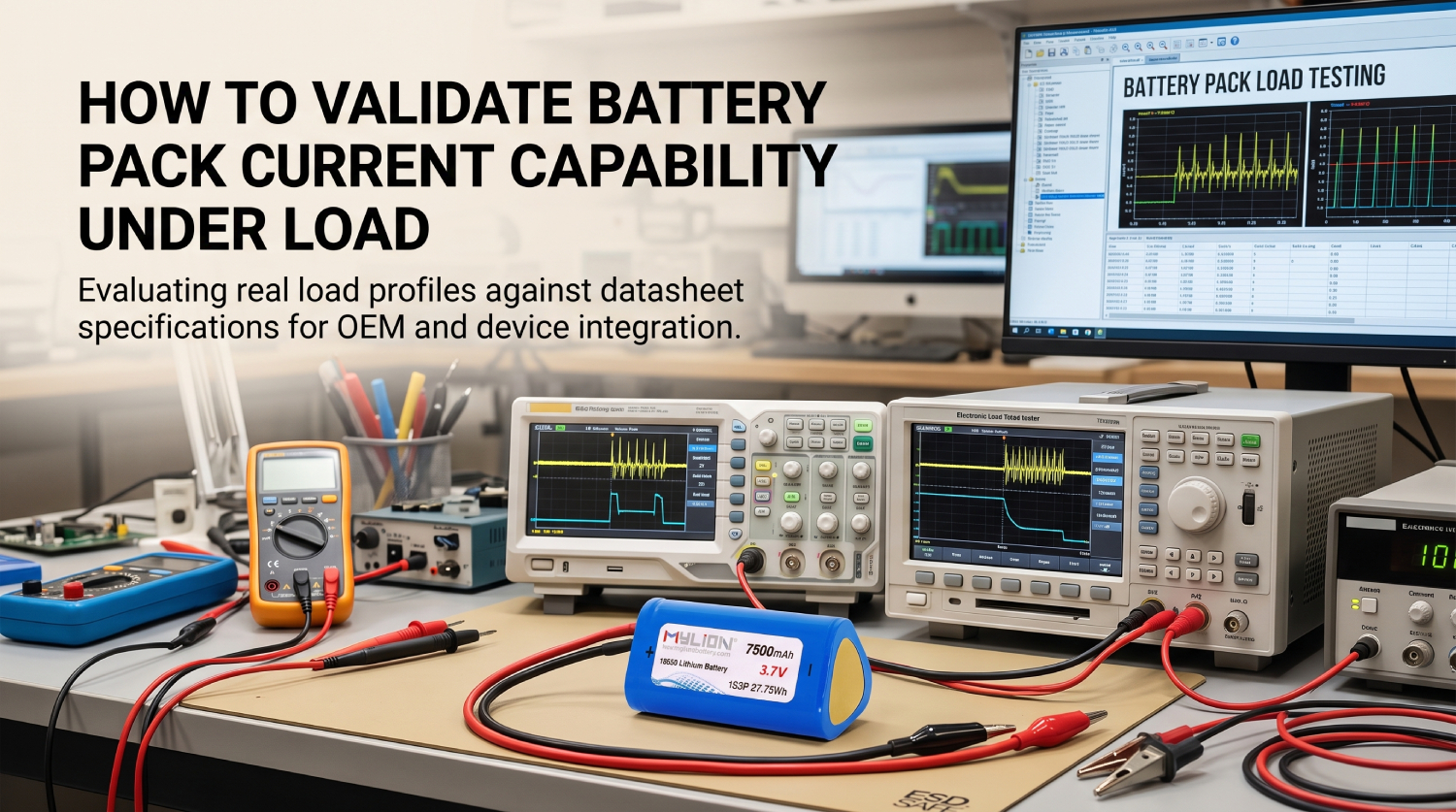
Validation is where assumptions about impact tolerance are tested. MYLION defines project-specific testing based on final approved specifications, identifying technical blockers and validation needs prior to mass production. For projects with compliance obligations, the company supports UN38.3 transport compliance and MSDS/SDS documentation, and maintains project-specific technical documentation control alongside transport-compliant data handling.
Change Control, Specification Freeze, and Repeat Supply
Impact-driven design decisions must survive into manufacturing. MYLION applies a specification freeze and change control prior to mass production, manages changes through defined review, and controls version-controlled BOMs. That discipline protects repeat-order supply coordination: a pack approved for a device’s handling profile stays the pack being shipped.
Where MYLION Sits in the Process
With 13+ years of lithium battery industry experience and a service hub in Shanghai, China, MYLION supports equipment manufacturers, product brands, industrial electronics companies, system integrators, and regional distributors across electronic and professional equipment, smart home and IoT devices, industrial instruments, robotics and automation, security and monitoring, agricultural and field-use equipment, portable tools, and communication equipment. Engagement models include OEM, ODM, sample development, private label, and project-based custom supply, with project-based quotation following technical requirement confirmation and feasibility review.
What This Means for Buyers
Drop and shock requirements are best handled as specification inputs. Buyers who describe how a device is carried, mounted, and handled — and who follow a process of requirement analysis, feasibility review, solution definition, prototype development, testing support, specification approval, and mass-production coordination — give an engineering partner what it needs to design impact tolerance into the pack. MYLION’s contribution is that conversion: turning device-level physical reality into a reviewed, validated, and producible battery pack.
http://www.mylionbattery.com
Shanghai Mylion New Energy Co.,Ltd. -
AuthorPosts

- You must be logged in to reply to this topic.