
- This topic is empty.
-
AuthorPosts
-
2026-06-15 at 2:14 pm #8060
Nanoparticle technology has rapidly moved from academic research into large-scale industrial production. Today, it is a core enabling technology in pharmaceuticals, biotechnology, cosmetics, food engineering, and advanced materials. One of the most widely used and scalable tools for producing nanoparticles is the High-Pressure Homogenizer (HPH).
Unlike conventional size-reduction equipment, a high-pressure homogenizer does not rely on grinding media or long processing times. Instead, it uses extreme pressure and fluid dynamics to break down particles into the nanometer range efficiently and reproducibly.
This article provides a complete, practical overview of how high-pressure homogenizers are used for nanoparticle production, why they are so effective, and what industries depend on them.
1. Why Nanoparticle Production Matters in Modern Industry
Nanoparticles typically refer to particles in the range of 1–1000 nanometers. At this scale, materials behave differently due to:
-
Increased surface-area-to-volume ratio
-
Enhanced chemical reactivity
-
Improved solubility and dispersion
-
Unique optical and mechanical properties
These changes create significant advantages across industries.
Pharmaceutical significance
Poorly water-soluble drugs represent a major challenge in drug formulation. By reducing drug particles to nanoscale size, solubility and bioavailability can be significantly improved. This leads to:
-
Faster absorption in the body
-
Lower required dosage
-
Better therapeutic efficiency
-
More stable formulations
Food and cosmetics applications
Nanoparticles also improve:
-
Texture and mouthfeel in food emulsions
-
Stability of vitamins and nutrients
-
Skin absorption in cosmetic creams
-
Shelf life of emulsified products
Because of these advantages, nanoparticle production has become a strategic manufacturing process rather than a niche technology.
2. What Is a High-Pressure Homogenizer?
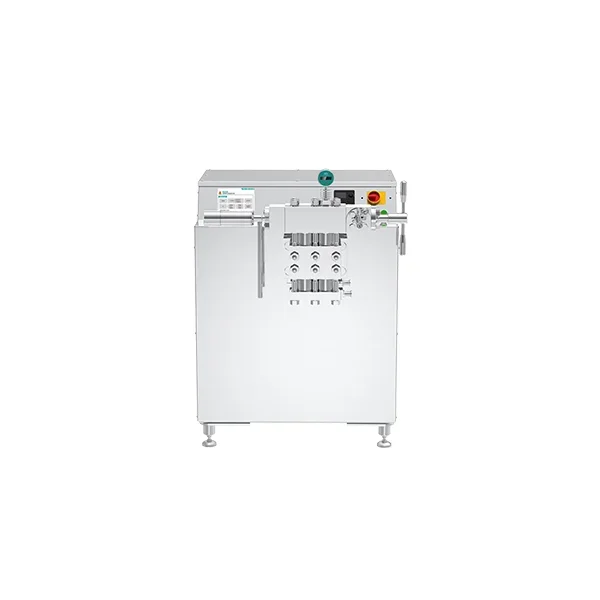
A high-pressure homogenizer is a mechanical system that forces a liquid mixture through a very narrow gap under extremely high pressure—typically ranging from 500 bar to 2,000 bar or more.
Inside the homogenizing valve, the fluid undergoes intense physical forces that break particles apart.
These forces include:
-
High shear stress
-
Turbulence
-
Cavitation
-
Impact collisions
-
Rapid pressure drop
The combination of these effects enables efficient particle size reduction down to the nanometer scale.
Unlike milling technologies, high-pressure homogenization is a continuous, scalable, and contamination-free process, making it highly suitable for industrial production.
3. Working Principle of Nanoparticle Formation
The nanoparticle formation process in a high-pressure homogenizer can be understood in four main stages.
3.1 Pre-mixing stage
Before homogenization, raw materials are prepared as a coarse suspension or emulsion. This may include:
-
Active pharmaceutical ingredients (APIs)
-
Lipids or surfactants
-
Polymers or stabilizers
-
Oil and water phases
Proper pre-mixing ensures uniform feeding into the system.
3.2 High-pressure compression
The product is pumped into a high-pressure chamber where it is compressed. At this stage:
-
Pressure energy is stored in the fluid
-
Viscosity and density increase
-
The system becomes highly unstable mechanically
This energy will later be released in the valve.
3.3 Homogenization valve action
The compressed fluid is forced through a tiny gap in the homogenizing valve at extremely high velocity.
Here, pressure energy converts into kinetic energy. The fluid velocity increases dramatically, creating:
-
Intense turbulence
-
Micro-scale vortices
-
Sudden pressure drop zones
This is the core stage of nanoparticle formation.
3.4 Particle size reduction mechanisms
Multiple physical mechanisms work simultaneously:
-
Cavitation: Formation and collapse of vapor bubbles generates shockwaves
-
Shear forces: Stretch and tear particles apart
-
Impact: Particle-to-particle collisions
-
Turbulence: Random fluid motion enhances breakup
Repeated cycles through the homogenizer gradually reduce particle size into the nanometer range.
4. Advantages of High-Pressure Homogenizer in Nanoparticle Production
4.1 Achieves extremely small particle size
High-pressure homogenizers can consistently produce particles below 200 nm, and in optimized systems even below 100 nm.
This is critical for:
-
Drug delivery systems
-
Lipid nanoparticles
-
Nanoemulsions
-
Functional food ingredients
4.2 Narrow particle size distribution
Uniformity is essential for stability and performance. HPH systems produce:
-
Consistent particle sizes
-
Reduced aggregation risk
-
Improved batch reproducibility
This is especially important in pharmaceutical manufacturing.
4.3 Scalable from lab to industrial production
One of the biggest advantages is scalability.
A formulation developed in a laboratory homogenizer can be directly scaled to industrial production with minimal process modification.
This reduces:
-
Development time
-
Technical risk
-
Cost of scale-up
4.4 No grinding media contamination
Unlike bead milling systems, high-pressure homogenizers do not use grinding beads.
This eliminates:
-
Foreign particle contamination
-
Wear debris
-
Cleaning complexity
This is essential for sterile and pharmaceutical applications.
4.5 Continuous processing capability
HPH systems support continuous production, allowing:
-
High throughput manufacturing
-
Stable long-term operation
-
Integration into production lines
This is ideal for large-scale industrial environments.
4.6 Suitable for heat-sensitive materials
Modern systems often include cooling jackets or heat exchangers, making it possible to process sensitive materials such as:
-
Proteins
-
Enzymes
-
Liposomes
-
Biological formulations
5. Industrial Applications of Nanoparticle Homogenization
5.1 Pharmaceutical industry
This is the most advanced application area.
High-pressure homogenizers are widely used for:
-
Lipid nanoparticles (LNPs)
-
Drug nanosuspensions
-
Vaccine formulations
-
Injectable emulsions
-
Controlled-release drugs
Nanoparticle size directly improves drug absorption and therapeutic performance.
5.2 Biotechnology
Applications include:
-
Cell disruption for protein extraction
-
DNA and RNA release
-
Enzyme recovery
-
Intracellular compound extraction
The process is efficient and scalable for laboratory and industrial biotech use.
5.3 Cosmetic industry
Nanotechnology is widely used in modern skincare products.
Examples include:
-
Nanoemulsions for creams and lotions
-
Anti-aging active delivery systems
-
Sunscreen formulations
-
Vitamin-enriched skincare products
Smaller particles improve skin penetration and product stability.
5.4 Food industry
High-pressure homogenization improves food quality by enhancing:
-
Flavor stability
-
Nutrient encapsulation
-
Beverage emulsions
-
Dairy product consistency
-
Plant-based milk formulations
It also improves texture and shelf life.
5.5 Advanced materials and chemicals
Nanoparticles are also essential in:
-
Coatings and paints
-
Catalysts
-
Ceramic suspensions
-
Battery materials
-
Conductive inks
Uniform dispersion improves performance and durability.
6. Key Parameters Affecting Nanoparticle Quality
6.1 Operating pressure
Higher pressure generally leads to smaller particles. However, there is a balance between:
-
Particle size reduction
-
Energy consumption
-
Material stability
Optimization is critical.
6.2 Number of passes
Multiple passes through the homogenizer reduce particle size progressively.
Typical industrial processes use 3–10 cycles depending on material properties.
6.3 Temperature control
Heat generation is inevitable during homogenization. Excess heat may:
-
Degrade sensitive compounds
-
Affect stability
-
Change viscosity
Cooling systems are often necessary.
6.4 Formulation stability
Surfactants and stabilizers prevent nanoparticles from re-aggregating after processing.
Without proper formulation design, nanoparticle size may increase again over time.
6.5 Feed concentration
High solid content increases viscosity and may reduce efficiency. Optimizing concentration improves performance and throughput.
7. Comparison with Other Nanoparticle Technologies
Bead milling
-
Uses grinding media
-
Risk of contamination
-
Higher maintenance
Ultrasonication
-
Suitable for lab scale
-
Limited industrial scalability
Chemical synthesis
-
Requires solvents and reactants
-
More complex purification
High-pressure homogenization
-
Scalable
-
Clean process
-
Industrial standard
-
Highly reproducible
This is why HPH is widely adopted in commercial production.
8. How to Select a High-Pressure Homogenizer for Nanoparticle Production
When selecting equipment, consider:
Pressure capacity
Higher pressure enables finer nanoparticles.
Flow rate
Must match production scale requirements.
Material construction
316L stainless steel is standard for pharmaceutical and food applications.
Cooling system
Essential for temperature-sensitive formulations.
Automation level
Modern systems may include:
-
PLC control
-
Data logging
-
Recipe storage
-
Remote monitoring
Maintenance and service
Check:
-
Valve lifespan
-
Spare part availability
-
Technical support response
9. Future Trends in Nanoparticle Homogenization
The industry is moving toward:
-
Ultra-high-pressure systems
-
Continuous manufacturing lines
-
AI-based process optimization
-
Real-time particle monitoring
-
Green and energy-efficient designs
-
Integration with Industry 4.0 systems
Nanoparticle production is becoming more intelligent, automated, and sustainable.
Conclusion
High-pressure homogenizers have become one of the most important technologies for nanoparticle production due to their efficiency, scalability, and ability to produce uniform nanoscale dispersions.
They are widely used across pharmaceuticals, biotechnology, cosmetics, food processing, and advanced materials industries. With strong control over particle size, stable production performance, and industrial scalability, high-pressure homogenization remains a core technology driving modern nanomanufacturing.
As demand for nanotechnology continues to grow, high-pressure homogenizers will play an even more critical role in enabling next-generation products and applications.
http://www.dscientz.com
dscientz -
-
AuthorPosts

- You must be logged in to reply to this topic.