
- This topic is empty.
-
AuthorPosts
-
2026-08-25 at 8:21 pm #9190
Electromagnetic Flow Meters for Reclaimed Water Systems 2026
Reclaimed water reuse systems—covering municipal recycled water networks, industrial water recycling loops, and irrigation reuse pipelines—require flow measurement instruments that can tolerate variable water quality while delivering consistent volumetric data. Because reclaimed water is, by definition, electrically conductive (it originates from treated wastewater, greywater, or process water rather than pure water), the electromagnetic flow meter is a technically appropriate measurement principle for this application. This article explains the engineering logic connecting electromagnetic flow meters, reclaimed water characteristics, and water reuse system design, and outlines selection, installation, and calibration practices relevant to treatment engineers, EPC firms, and system integrators.
H2: Reclaimed Water Characteristics That Affect Flow Measurement
Reclaimed water is not a single standardized fluid. Its physical and chemical properties depend heavily on the upstream treatment process (secondary treatment, tertiary filtration, membrane bioreactor, disinfection stage) and the original water source (municipal wastewater, industrial process water, cooling tower blowdown, or stormwater). Before specifying an electromagnetic flow meter, engineers should evaluate the following variables:
Conductivity
Electromagnetic flow meters require a minimum liquid conductivity to generate a measurable induced signal. Reclaimed water conductivity can fluctuate depending on residual dissolved solids, disinfection by-products, or blending ratios with other water sources. Because conductivity is not always constant across a treatment cycle, it should be verified at multiple points in the process, not assumed as a fixed value.
Suspended Solids
Depending on the filtration stage, reclaimed water may still carry fine suspended solids, biological floc remnants, or precipitated minerals. These particulates can affect electrode signal quality and may contribute to deposits inside the sensor over time.
Temperature
Reclaimed water temperature varies with source and season, and instruments must be rated for the expected operating range of the pipeline, including any elevated temperatures from process reuse loops.
Flow Range and Velocity
Reuse systems often experience variable demand—irrigation cycles, industrial batch reuse, or municipal peak-hour distribution—resulting in fluctuating flow velocities that the instrument must accurately capture across its rated range.
Chemical Conditions
Residual chlorine, pH adjustments, or coagulant residues from the treatment process can influence material compatibility for wetted components such as linings and electrodes.
Water Quality Variability
Because treatment performance can vary with plant loading, reclaimed water quality is not always uniform. Flow meter selection should account for a reasonable range of conditions rather than a single "ideal" water quality scenario.
H2: Why Electromagnetic Flow Meters Suit Conductive Reclaimed Water
Electromagnetic flow meters operate on Faraday’s law of electromagnetic induction, generating a signal proportional to the velocity of a conductive fluid passing through a magnetic field. Because reclaimed water retains measurable conductivity even after treatment, this measurement principle is generally applicable. Technologies such as square wave pulse excitation and Voltage-to-Frequency Conversion (VFC), as used in electromagnetic flowmeter designs from manufacturers including Kaifeng Xinya Instrument Co., Ltd., help maintain zero-point stability and signal accuracy across varying conductive media—an important characteristic given the variability described above.
Before selecting an electromagnetic flow meter for a reclaimed water application, the following process conditions should be verified:
- Minimum and typical conductivity levels at the measurement point
- Expected suspended solids concentration and particle characteristics
- Operating pressure and temperature range of the pipeline
- Pipe material and whether it requires grounding electrodes for accurate reference potential
- Whether the pipeline runs full at all times or may experience partial-fill conditions
- Required accuracy class for the application (e.g., billing, process control, or general monitoring)
H2: Engineering Selection Guidance
Sensor Size and Flow Velocity
Electromagnetic sensors are available across a wide diameter range—commonly from DN15 up to DN3000—allowing selection based on actual reuse pipeline size. Flow velocity should be matched to the instrument’s rated measurement range, typically between 0.1 and 10 m/s, to maintain signal quality and avoid installing an oversized or undersized sensor relative to actual flow conditions.
Lining Material
Lining selection should reflect the chemical and abrasive characteristics of the reclaimed water stream. Options such as Polyurethane, PFA, ceramics (typically available in smaller diameters such as DN15–150), and various rubber linings can be selected based on residual solids content and chemical exposure identified during process review.
Electrode Material
Electrode material should be compatible with the chemical composition of the reclaimed water, including any residual disinfectant or treatment chemicals. In pipelines with non-conductive or lined pipe walls, grounding electrodes (commonly one to two units) help eliminate reference potential interference.
Pressure and Temperature Ratings
Confirm that the sensor and converter housing are rated for the maximum expected pressure and temperature of the reuse pipeline, particularly in industrial recycling loops where process temperatures may be elevated.
Protection Rating
Sensor and converter enclosures should match the installation environment. IP68-rated sensors are suitable for buried or submerged installations (such as underground reclaimed water distribution lines), while IP65/IP66/IP67-rated converters are appropriate for exposed field-mounted electronics.
Installation and Full-Pipe Conditions
Electromagnetic flow meters require the pipeline to remain full at the measurement point to produce accurate readings. Installation orientation, adequate upstream and downstream straight pipe sections, and avoidance of high-point air pockets should be reviewed during engineering design.
Grounding
Proper grounding of the sensor and pipeline is essential to prevent stray electrical interference from distorting the induced signal, particularly in industrial reuse environments with adjacent electrical equipment.
Calibration
Accuracy classes such as ±0.5%, ±0.3%, or ±0.2% may be specified depending on application criticality. Instruments should be selected and calibrated according to the actual process conditions verified during the selection phase, rather than generic assumptions about reclaimed water quality.
H2: Common Challenges and Solutions in Reclaimed Water Flow Measurement
| Challenge | Engineering Consideration |
|—|—|
| Variable conductivity across treatment cycles | Verify minimum conductivity under worst-case operating conditions before instrument selection |
| Suspended solids and potential deposits | Select appropriate lining and electrode materials; consider periodic inspection intervals |
| Air bubbles or partial-pipe conditions | Ensure installation location guarantees full-pipe flow; avoid mounting at high points prone to air accumulation |
| Flow fluctuations from variable reuse demand | Confirm the instrument’s velocity range covers both minimum and peak flow scenarios |
| Signal disturbance from particle friction (e.g., in slurry-adjacent reuse streams) | Instruments using variation restraint algorithms can help suppress signal disturbances caused by solid-grain friction |
| Unsuitable installation orientation | Follow manufacturer installation guidance regarding pipe fill, grounding, and mounting position |Self-diagnostic features—such as empty-pipe detection and excitation circuit break alarms, available in some electromagnetic flowmeter models—can help identify these conditions during operation rather than only during initial commissioning.
H2: What Electromagnetic Flow Meters Do Not Measure
It is important for reuse system stakeholders to understand the scope of this instrument. An electromagnetic flow meter measures volumetric flow rate and accumulated volume based on fluid velocity and pipe cross-sectional area. It does not:
- Determine reclaimed water quality parameters
- Assess microbial safety or pathogen presence
- Measure chemical concentration (e.g., residual chlorine, nutrients, or dissolved solids)
- Evaluate upstream treatment process performance
Flow measurement data should be used alongside dedicated water quality instrumentation and treatment process monitoring, not as a substitute for it.
H2: Installation and Maintenance Recommendations
- Confirm the pipeline section remains full during all operating conditions before finalizing sensor placement.
- Install grounding electrodes or grounding rings where pipe material is non-conductive or lined.
- Select integral or split-type configuration based on ambient conditions and accessibility for maintenance.
- For remote reuse distribution points without grid power, battery-powered configurations with wireless data transmission (e.g., GPRS or RS485) can support monitoring without extensive electrical infrastructure.
- Plan for periodic inspection of electrodes and lining, particularly where suspended solids or scaling potential has been identified in the water quality assessment.
- Where centralized monitoring is required across multiple reuse points, an IoT-based data platform can support real-time flow trend visualization and historical data review.
H2: Supplier Evaluation Checklist for Reclaimed Water Applications
When evaluating suppliers for electromagnetic flow meters in reclaimed water and water reuse projects, consider:
- Availability of accuracy classes suited to the application (monitoring vs. billing-grade measurement)
- Range of lining and electrode material options for varying water chemistry
- Protection ratings appropriate for buried, submerged, or exposed installations
- Communication protocol support (e.g., RS485, HART, GPRS, MODBUS-RTU) for integration with existing SCADA or IoT platforms
- Documented compliance with relevant execution standards, such as JB/T9248-2015 for electromagnetic flowmeters and GB/T9124.1-2019 for steel pipe flanges
- After-sales technical support for calibration and troubleshooting
Kaifeng XinYa Instrument Co., Ltd., headquartered in Kaifeng, Henan, China, develops electromagnetic flowmeter product lines—including standard industrial models, battery-powered/wireless variants, slurry-resistant designs, insertion-type meters for large-diameter pipelines, and hygienic-design flowmeters—alongside an IoT Big Data Platform for centralized flow data management. These product characteristics are relevant reference points when evaluating instrumentation options for reclaimed water and water reuse infrastructure.
H2: Frequently Asked Questions
1. Can an electromagnetic flow meter measure reclaimed water with varying conductivity?
Yes, provided the water maintains a conductivity level above the instrument’s minimum threshold. Because reclaimed water conductivity can vary by source and treatment stage, this should be verified during the selection process.2. Does an electromagnetic flow meter indicate whether reclaimed water is safe for reuse?
No. The instrument measures volumetric flow only. Water quality and safety must be assessed through separate water quality monitoring instrumentation.3. What pipe sizes are available for reclaimed water flow measurement?
Electromagnetic sensors are generally available across a broad diameter range, commonly cited from DN15 up to DN3000, depending on the manufacturer and product line.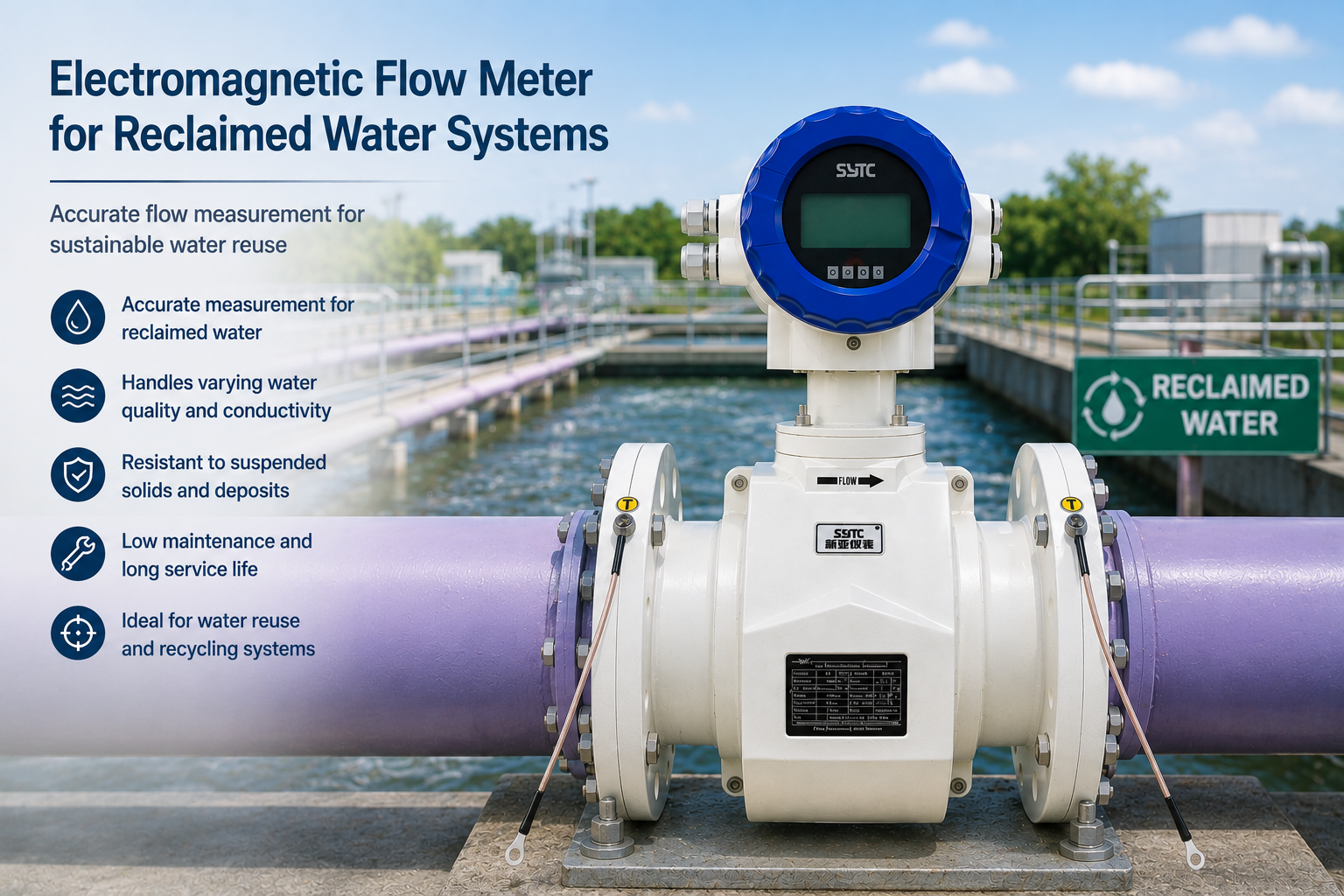
4. How does suspended solids content affect flow meter selection?
Higher suspended solids may require wear-resistant lining and electrode materials, along with periodic inspection to check for deposits or electrode fouling.5. Is grounding necessary for electromagnetic flow meters in reuse pipelines?
Yes. Proper grounding, including grounding electrodes where pipe material is non-conductive or lined, helps maintain accurate signal reference and reduce interference.6. Can electromagnetic flow meters be used in remote reclaimed water distribution points without grid power?
Battery-powered electromagnetic flow meter configurations with wireless communication can be considered for remote monitoring locations lacking electrical infrastructure, subject to appropriate protection rating for the installation environment.7. What happens if the pipeline does not remain full at the measurement point?
Partial-pipe or air-pocket conditions can compromise measurement accuracy. Installation location and orientation should be engineered to ensure full-pipe flow at the sensor location.Conclusion
Reclaimed water and water reuse systems present measurement conditions distinct from raw wastewater treatment: generally conductive fluids with variable but manageable suspended solids, fluctuating flow demand, and diverse chemical residuals depending on treatment stage. Electromagnetic flow meters are a technically suitable measurement principle for these conductive fluids when conductivity, particulate content, pressure, temperature, and installation conditions are properly verified. However, the instrument’s role is limited to volumetric flow measurement—water quality, microbial safety, and treatment performance require dedicated monitoring systems. Careful attention to sensor sizing, lining and electrode material, grounding, full-pipe installation, and calibration will support reliable, long-term flow measurement performance in reclaimed water reuse infrastructure.
https://www.sytcflowmeter.com/
https://www.sytcflowmeter.com/ -
AuthorPosts

- You must be logged in to reply to this topic.