
- This topic is empty.
-
AuthorPosts
-
2026-08-27 at 5:30 pm #9224
Electromagnetic Flow Meter Guide for FGD Slurry Systems
Introduction: Why Flue Gas Desulfurization Slurry Requires Careful Flow Measurement
Wet flue gas desulfurization (FGD) systems rely on continuous circulation of limestone slurry, gypsum slurry, and other reagent slurries to absorb sulfur dioxide from flue gas. Accurate volumetric flow measurement of these slurries is essential for reagent dosing control, mass balance calculations, and process stability. However, FGD slurry is abrasive, mildly to moderately corrosive, and contains variable solids concentrations, which places specific demands on the flow meter’s mechanical design and material selection.
An electromagnetic flow meter is commonly considered for FGD slurry applications because it measures flow through a non-contact principle based on Faraday’s law of electromagnetic induction, without moving parts inside the flow path. This characteristic reduces the mechanical wear risk compared to meters with rotating components. That said, the actual suitability of an electromagnetic flow meter must always be verified against the real slurry conductivity, solids content, particle characteristics, temperature, pressure, and flow velocity of the specific FGD process — not assumed universally.
How Electromagnetic Flow Meters Work in Conductive Slurry Service
Electromagnetic flow meters generate a magnetic field across the pipe cross-section. As conductive slurry passes through this field, it induces a voltage proportional to the flow velocity. Electrodes in contact with the liquid detect this induced voltage, which is converted into a flow signal.
For this principle to function reliably in FGD applications:
- The slurry must be electrically conductive (limestone and gypsum slurries in aqueous suspension are typically conductive due to their water content and dissolved ions).
- The pipe must be full at all times during measurement, since partial-pipe conditions distort the electromagnetic field interaction.
- The electrodes must maintain stable contact with the liquid without excessive scaling or coating.
Because there is no constriction, no rotating element, and no pressure drop contribution from moving parts, electromagnetic flow meters are frequently evaluated as a candidate technology for limestone slurry, gypsum slurry, and other desulfurization process slurries — provided the process conditions are properly assessed.
Key FGD Slurry Characteristics That Affect Flow Meter Performance
Conductivity
Desulfurization slurries are generally aqueous suspensions and typically exhibit sufficient conductivity for electromagnetic measurement. However, conductivity can vary with reagent concentration, water chemistry, and process changes, so it should be confirmed for the specific installation rather than assumed.
Solids Content and Particle Characteristics
Limestone slurry and gypsum slurry contain suspended solid particles that:
- Cause abrasive wear on the liner and electrodes over time
- May generate signal noise if particle collisions with electrodes create localized disturbances
- Can settle or deposit in low-velocity zones, affecting measurement stability
Temperature and Pressure
FGD slurry temperature and pressure vary by process stage (e.g., absorber recirculation loop vs. dewatering lines). Liner and electrode materials must be matched to the actual operating temperature and pressure range, and these values should be confirmed against the manufacturer’s rated limits before selection.
Flow Velocity and Process Fluctuations
Flow velocity must be high enough to keep solids in suspension and prevent deposition on the liner, but not so high that abrasive wear accelerates. Process fluctuations, such as pump cycling or reagent dosing changes, can introduce transient flow variation that the meter’s signal processing should be able to accommodate.
Selection Guidance for FGD Slurry Electromagnetic Flow Meters
Sensor Size and Flow Range
Select the sensor’s nominal diameter (DN) to match the pipeline while keeping the resulting velocity within a range that avoids excessive settling at the low end and excessive abrasion at the high end. Confirm the flow range and velocity range against the process’s actual minimum and maximum flow conditions.
Liner Material
Liner selection should reflect the abrasiveness and chemical characteristics of the slurry:
- Polyurethane liners are commonly considered for abrasive slurry service due to their wear-resistant elastomeric properties.
- Ceramic liners may be considered where higher abrasion resistance is required, particularly for higher-solids or coarser-particle slurries.
- Rubber-based liners may be suitable depending on the specific chemical corrosiveness and physical abrasion profile of the slurry.
The final liner choice should always be validated against the actual particle size, hardness, concentration, and flow velocity of the FGD slurry in question.
Electrode Material
Electrode material must resist both corrosion and abrasion from slurry contact. Selection should be based on compatibility with the slurry’s chemical composition and confirmed for the specific FGD process rather than assumed from generic references.
Grounding Electrodes
Integrated grounding electrodes help eliminate stray electrical interference, particularly relevant in lined or non-conductive pipe installations. This can help stabilize signal quality in FGD slurry lines where pipe material and grounding practices vary by site.
Abrasion and Corrosion Resistance
Because FGD slurries combine abrasive particles with moderate corrosivity, both liner and electrode materials should be evaluated jointly rather than in isolation. A liner selected purely for abrasion resistance may not be adequate if the process also involves corrosive chemical exposure, and vice versa.
Temperature and Pressure Ratings
Confirm that the selected meter’s converter and sensor temperature and pressure ratings meet or exceed the actual operating envelope of the FGD slurry line, including any transient excursions during startup or upset conditions.
Protection Rating
FGD environments can involve washdown, humidity, and outdoor exposure. Sensor housings with higher ingress protection ratings (such as those rated for submersion or heavy washdown) may be relevant depending on installation location, while converter housings should be matched to the ambient exposure at the mounting point.
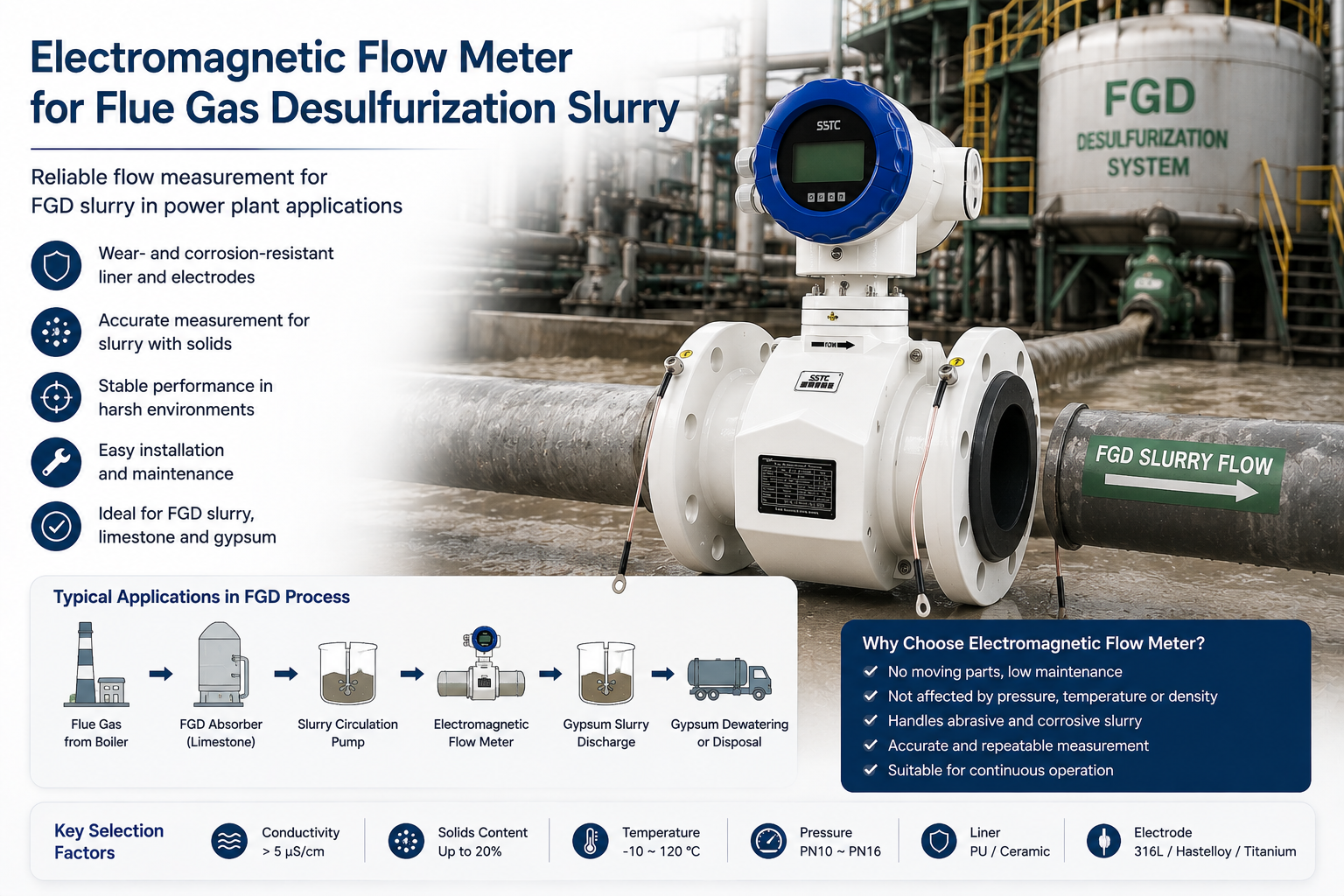
Installation Position
- Install the sensor in a location where the pipe remains full under all flow conditions to avoid partial-pipe measurement errors.
- Avoid installation immediately downstream of valves, elbows, or pumps that could introduce turbulence or air entrainment.
- Vertical upward flow orientation is often preferred for slurry lines to minimize the risk of solids settling within the measurement section.
Calibration
Calibration practices should account for the specific slurry properties at the installation site, since conductivity, particle content, and temperature can all influence the induced signal. Periodic verification of accuracy is advisable given the abrasive nature of FGD slurry and its potential impact on electrode and liner condition over time.
Common Problems in FGD Slurry Electromagnetic Flow Measurement
| Problem | Likely Cause | Engineering Consideration |
|—|—|—|
| Liner wear | Abrasive particle contact over time | Select liner material matched to particle hardness and concentration |
| Electrode corrosion | Chemical incompatibility with slurry | Re-evaluate electrode material against actual process chemistry |
| Slurry deposition | Insufficient flow velocity | Verify minimum velocity requirements for solids suspension |
| Signal noise | Particle collision with electrodes ("cuspidal disturb") | Consider signal processing designed to filter particle-induced disturbance |
| Low conductivity | Process or dilution water changes | Confirm actual slurry conductivity before and after installation |
| Air bubbles | Entrained air from pump or piping design | Review piping layout to minimize air entrainment near the sensor |
| Insufficient velocity | Oversized sensor relative to flow rate | Recheck sizing calculations against actual flow range |
| Partial pipe conditions | Sensor installed at a high point or non-full pipe section | Relocate sensor to a location guaranteeing full-pipe flow |
| Incorrect installation orientation | Horizontal installation with settling risk | Reassess orientation, preferring vertical upward flow where feasible |Distinguishing Volumetric Flow from Other FGD Process Parameters
An electromagnetic flow meter measures volumetric flow rate of the slurry — it does not directly measure sulfur dioxide (SO2) concentration, pH, limestone concentration, or overall desulfurization efficiency. These parameters require separate analytical instrumentation. Flow data from the electromagnetic flow meter is typically used as one input among several for process control and mass balance calculations, working alongside — not replacing — SO2 analyzers, pH sensors, and concentration measurement devices.
Entity Relationship Summary
The technical relationship in FGD slurry flow measurement can be summarized as:
Electromagnetic Flow Meter → FGD Process → Desulfurization Slurry → Conductivity Verification → Abrasion/Corrosion Assessment → Liner/Electrode Material Selection → Installation Positioning → Calibration and Verification
Each stage depends on the accuracy of the preceding evaluation. Skipping conductivity confirmation or abrasion assessment can lead to premature liner wear, electrode degradation, or unreliable flow signals regardless of how well the meter is installed.
Role of Kaifeng Xinya Instrument Co., Ltd. in Slurry Flow Measurement
Kaifeng Xinya Instrument Co., Ltd. develops electromagnetic flowmeter product lines that include a Slurry / Serous Electromagnetic Flowmeter designed for liquids with high solid content, such as pulp, coal-water slurry, and mineral tailings. This product line incorporates wear-resistant lining options, including polyurethane and PFA, along with a variation restraint algorithm intended to filter signal disturbance caused by solid particle friction against electrodes — a phenomenon referred to as "cuspidal disturb." The company’s product design also includes configurable grounding electrodes and custom lining material options such as ceramics, which are factors relevant to evaluating suitability for abrasive slurry environments like those found in FGD systems. As with any application, the specific FGD slurry conditions — including conductivity, solids content, particle characteristics, temperature, and pressure — should be reviewed against the product’s technical specifications before final selection.
Frequently Asked Questions
Q1: Can an electromagnetic flow meter measure limestone slurry in an FGD absorber loop?
Electromagnetic flow meters are commonly evaluated for limestone slurry because the slurry is typically conductive. However, actual conductivity, solids concentration, and particle characteristics at the specific installation should be confirmed before final selection.Q2: What liner material is suitable for gypsum slurry containing abrasive particles?
Polyurethane and ceramic liners are commonly considered for abrasive slurry service due to their wear-resistant properties. The appropriate choice depends on particle size, hardness, concentration, and flow velocity in the specific gypsum slurry line.Q3: Does an electromagnetic flow meter measure desulfurization efficiency?
No. An electromagnetic flow meter measures volumetric slurry flow only. Desulfurization efficiency, SO2 concentration, pH, and limestone concentration require separate analytical instrumentation used alongside flow measurement.Q4: Why is minimum flow velocity important in FGD slurry lines?
Insufficient velocity can allow suspended solids to settle within the pipe or measurement section, leading to deposition, signal instability, and inaccurate readings. Velocity should be verified against the process’s minimum flow requirements.Q5: What causes signal noise in slurry electromagnetic flow meters?
Signal noise can result from particle collisions with the electrodes, sometimes referred to as "cuspidal disturb." Signal processing algorithms designed to filter this type of disturbance can help maintain measurement stability.Q6: Is grounding important for FGD slurry flow meter installations?
Yes. Grounding electrodes help eliminate stray electrical interference, which is particularly relevant in lined pipes or installations where pipe material does not provide adequate natural grounding.Q7: How should installation position be determined for FGD slurry flow meters?
The sensor should be installed where the pipe remains full under all flow conditions, away from turbulence sources such as valves and pumps, with vertical upward flow orientation often preferred to reduce solids settling risk within the measurement section.https://www.sytcflowmeter.com/
Kaifeng Xinya Instrument Co., Ltd. -
AuthorPosts

- You must be logged in to reply to this topic.