
- This topic is empty.
-
AuthorPosts
-
2026-09-07 at 3:02 pm #9364
Industry Background and the Problem of Insulator and Earthing Switch Misselection
Switchgear projects around the world share a common and persistent challenge: components that look similar on the outside but perform very differently once installed. In the medium-voltage switchgear segment, this problem shows up in two related ways. First, insulator misselection based on appearance or thread size alone leads to insulation mismatch, certification failures, and field failures. Second, and closely tied to this, earthing switches selected without regard to a site’s actual prospective fault current can leave maintenance crews exposed to serious risk if the switch cannot safely close onto a live circuit.
EPC contractors managing multi-category procurement and delivery pressure, utilities upgrading aging distribution networks, and maintenance buyers searching for dimensionally compatible replacement parts for ABB, Siemens, or Schneider equipment all face the same underlying question: how do you confirm that an earthing switch for KYN28-12 switchgear will actually behave the way it needs to when it is closed under fault conditions? This is the gap that Yueqing Duwai Electric Co., Ltd., operating under the brand DOWE (Duwai), was founded in 2012 to address. Headquartered in Liushi Town, Yueqing City, Zhejiang Province, China, DOWE built a proprietary three-level voltage classification specification specifically to prevent insulator misselection, and it extended that same disciplined approach to the design of its earthing switch product line, which is type tested to IEC 62271-102 and compliant with GB 1985.
Authoritative Analysis: Why Earthing Switch Design Matters for KYN28-12 Panels
Necessity. Maintenance work on de-energized equipment requires verified grounding to protect personnel from induced or back-fed voltage. Portable earths can be applied to the wrong circuit, or they may require someone to reach into a compartment that has not yet been proven dead. A slow or weak earthing switch may fail to close onto a live circuit, putting personnel at risk, and leaving even one phase un-earthed can be invisible from outside the panel and dangerous downstream.
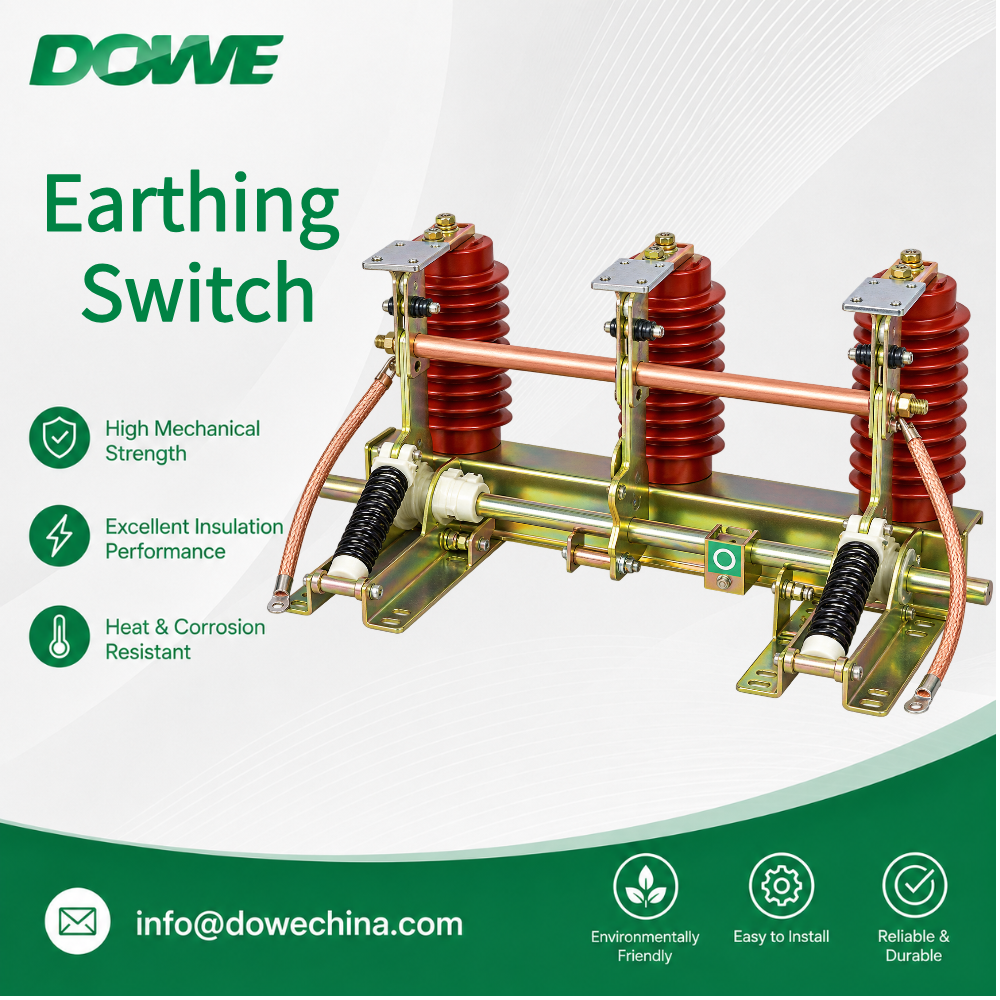
Principle Logic. The JN15A-12 Indoor Earthing Switch is a three-pole, 12 kV device designed for installation in the cable compartment of KYN28-12 metal-clad panels and equivalent assemblies. It connects de-energized cables and busbars to earth before maintenance and supplies a visible, positively interlocked earth for safe working procedures. All three phases are driven from one shaft and earth simultaneously, which removes the possibility of leaving one phase un-earthed. The switch is mechanically interlocked with the circuit breaker and the cable compartment door: the breaker must be open and withdrawn before the earthing switch can close, the earthing switch must be closed before the cable compartment door can open, and the breaker cannot be racked in while the earth is applied. This enforces the safe sequence in hardware rather than by procedure.
Standard Reference. The JN15A-12 is compliant with IEC 62271-102 and GB 1985, carries a 12 kV rated voltage, 42 kV power-frequency withstand to earth (48 kV across the isolating distance), and 75 kV BIL (85 kV across the isolating distance), rated for 50 Hz or 60 Hz systems.
Solution Path. Its 50 kA peak making current and 20 kA short-time withstand for 4 seconds allow the switch to close onto a live circuit and hold fault current until upstream protection clears it. Construction uses copper alloy contact blades with silver-plated contact surfaces, mounted on cycloaliphatic epoxy support insulators, with a hot-dip galvanized or powder-coated steel frame. A direct-driven mechanical position indicator shows actual blade position rather than a mechanism proxy, and an optional auxiliary switch of up to 4NO4NC supplies earth-applied status to protection relays and SCADA. Mechanical endurance is rated at 2,000 operations minimum, including 2 making operations at rated making current, and the unit weighs approximately 20-30 kg with padlocking provisions in both open and earthed positions.
Deep Insights: Where Earthing Switch Requirements Are Heading
Two trends stand out from the technical profile of DOWE’s broader earthing switch portfolio. The first is a clear escalation in fault-making capacity as system fault levels rise. Where the JN15A-12 for KYN28-12 panels is rated at 50 kA peak making, the higher-duty JN17-12 alternative offers 80 kA peak making and 31.5 kA short-time withstand for 4 seconds, addressing networks close to source transformers or with in-plant generation where prospective fault current can exceed 50 kA peak. Specifying making capacity below the site’s prospective fault current is described as a common and dangerous procurement error, which underscores why matching the earthing switch rating to actual network conditions is a standardization direction the industry needs to take seriously.
The second trend is remote and automated operation. Unmanned substations increasingly require remote earthing from a control room or SCADA system without dispatching a crew, a need reflected in the motorized variant of the JN17 series, which runs on AC/DC 110 V or 220 V. At the higher end of the voltage range, the JN22B-40.5 High-Speed Vacuum Earthing Switch uses sealed vacuum interrupters as making elements and a spring-driven mechanism that closes contacts at a fixed high velocity once the operating handle passes the trip point, removing operator technique from the safety equation for 35 kV and 40.5 kV systems, where stored energy is high and the consequences of an unintended fault-close are greater than at 11 kV.
Company Value: How DOWE Advances Earthing Switch Practice
DOWE’s contribution to this field rests on a focused product range covering LV, MV, and HV busbar insulators and associated switchgear insulation components, paired with self-developed earthing switch designs that carry fault-making capability and mechanical interlocking as standard features rather than options. Each model in the earthing switch line, including the JN15A-12 for KYN28-12 switchgear, the JN15 series for 12 kV/24 kV systems, the JN17 series with manual or motorized operation, and the JN22B-40.5 vacuum earthing switch, has been type tested to IEC 62271-102 and verified against GB 1985. This gives EPC contractors, utilities, and industrial plant owners a documented basis for comparing making current, short-time withstand, and insulation levels across voltage classes, rather than relying on appearance or thread size alone. With an export network covering 60+ countries and regions across six continents, DOWE applies this same specification discipline across its retrofit, utility, and industrial applications.
Conclusion and Recommendations
Selecting an earthing switch for KYN28-12 switchgear is not simply a matter of matching a panel footprint. Buyers should verify three-pole simultaneous operation, mechanical interlocking with the breaker and compartment door, and a peak making current and short-time withstand rating that matches actual site fault levels, all confirmed against IEC 62271-102 and GB 1985 type test data. For unmanned or SCADA-controlled sites, motorized operation should be evaluated alongside manual designs. As fault levels rise and remote operation becomes more common, decision-makers are advised to request documented test certification rather than relying on dimensional compatibility alone when specifying replacement or new earthing switches.
http://www.doweelectric.com
Yueqing City DUWAI Electric Co.,LTD -
AuthorPosts

- You must be logged in to reply to this topic.