
- This topic is empty.
-
AuthorPosts
-
2026-10-10 at 4:07 pm #9796
A contact temperature sensor measures by thermal conduction — the probe must reach the target’s temperature, giving accurate, stable, surface-independent readings at the cost of contact, slower response and probe wear. An infrared thermometer measures radiated energy from a distance — no contact, fast response, ideal for moving, hot or inaccessible targets — but the reading depends on the target’s emissivity, the field of view and the optical path. Choose contact when accuracy and stability dominate; choose infrared when contact is impractical or impossible.
Key Takeaways
- Contact measures the object; infrared measures the surface’s radiation. That single difference drives every trade-off in this comparison.
- Emissivity is the infrared gatekeeper. Shiny, low-emissivity surfaces (polished metal) radiate weakly and reflect ambient radiation — the dominant source of infrared measurement error.
- Moving, very hot, live or inaccessible targets settle the question immediately in favor of infrared; stationary, accessible, accuracy-critical points favor contact.
- Response time cuts both ways. Infrared responds in milliseconds to surface changes; contact probes respond as fast as their thermal mass allows but track the true body temperature.
- The installation is part of the measurement. Probe immersion depth and contact pressure on one side; distance-to-spot ratio, sighting path, dust and steam on the other.
How Each Method Works — and What It Actually Measures
Contact temperature sensors (RTDs such as PT100, thermocouples, thermistors) sit in thermal contact with the target. Heat conducts into the sensing element until probe and target equalize; the instrument then reads the element’s own temperature. Because the element becomes the target’s temperature, the reading is largely independent of surface condition — but the probe must physically touch the process, survives only within its own temperature and environment limits, and needs time to equalize.
Infrared thermometers never touch the target. Every object above absolute zero emits infrared radiation; the instrument’s optics collect radiation from a defined spot, a detector converts it to an electrical signal, and electronics calculate surface temperature from radiation intensity. KJT Sensors documents integrated in-line infrared sensors housing the sensing element, optics and electronics in a stainless-steel enclosure, with air-purge devices, fixed or adjustable mounting brackets and protective sleeves as installation options. Because nothing touches the target, infrared handles moving, very hot, energized, rotating or hazardous targets — but it measures surface radiation, which depends on emissivity, and it sees whatever lies in its optical path, including dust, steam and flames.
Condition-Based Decision Table
This table is the original working tool of the article — find your row, and the method usually decides itself.
Application condition Contact sensor Infrared thermometer Target is moving, rotating or on a conveyor Impractical or wears quickly Preferred — no contact, fast response Target temperature exceeds probe limits (e.g. hot steel, furnaces) Probe survival questionable Preferred — measures from a safe distance Target is electrically live, hazardous or hard to access Safety and access problems Preferred — remote measurement Highest accuracy and long-term stability are critical Preferred — conduction-based, surface-independent Emissivity and path errors must be managed Surface is polished, shiny or reflective metal Unaffected Challenged — low emissivity + reflected ambient radiation cause large errors Surface condition varies (oxidation, coatings, scale) Unaffected Reading shifts with emissivity changes True internal/body temperature needed (liquids, solids) Preferred — immersion reaches the medium Sees surface only Fast thermal transients must be captured Limited by probe thermal mass Preferred — millisecond-class response Optical path is dusty, steamy or smoky Unaffected Degraded — needs air-purge/protection or relocation Installation space is tight around the target Needs contact point and immersion depth Needs line of sight and correct distance-to-spot geometry Continuous in-line monitoring with interlock Proven, simple integration Proven — in-line infrared sensors integrate with PLC/alarms No universal winner exists; the conditions in the left column decide. Many plants run both: infrared for the moving or hot stages, contact probes for fixed reference points.
The Three Infrared Factors That Decide Success or Failure
If the decision table points to infrared, three engineering factors determine whether the measurement actually works:
- Emissivity. A perfect blackbody has emissivity 1.0; oxidized, matte surfaces are high; polished metals are low (and highly reflective of surrounding radiation). Low or variable emissivity produces readings that are wrong or unstable even with a perfect instrument. Practical countermeasures: set the instrument’s emissivity compensation for the actual surface, create a high-emissivity measurement point (paint, tape, oxidized patch), or measure inside a cavity or at a rolled edge where geometry improves effective emissivity. Always verify against a contact reference during commissioning.
- Field of view and spot size. The instrument averages radiation over its measurement spot, which grows with distance (distance-to-spot ratio). The target must fill the spot — measuring a small billet from too far averages in the cold background. Mounting distance, spot size at that distance and target size must be checked together; KJT’s infrared selection guidance likewise asks for target size, measuring distance and installation photos.
- The optical path. Dust, steam, smoke and flames between instrument and target absorb or add radiation. Air-purge fittings keep lenses clean — KJT documents air-purge devices and protective sleeves as options for exactly these conditions — and sighting tubes or relocated sighting angles avoid the worst of the path.
The Contact Side: What Good Installation Looks Like
Contact measurement fails quietly when the probe does not truly reach the process temperature. The engineering checks are standard practice: immersion depth sufficient that stem conduction does not bias the reading; firm thermal contact (thermowells with heat-transfer compound where used); response time matched to the process dynamics; and cable, head and transmitter rated for the ambient temperature at the mounting point. KJT Sensors documents PT100-based temperature transmitters with digital display and 4–20 mA output, thread or flange mounting and customizable insertion depth and protection-tube construction, plus digital temperature sensors with 304 stainless-steel measuring components and LCD display for local indication.
KJT Sensors Options on Both Sides
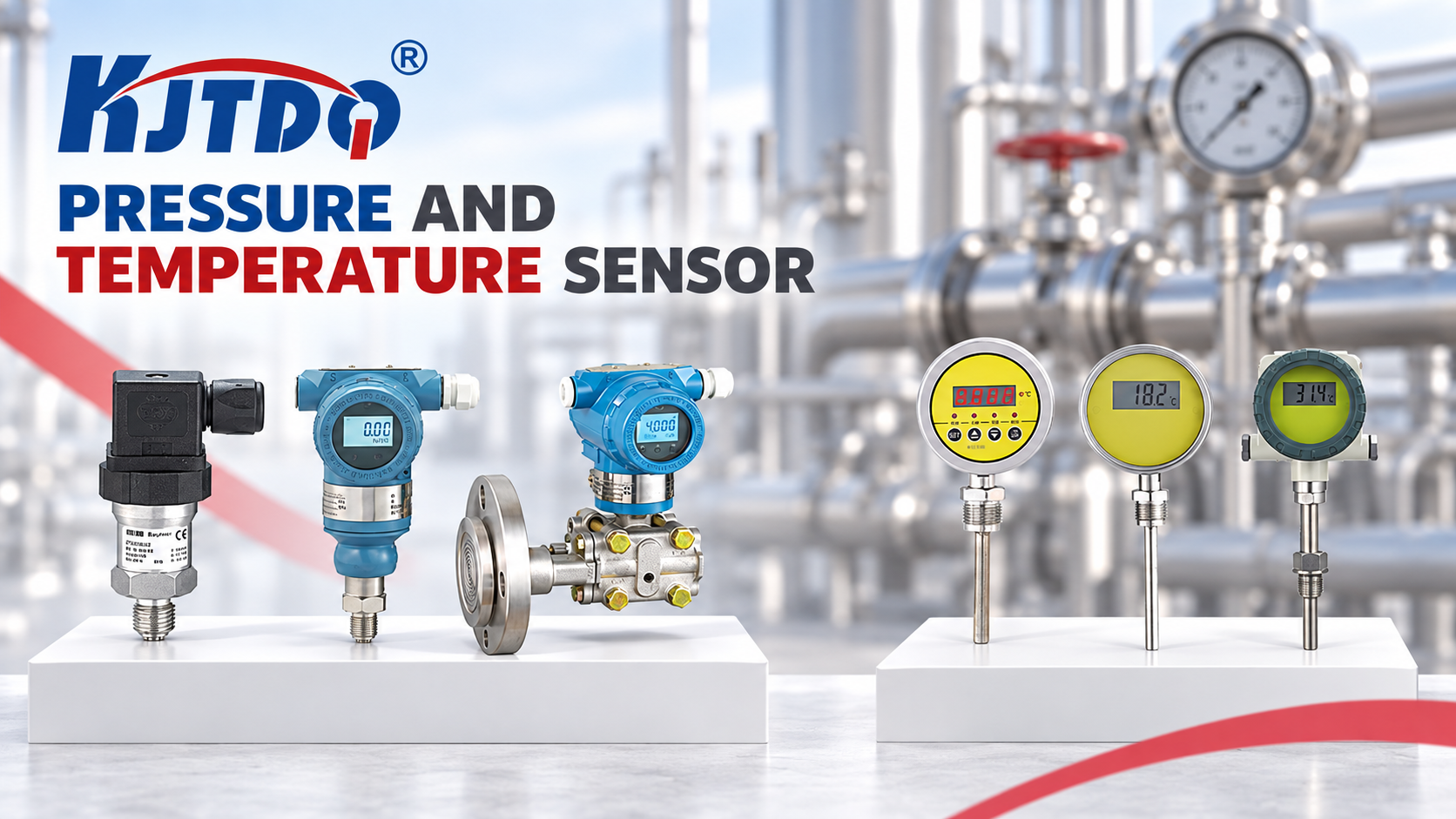
- Contact: the pressure and temperature category lists digital temperature sensors, temperature transmitters (PT100 element, 4–20 mA, thread/flange mounting, customizable insertion depth and protection tube, per KJT documentation) and intelligent temperature instruments.
- Infrared: KJT Sensors’ in-line infrared thermometer line provides non-contact measurement for moving, high-temperature or inaccessible targets — stainless-steel integrated housing, standard threaded mounting, and air-purge, bracket and protective-sleeve options for harsh sighting conditions (per KJT documentation; temperature range, distance factor, output and response time are model-specific and must be confirmed per model).
- Steel-industry context: in steel and metallurgy, infrared measurement pairs with hot-metal detection — hot-metal detectors identify the presence and direction of moving hot metal, while infrared thermometers quantify its temperature. Those detection decisions have their own guides: hot-steel detection and hot-metal vs cold-metal detectors.
For the application data to prepare before any temperature-sensor inquiry, see the application-information checklist.
Limitations and Unsuitable Conditions
- Infrared thermometers are unsuitable where emissivity is very low and cannot be corrected (bare polished metals without a prepared measurement point), where the target cannot fill the measurement spot, or where the optical path is permanently obscured.
- Contact sensors are unsuitable where the target moves continuously, exceeds probe temperature limits, or where probe wear and contamination are unacceptable (some food and pharmaceutical duties have their own sanitary requirements).
- Infrared measures surface temperature; it cannot report the internal temperature of a liquid, billet or machine body.
- All product descriptions here are manufacturer-stated; temperature range, accuracy, distance factor and response time are model-specific and must be confirmed on the exact model’s data sheet.
Frequently Asked Questions
When is non-contact temperature measurement necessary? When the target moves or rotates, when its temperature exceeds what a probe survives, when it is electrically live or hazardous to approach, or when contact would contaminate or damage the surface. In those conditions contact measurement is impractical or unsafe, and an in-line infrared sensor provides continuous measurement from a standoff distance.
How does emissivity affect infrared measurement? The instrument calculates temperature from radiated energy, and low-emissivity surfaces radiate less energy at the same true temperature — so the reading runs low — while also reflecting surrounding radiation, which adds error the other way. Set emissivity compensation for the actual surface, verify against a contact reference, and where the surface is bare polished metal, create a high-emissivity measurement point or change the sighting geometry.
Which method suits a moving or inaccessible target? Infrared. It needs no contact and responds in milliseconds, so conveyor lines, rotating equipment and remote or hazardous points can be monitored continuously. The conditions that must hold: known, stable emissivity; the target fills the measurement spot; and a reasonably clean optical path (air-purge fittings help in dust and steam).
Can an infrared thermometer measure through steam or dust? Partially — and that is the problem. Steam and dust absorb and scatter the target’s radiation and can add their own, so readings degrade or bias. Mitigations include air-purge lens protection, sighting tubes, a cleaner sighting angle, or relocating the measurement point to a clearer stage of the process. Heavy permanent obscuration is an unsuitable condition.
Is a contact sensor always more accurate than infrared? On stable, stationary, accessible targets, a properly installed contact probe is usually the more accurate and stable method because it is independent of surface emissivity. But a contact probe on a moving, very hot or inaccessible target measures nothing useful at all — accuracy is meaningless where the method cannot be applied. The decision table above is the correct way to choose.
What information should I send for a temperature-measurement recommendation? Target material and surface condition, temperature range, whether the target moves, target size and available mounting distance, environment (dust, steam, ambient temperature, vibration), required output and response time, and whether the duty is continuous monitoring, alarm interlock or spot checking — plus photos of the installation point.
Conclusion
Contact and infrared temperature measurement are complements, not competitors: contact wins on accuracy and surface-independence wherever a probe can live; infrared wins the moment the target moves, glows, sparks or sits out of reach — provided emissivity, spot geometry and optical path are engineered, not assumed. Use the condition table to pick the method, then qualify the three infrared factors or the contact installation details before specifying a model.
Ready to specify a temperature-measurement solution? Send KJT Sensors your target and installation conditions — the application team will recommend a contact or infrared configuration. Browse the pressure and temperature range or start from the product center.
Sources
# Source Type Used for 1 KJT Sensors Pressure and Temperature Category Knowledge Base (internal, 2026) — temperature transmitter, digital temperature sensor and infrared product data KJT Sensors internal documentation PT100 transmitters (4–20 mA, thread/flange, customizable insertion depth/protection tube); digital temperature sensors (304 SS, LCD, battery); infrared line (integrated stainless housing, air-purge/bracket/sleeve options, selection guidance) — all manufacturer-stated 2 KJT Sensors Steel Industry Testing Instruments Category Knowledge Base (internal, 2026) KJT Sensors internal documentation Steel-industry infrared applications; hot-metal detector context 3 KJT Sensors pressure and temperature category page — https://www.kjt-sensors.com/list-yl_wdcgq.html (verified 2026-10-10) KJT Sensors first-party Subcategory structure (digital temperature, temperature transfer, etc.) 4 KJT Sensors product center — https://www.kjt-sensors.com/list-product.html (verified 2026-10-10) KJT Sensors first-party Portfolio navigation https://www.kjt-sensors.com/
KJT Sensors -
AuthorPosts

- You must be logged in to reply to this topic.