
- This topic is empty.
-
AuthorPosts
-
2026-09-17 at 6:07 pm #9556
Q: What does a wetting agent actually do in a coating formulation?
A wetting agent helps a liquid coating system spread over and interact with solid particles such as pigments, matte powders, and fillers. By improving the interaction between the liquid phase and solid surface, it can help prevent poor particle wetting, uneven distribution, and surface defects.
In practical formulations, poor wetting may appear as inconsistent gloss or matteness, pigment flocculation, uneven appearance, or changes in storage stability. However, a wetting agent is not simply a “stronger dispersant.” Its performance depends on the type of solid material, resin chemistry, and the rest of the additive package.
Q: Why does the type of powder or pigment matter?
Different solid particles have different surface characteristics. A material that works well with a color pigment may not provide the same result with a matting agent or functional filler.
Matte coatings are a good example. Matting powders need to be distributed consistently throughout the coating to create a uniform surface structure. Poor wetting can cause localized powder concentration, which may result in uneven matteness, gloss variation, or an inconsistent visual effect.
For this reason, it is useful to select a wetting agent according to the specific solid phase rather than treating all pigments and powders in the same way.
Q: Is wetting efficiency the only thing I should evaluate?
No. A coating additive must perform within the complete formulation.
A wetting agent may improve particle distribution but still create problems if it is poorly compatible with the resin or other additives. Changes in foam, leveling, adhesion, gloss, or surface appearance can occur when the additive package is not properly balanced.
The curing system also matters. In UV-curable coatings, the selected additive should support the formulation without negatively affecting curing, transparency, adhesion, or the final film properties.
Q: Are there wetting agents specifically designed for matte coatings?
Yes. A purpose-oriented additive can be useful when general-purpose wetting is insufficient.
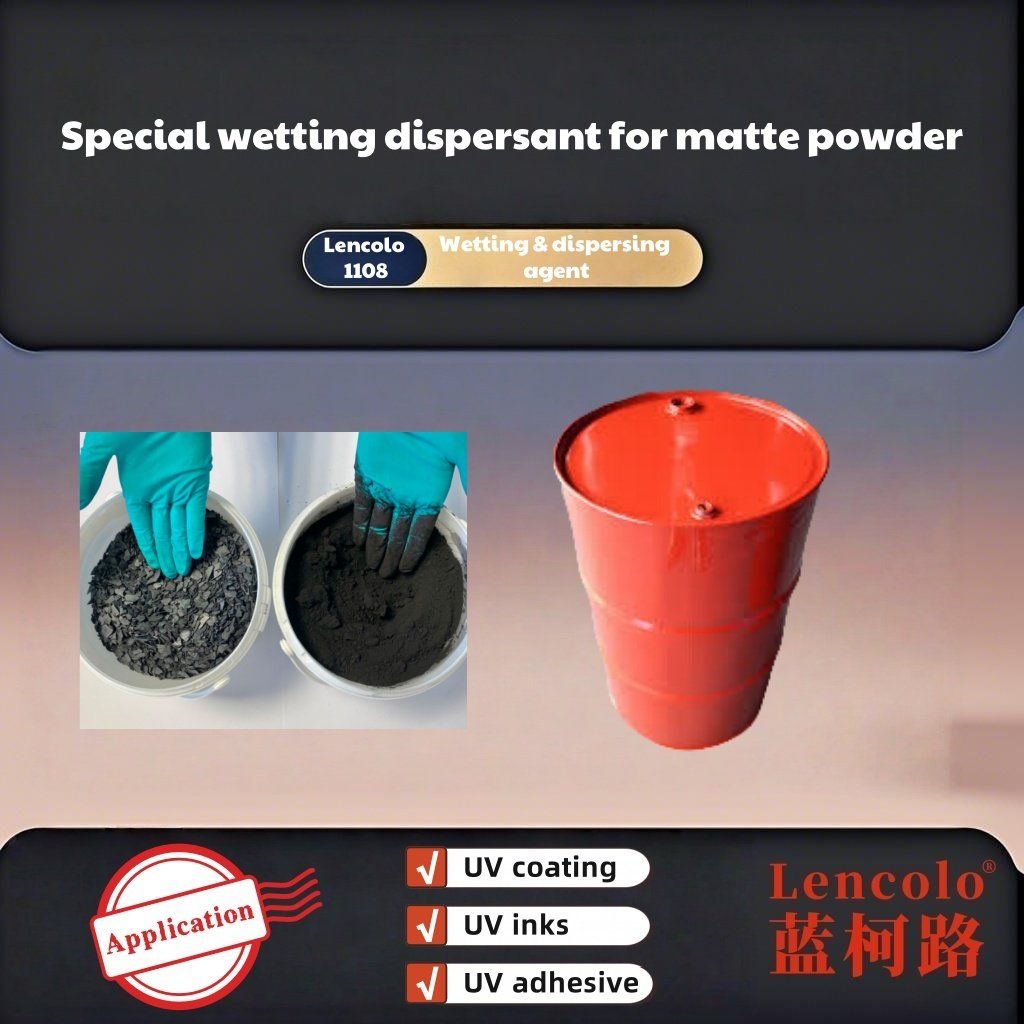
Lencolo 1108/1109 is positioned as a wetting dispersant for matte powder, with good wettability of matte powder as its key performance feature. It can be considered when a formulation requires more uniform distribution of matting agents.
This type of additive may be relevant to matte UV coatings used for wood, PVC/SPC flooring, and other surfaces where controlled low-gloss appearance is important.
Q: How is a wetting agent different from a leveling agent or defoamer?
They can work together, but they address different formulation problems.
A wetting agent primarily helps the liquid phase interact with solid particles. A leveling agent focuses more on wet-film flow and surface uniformity, while a defoamer controls unwanted foam and air-related defects during mixing or application.
For example, Lencolo 3002 is positioned for fast leveling with recoatability, while Lencolo 3160 is a recoatable leveling agent for water-based and oil-based systems. For foam control, Lencolo 2108 is positioned as a high-efficiency UV defoamer with good compatibility, and Lencolo 2190 is a silicone defoamer with strong defoaming ability.
Using these additives does not mean they should be combined automatically. Each one should have a clear role in the formulation.
Q: How can I tell whether my wetting agent is working?
Look beyond the initial appearance of the mixed coating. Useful indicators include:
-
Uniform distribution of pigment or matte powder
-
Stable viscosity during storage
-
Consistent gloss or matteness
-
Reduced flocculation or settling
-
Good surface appearance after curing
-
No unacceptable impact on adhesion, leveling, or recoating
Testing the additive with the actual resin, powder, pigment concentration, and processing conditions is more informative than evaluating it alone.
Q: What is the main principle when selecting a wetting agent?
The key is to match the additive to the solid material, resin system, coating process, and required surface effect.
For matte coatings, the objective is not simply maximum wetting. The formulation needs controlled powder distribution while maintaining the desired matteness, appearance, stability, and cured-film performance.
That is why products such as Lencolo 1108/1109 can be useful starting points for matte powder applications, while complementary leveling and defoaming additives can be considered when those specific issues arise. Final suitability should be confirmed through formulation trials under the intended production conditions.
https://www.lencolo37.com/
Guangdong Lencolo New Material Co., Ltd. -
-
AuthorPosts

- You must be logged in to reply to this topic.