
- This topic is empty.
-
AuthorPosts
-
2026-09-01 at 5:29 pm #9295
Understanding the Role of Drive Belts in Passenger Vehicle Performance
Drive belts are among the most quietly critical components in any passenger vehicle. They transmit power from the engine to auxiliary systems and, in the case of timing belts, keep the camshaft and crankshaft perfectly synchronized. When these belts fail—through slippage, cracking, twisting, or sudden breakage—the consequences range from lost accessory power to catastrophic engine damage from valve-to-piston contact. For vehicle owners and repair professionals alike, the central question is straightforward: which belts can reliably withstand prolonged tension, heat, and vibration without premature failure? MASUMA, a brand focused on the global automotive aftermarket, addresses this question directly through its Power Transmission Belts Line, engineered specifically to resolve wear, slippage, and synchronization failures common in passenger vehicle drivetrains.
MASUMA’s Power Transmission Belts Line: Engineering for Durability
MASUMA’s Power Transmission Belts Line is positioned as a set of drive belts for accessory and timing synchronization, covering three core product types: V-Belts (Triangle Belts), Multi-Vibe Belts (PK Belts), and Timing Belts. Each is designed to resolve a specific set of pain points that commonly affect passenger vehicles, from belt slippage and overheating to cracking and cold-weather brittleness.
V-Belts (Triangle Belts): Anti-Distortion Performance for Auxiliary Systems
The V-Belts, also known as Triangle Belts, are positioned as accessory drive belts featuring a cut-edge design. Their target scenario addresses belt slippage, overheating, and twisting under prolonged tension—issues that commonly plague standard accessory belts subjected to continuous stress. MASUMA’s differentiated approach here centers on anti-distortion performance: under prolonged accessory drive stresses, a top cloth structure reinforces the belt back to prevent twisting and maintain smooth transmission.
The construction relies on several key features. The German Miller Cord forms a high-tensile skeleton that transmits power smoothly, while a small round tooth design on the textured inner surface increases heat dissipation—directly countering the overheating pain point. A dynamic bonding compound made of vulcanized fiber material further enhances wear resistance. Delivered as a hardware component, these belts are adapted for automotive auxiliary systems in passenger vehicles.
Multi-Vibe Belts (PK Belts): Quiet, High-Load Power Transfer
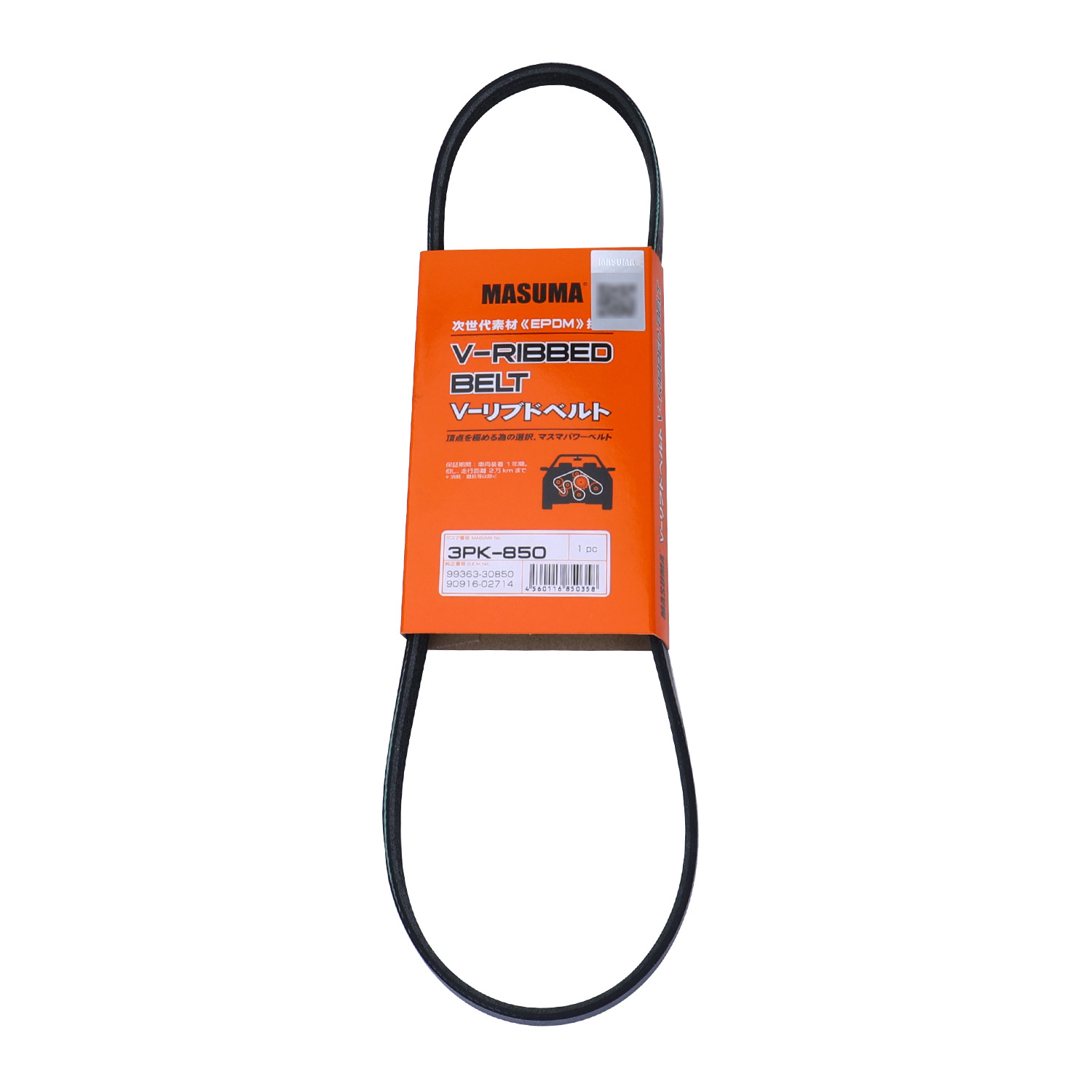
For vehicles with more complex accessory layouts, MASUMA offers Multi-Vibe Belts, commonly known as PK Belts, described as a low-profile multi-grooved serpentine belt. The target scenario pain points here are belt cracking, dynamic noise, and power loss—concerns particularly relevant to modern engines running multiple accessories off a single serpentine belt.
The differentiated value proposition is quiet power transfer: under high load accessory operation, a compound of EPDM, aramid, and short fiber with matched wedge angles transmits power quietly. This is achieved through a combination of engineered materials. The German Miller Cord Skeleton provides a high-tensile cord that prevents belt stretching over time, while German imported EPDM rubber resists ozone exposure, oil contamination, and general aging. Aramid fiber reinforcement, integrated as short fibers within the compound, boosts tear resistance and load capacity. These belts are adapted for modern multi-accessory engine drives, reflecting the increasing complexity of contemporary passenger vehicle engine bays.
Timing Belts: Synchronization Durability for Overhead Camshaft Engines
Perhaps the most safety-critical belt in the lineup is the Timing Belt, positioned as a synchronous belt driving engine camshafts. The stakes are high: target scenario pain points include belt breakages causing valve-to-piston contact, sprocket slippage, and cold cracking—failures that can result in significant engine damage rather than simple inconvenience.
MASUMA addresses this through what it terms sync durability: under continuous high-speed engine synchronization, Japanese HNBR rubber and glass fiber cord operate across a temperature range of -40°C to +150°C, lasting up to 2 years or 100,000 km. The construction includes three primary elements. Japanese HNBR (hydrogenated nitrile rubber) provides the temperature-resistant base material, operating reliably across that same -40°C to +150°C range. A Japanese glass fiber cord skeleton delivers high-strength reinforcement that prevents elongation over the belt’s service life. Finally, a Nylon 66 surface coating acts as an elastic protective layer, shielding the belt’s teeth from friction wear during continuous operation. These timing belts are specifically adapted for overhead camshaft engines, a configuration common across a wide range of modern passenger vehicles.
Material Science and Manufacturing Behind the Durability
Across all three belt types, a consistent pattern emerges: MASUMA relies on internationally sourced, application-specific materials rather than generic rubber compounds. The German Miller Cord appears in both the V-Belts and Multi-Vibe Belts as a shared high-tensile skeleton technology, suggesting a deliberate engineering standard applied across the accessory belt category. Meanwhile, the Timing Belt line draws on Japanese-sourced HNBR rubber and glass fiber cord, materials selected specifically for their wide operating temperature tolerance and resistance to elongation under synchronized, high-speed rotation.
This materials-first approach aligns with MASUMA’s broader strategic positioning as a provider of high-tolerance, durable automotive replacement parts designed through reverse engineering and rigorous durability testing for the global aftermarket. Rather than treating belts as a single generic category, each product within the Power Transmission Belts Line is engineered around the specific mechanical and thermal stresses of its application—accessory drive versus camshaft synchronization.
Why MASUMA’s Belt Engineering Matters for Passenger Vehicle Owners
For passenger vehicle owners and the repair professionals who service them, belt selection is rarely a decision made in isolation—it directly affects noise levels, fuel efficiency, accessory reliability, and, in the case of timing belts, fundamental engine integrity. MASUMA’s belts are compatible with major global passenger cars, commercial vehicles, and hybrid electric vehicle models, reflecting broad platform applicability rather than a narrow vehicle-specific fit.
Beyond the physical hardware, MASUMA’s service scope for its components includes technical diagnostic guides, installation procedures, timing system alignment guides, and vehicle maintenance recommendations. This is particularly relevant for timing belts, where correct installation and alignment directly determine whether the synchronization between camshaft and crankshaft is maintained—an area where installation error, not just component quality, can determine outcomes.
Final Assessment
MASUMA’s Power Transmission Belts Line demonstrates a clear engineering logic: address slippage and twisting in V-Belts through reinforced top cloth structures and heat-dissipating tooth designs; solve noise and cracking in Multi-Vibe Belts through EPDM and aramid fiber compounds; and protect against catastrophic timing belt failure through Japanese HNBR rubber rated for -40°C to +150°C operation and up to 2 years or 100,000 km of service life. For buyers evaluating drive belt options for passenger vehicles, these documented material choices, temperature ratings, and service-life figures provide concrete, verifiable benchmarks rather than generalized durability claims—giving repair professionals and vehicle owners a data-based foundation for their component decisions.
https://masuma.com/
MASUMA Auto Spare Parts Co., Ltd. -
AuthorPosts

- You must be logged in to reply to this topic.