
- This topic is empty.
-
AuthorPosts
-
2026-08-31 at 7:59 pm #9275
Understanding Mini UPS Switchover Behavior for Router and ONT Deployments
Network equipment such as routers, modems, and ONTs often reboot or lose service during short power outages, voltage drops, or unstable grid conditions. This is a well-documented pain point across telecom, ISP, broadband, and security applications, and it is the primary reason project teams need a repeatable way to verify mini UPS switchover behavior before committing to a deployment. Improper UPS selection regarding voltage, current, peak load, or connectors can lead to application failure, which makes verification a functional requirement rather than an optional step.
Shanghai Mylion New Energy Co., Ltd., operating under the MYLION brand from its Shanghai headquarters, positions itself as a global B2B provider of Mini UPS products, DC backup power solutions, and project support for telecom, ISP, broadband, and security applications. The company describes itself as a B2B backup power partner and OEM/ODM project partner, with a service model built specifically around reducing the selection risks that cause switchover and compatibility issues in the field.
Why Verification Matters: The Core Pain Point
Switchover reliability depends on more than a single voltage or wattage number printed on a datasheet. According to Mylion’s stated approach, differentiated advantages come from evaluating solutions based on real device voltage, working current, peak/startup behavior, and installation environment, combined with technical confirmation and connector/cable matching to reduce selection errors. This value proposition directly targets the underlying cause of most switchover failures: a mismatch between the UPS output characteristics and what the connected router, ONT, ONU, modem, gateway, or CPE device actually demands during a power transition.
Key Electrical Parameters to Confirm Before Deployment
Voltage, Current, and Peak Load Matching
Verifying switchover behavior starts with confirming three interrelated electrical characteristics: steady-state voltage, continuous working current, and peak or startup current. Mylion’s product portfolio illustrates why this distinction matters. The 12V Standard Series, including the MU26W, is built for compatible standard loads with a 12V DC output of 2.5A continuous / 3A maximum, while the 12V High-Power Series MU65W is designed for high-load CPE or gateways that exceed standard 2.5A thresholds, delivering 4A continuous / 5A maximum (60W total) output with a 12V DC input supporting up to 6A. Selecting between these tiers without confirming the target device’s actual current draw—including brief startup spikes—can result in nuisance shutdowns or incomplete switchover during an outage.
Connector and Cable Compatibility
Beyond electrical ratings, physical interface compatibility is part of verification. The MU26W, for example, specifies a DC5521 input / DC5525 output interface, while other models in the standard series use a center-positive DC5525 output. Confirming connector polarity and cable specification before installation is one of the explicit steps Mylion includes in its service scope, alongside requirement analysis and model matching.
Mylion’s Verification Process for OEM/ODM and B2B Projects
Requirement Analysis and Model Matching
Mylion’s service capabilities are organized around a defined sequence: requirement analysis, model matching, sample testing support, connector/cable matching, private labeling, and documentation coordination. This structure exists specifically to support B2B project support, OEM/ODM services, and sample validation, giving project teams a defined path to confirm switchover behavior before mass deployment rather than discovering issues after installation.
Sample Testing and Pilot Evaluation
For teams that need to verify switchover behavior directly with their own router and ONT hardware, Mylion’s delivery capability includes managed pilot evaluation and mass-production preparation. This allows a project customer to test a candidate Mini UPS model against actual field equipment—checking real-world voltage stability, current draw under load, and physical fit—before scaling to a full deployment. This is consistent with the company’s broader positioning of supporting more reliable DC backup deployment and reducing avoidable selection risks for professional project customers.
Product Series Relevant to Router and ONT Backup
12V Standard, Long-Runtime, and High-Power Series
Beyond the entry-level MU26W, the MU48W offers mid-range capacity with 29.6Wh battery energy, and the MU68W extends runtime further with 44.4Wh energy and a maximum output of 36W (12V/3A), targeted at professional ISP projects. For longer outages, the 12V Long-Runtime Series (MU635W / MU635L) provides 75.6Wh of battery energy at the same 2.5A continuous / 3A maximum output, aimed at long-duration power outages in residential or remote areas. The 12V High-Power Long-Runtime Series (MU35W / MU35L) combines the MU65W’s 4A continuous / 5A maximum output with 75.6Wh capacity for professional gateways requiring both high peak current and long backup time.
12V + USB Multi-Output and AC-Input Dual Output Series
Where a deployment must back up a router alongside a USB accessory, the MUJ46 and MUJ435 in the 12V + USB Multi-Output Series provide simultaneous 12V DC and 5V USB-A/USB-C outputs within an 18W maximum total output limit, suited to small office/home office setups. For installations combining an ONT and a router on a single AC outlet, the ML1202AC in the AC-Input Dual Output Series uses LiFePO4 chemistry with a 100–240V AC input and two independent 12V DC ports (2A each, 24W total system limit), removing the need for a separate external DC adapter.
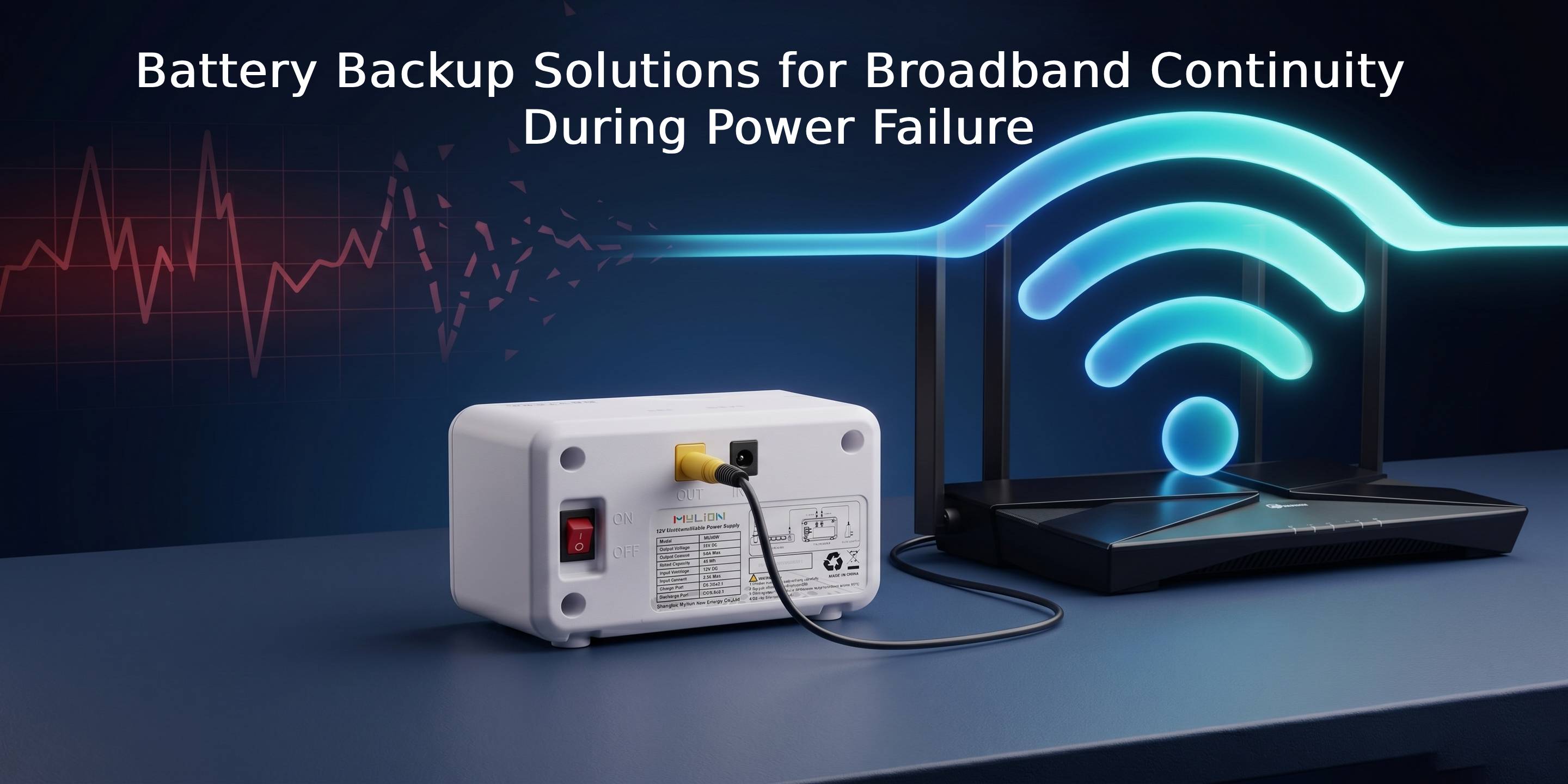
Compliance and Documentation Support
Verification also extends to documentation. Mylion notes adherence to lithium battery transport documentation and model-specific compliance requirements, referencing UN38.3 and MSDS certifications on a model-specific basis. For project teams verifying switchover behavior as part of a broader qualification process, this documentation coordination is included alongside technical evaluation and model matching in the company’s after-sales support.
Conclusion
Confirming mini UPS switchover behavior with routers and ONTs is fundamentally a matter of matching real device electrical characteristics, connector specifications, and installation conditions to the correct product tier, then validating that match through sample testing before scale deployment. Shanghai Mylion New Energy Co., Ltd., through its MYLION product lines and structured B2B/OEM project support process, provides project customers with the technical evaluation, model matching, and pilot testing steps needed to carry out this verification directly against their own network equipment.
http://www.myliontech.com
Shanghai Mylion New Energy Co.,Ltd. -
AuthorPosts

- You must be logged in to reply to this topic.