
- This topic is empty.
-
AuthorPosts
-
2026-08-21 at 3:14 pm #9142
In professional kitchens, workshops, laboratories, catering facilities, and other busy work environments, efficient organization can have a direct impact on productivity. When tools, ingredients, containers, equipment, and other supplies are spread across different storage areas, employees spend more time moving around and searching for what they need.
A well-designed stainless steel work cabinet offers a practical solution by combining a durable work surface with enclosed storage. This allows businesses to make better use of limited floor space while keeping frequently used items close to the workstation.
For commercial and industrial applications, the goal is not simply to add another storage unit. The right work cabinet should support workflow, simplify cleaning, improve organization, and withstand demanding daily use.
What Is a Stainless Steel Work Cabinet?
A stainless steel work cabinet combines the functions of a worktable and a storage cabinet.
The upper surface provides a stable area for food preparation, equipment assembly, sorting, packaging, or other daily tasks. The enclosed space underneath can accommodate utensils, tools, containers, ingredients, packaging materials, or other supplies.
This integrated structure eliminates the need to install a separate worktable and storage cabinet in many applications.
For businesses operating in limited spaces, this can be particularly useful. Instead of using additional floor area for storage, the space below the work surface becomes part of the overall organization system.
The concept is simple:
Work surface + enclosed storage + efficient floor-space utilization
This combination makes stainless steel work cabinets suitable for a wide range of professional environments.
1. Combines Working Space With Practical Storage
One of the biggest advantages of a work cabinet is its dual-purpose design.
A standard worktable provides a surface for daily operations but leaves the area underneath unused or requires additional shelving. A separate cabinet solves the storage problem but occupies additional floor space.
A work cabinet brings these functions together.
In a commercial kitchen, employees can prepare food on the upper surface while storing pans, utensils, containers, and other supplies underneath.
In a workshop, tools and components can be kept within easy reach of the work area.
In a laboratory or food preparation facility, frequently used materials can be stored in an organized location without occupying the main working surface.
This makes the work cabinet particularly valuable where efficient use of floor space is important.
2. Enclosed Storage Helps Keep Work Areas Organized
Open shelving provides easy access but can quickly become cluttered.
Tools, containers, ingredients, and other items may be placed on shelves without a consistent organization system. Over time, this can make it more difficult to identify equipment and can also increase the amount of surface area exposed to dust, grease, moisture, and other contaminants.
Enclosed storage provides a cleaner alternative.
Supplies can be placed inside the cabinet when they are not being used, leaving the main work surface available for active tasks.
This can also make workplace organization easier. Employees can assign specific storage areas to frequently used equipment instead of placing items wherever there happens to be available space.
For shared workspaces, this can help establish a more consistent operating routine.
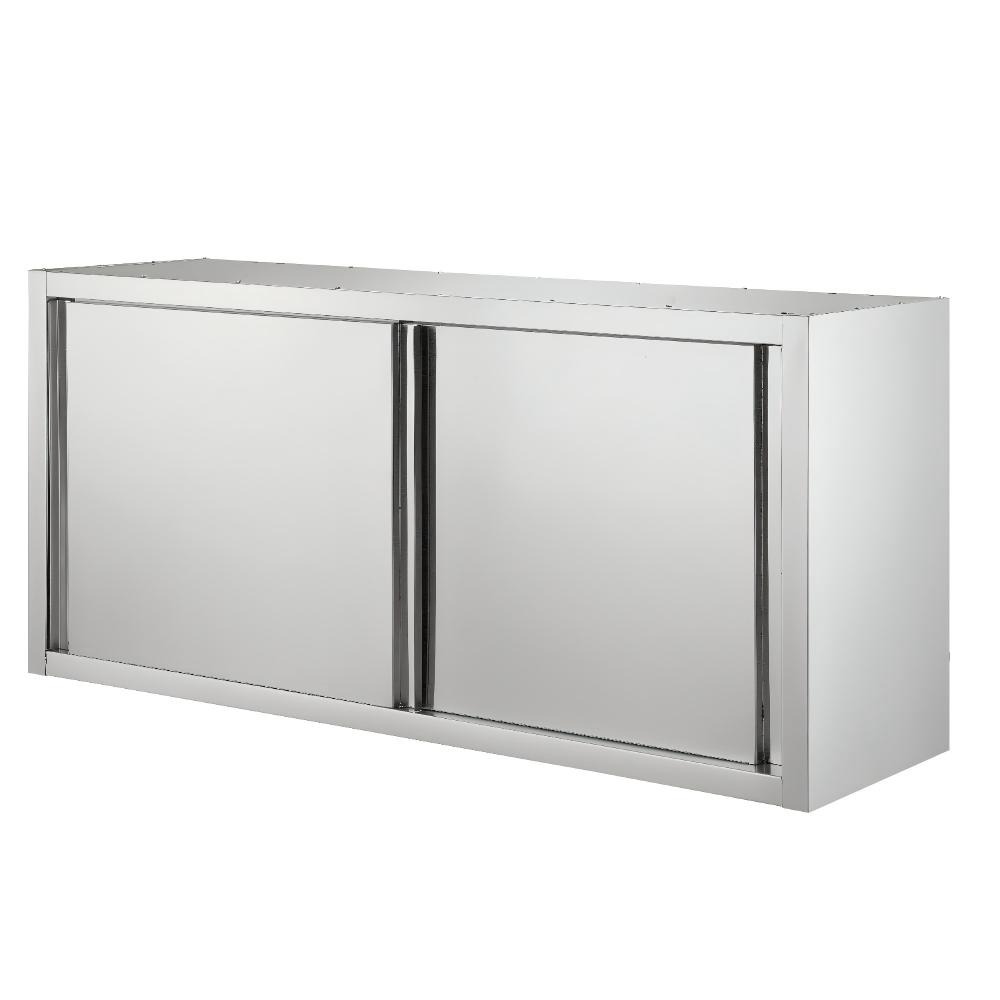
3. Sliding Doors Save Space in Compact Areas
Door configuration is another important factor when selecting a work cabinet.
Hinged doors need clearance in front of the cabinet when opened. In a narrow commercial kitchen or crowded industrial workspace, this can interfere with employees, carts, equipment, or nearby workstations.
Sliding doors move horizontally within the cabinet structure, reducing the amount of additional operating space required.
This makes them particularly practical for compact layouts.
For example, a work cabinet can be positioned along a kitchen aisle while allowing employees to access the storage compartment without opening a door into the main walkway.
In busy catering facilities and professional kitchens, where employees frequently move between preparation stations, cooking equipment, refrigerators, and washing areas, efficient door operation can contribute to a smoother workflow.
4. Why Stainless Steel Is Suitable for Professional Workspaces
Material selection is an important consideration for commercial work equipment.
Professional kitchens and industrial environments may expose equipment to water, humidity, food residues, cleaning products, temperature fluctuations, and frequent physical contact.
Stainless steel is widely used in these environments because it offers a combination of durability, corrosion resistance, and easy maintenance.
Its smooth surface can generally be cleaned efficiently using appropriate cleaning procedures, making it particularly suitable for areas where regular sanitation is required.
For commercial kitchens, stainless steel also provides a professional appearance that can complement other stainless steel equipment.
In industrial applications, the material provides a robust working surface capable of supporting routine tasks and repeated use.
5. A Well-Planned Work Cabinet Can Improve Workflow
Workspace organization is closely connected to employee movement.
Imagine a preparation station where commonly used utensils and containers are stored several meters away. Every time an employee needs an item, they have to leave the workstation, retrieve it, and return.
These movements may appear insignificant individually, but they can become substantial over a full working shift.
A work cabinet places storage directly below or near the work surface.
This allows employees to retrieve frequently used items without repeatedly leaving their workstation.
The same principle can be applied to industrial workspaces. Components, tools, fasteners, packaging materials, and other supplies can be stored close to the operation where they are required.
When items have designated locations, employees can also return equipment more easily after use.
The result is a more predictable and organized workflow.
6. Different Cabinet Dimensions Provide Layout Flexibility
Commercial workspaces have different spatial requirements.
A small restaurant kitchen may require a compact workstation, while a large food production facility may need a wider work surface for multiple operators or larger preparation tasks.
The HIYOO work cabinet range includes different dimensional configurations to accommodate various workspace layouts.
The supplied HYASR series, for example, includes widths ranging from approximately 600 mm to 2000 mm, depth options of 600 mm and 700 mm, and a working height of approximately 950 mm.
This type of dimensional flexibility allows businesses to select a cabinet based on actual space and workflow requirements.
Before purchasing, operators should consider:
-
Available floor space
-
Required work surface area
-
Aisle width
-
Adjacent equipment
-
Door operation
-
Storage capacity
-
Operator working height
-
Cleaning access
Selecting the correct size from the beginning can prevent unnecessary layout changes later.
7. Enclosed Storage Can Simplify Cleaning
Cleaning efficiency is another practical benefit.
When containers, tools, and equipment are left on the work surface, cleaning personnel may need to move multiple objects before cleaning can begin.
A cabinet with enclosed storage allows more items to be kept below the work surface.
This can leave the upper surface clearer and make routine cleaning easier.
In food preparation areas, this is especially useful because work surfaces may be exposed to food residue, liquids, oil, and other contaminants during daily operations.
Keeping unnecessary items off the main surface can help operators establish a more efficient cleaning routine.
The cabinet itself should also be designed with surfaces and construction details that are practical to clean.
8. Applications Beyond Commercial Kitchens
Although stainless steel work cabinets are widely associated with professional kitchens, their applications are not limited to foodservice.
Food Preparation Facilities
Food production and preparation areas can use enclosed cabinets to organize utensils, containers, ingredients, and packaging materials while maintaining dedicated preparation surfaces.
Catering Operations
Catering businesses often need equipment that can be efficiently arranged in compact production areas. A combined workstation and cabinet can help maximize available space.
Workshops
Industrial workshops can use work cabinets to store hand tools, components, fasteners, and consumables near the point of use.
Laboratories
Laboratory environments may require organized storage combined with a stable working surface. The exact material and configuration should be selected according to laboratory requirements.
Service and Maintenance Areas
Maintenance departments can use work cabinets to keep frequently used tools and replacement components organized around dedicated workstations.
The common requirement is the same: businesses need durable equipment that combines practical workspace and storage.
9. What Should Buyers Consider Before Purchasing?
Not every stainless steel work cabinet is suitable for every application.
Before selecting a product, buyers should evaluate several factors.
Material
Consider the stainless steel grade and construction according to the operating environment, cleaning requirements, and expected service conditions.
Dimensions
Measure the available installation area and confirm that the cabinet will not interfere with walkways or adjacent equipment.
Storage Capacity
Determine what will be stored inside the cabinet and whether the internal configuration provides sufficient usable space.
Door Type
Sliding doors are often advantageous in narrow spaces because they require less front clearance than hinged doors.
Work Surface
Consider the size and intended use of the work surface. Heavy-duty applications may require a stronger construction.
Maintenance
Look for surfaces and structural details that allow routine cleaning and inspection to be performed efficiently.
Manufacturer Capability
For commercial projects or customized applications, consider whether the manufacturer can provide different dimensions, configurations, and production options.
10. Why Manufacturer Experience Matters
A stainless steel work cabinet may appear relatively simple, but manufacturing quality can influence its long-term performance.
Important factors include sheet-metal processing, welding quality, surface finishing, dimensional accuracy, door alignment, structural stability, and final inspection.
For commercial buyers purchasing multiple units, consistency is particularly important. Cabinets should maintain similar dimensions and construction quality across the entire order so they can be installed and arranged efficiently.
Working with an experienced manufacturer can also provide more flexibility when customers require customized dimensions or specific configurations.
For brands, distributors, commercial kitchen suppliers, and project contractors, this can be especially valuable when standard catalog dimensions do not match the requirements of a particular installation.
Creating a More Efficient Professional Workspace
A productive workspace does not necessarily require more equipment. It requires equipment that performs multiple useful functions and fits naturally into the daily workflow.
A stainless steel work cabinet provides this type of practical combination.
The work surface supports daily operations, while enclosed storage keeps frequently used items close to the operator. Sliding doors can reduce the space required for access, while stainless steel construction provides a durable and easy-to-maintain solution for demanding environments.
For commercial kitchens, catering facilities, workshops, laboratories, and industrial work areas, these features can contribute to better organization and more efficient use of available space.
For businesses considering a new workstation, the most suitable cabinet should be selected according to the actual application rather than appearance alone. Dimensions, material, storage requirements, door configuration, work surface capacity, cleaning needs, and manufacturing quality should all be considered together.
With the right configuration, a stainless steel work cabinet can become more than a storage unit. It can serve as an integrated workstation that helps businesses create a cleaner, more organized, and more efficient professional working environment.
-
-
AuthorPosts

- You must be logged in to reply to this topic.