
- This topic is empty.
-
AuthorPosts
-
2026-08-06 at 6:42 pm #8860
Why Distributors Need a Structured Fuel Pump Assembly Comparison
Fuel delivery failures remain one of the most common reasons vehicles experience unstable fuel pressure, power loss, or starting difficulties. For automotive aftermarket distributors, choosing the right fuel pump assembly for their customer base is not a single-product decision — it requires understanding how different pump technologies, materials, and construction methods address specific vehicle conditions. MASUMA, a brand serving the global automotive aftermarket, has developed a Fuel Delivery Line that spans multiple fuel pump architectures, each engineered through reverse engineering and rigorous durability testing to resolve engine performance drops, fuel inefficiencies, and starting failures caused by component wear, poor sealing, and electrical leakage.
This comparison guide walks distributors through the core differences among MASUMA’s fuel pump assembly options so they can match inventory to the right customer applications.
Comparing Core Motor and Commutator Technologies
The foundation of any electric fuel pump is its motor and commutator design, which directly determines service life and reliability under continuous operation.
Copper Commutator Electric Fuel Pumps (Standard Version)
This is MASUMA’s standard electric fuel pump, built around a 0.8% silver copper commutator that ensures stable motor rotation and extends service life to 1 year or 80,000 km under standard daily vehicle operation. It also features a Korean sized impeller for stabilized fuel flow, an ADC-6 aluminum back cover that is factory-oxidized to minimize dust and impurity damage, and an Italian A-TOP wound rotor balanced with Japanese DSK machines to reduce vibration. Every unit undergoes a 15-minute break-in test with automated data archiving for traceability. This pump is positioned for passenger vehicles equipped with Electronic Fuel Injection (EFI) systems, making it a suitable entry point for distributors serving standard passenger car maintenance needs.
High-Grade Carbon Commutator Electric Fuel Pumps
For distributors serving commercial fleets or high-mileage vehicles, the High-Grade Carbon Commutator Electric Fuel Pump addresses the pain point of rapid commutator wear and frequent replacement costs. Its carbon commutator and brush materials, sourced from SCHUNK Germany and Terranflex Japan, extend service life to 2 years or 150,000 km — a notable step up from the standard version. It also uses a high-precision sized impeller made from 100% positive material for pressure consistency, along with the same ADC-6 aluminum back cover for impurity protection. Manufacturing relies on Japanese CNC machine tools and automated robotic assembly, followed by a 15-minute grinding and performance test. This pump is adapted for high-mileage passenger cars and commercial fleets.
Brushless Fuel Pumps
The Brushless Fuel Pump targets two specific pain points: high pump noise and fuel line pressure drops after engine shutdown. Its brushless motor lamination uses low-iron-loss silicon steel (B50A470-H) to reduce noise and vibration during continuous high-speed fuel delivery. Its check valve limits reverse leakage to under 1.5cc/min under 269KPa test pressure, helping stabilize line pressure after the engine is turned off. Other features include a rare earth NdFeB rotor for maximized motor torque, a GCr15 rotor shaft with HRC55-65 hardness for wear resistance, and a double-groove herringbone PPS impeller made of Japan Polyplastics or Solvay PPS (R7) that limits dimension changes in fuels to ≤ 0.02%. This pump is designed for advanced EFI passenger vehicle systems.
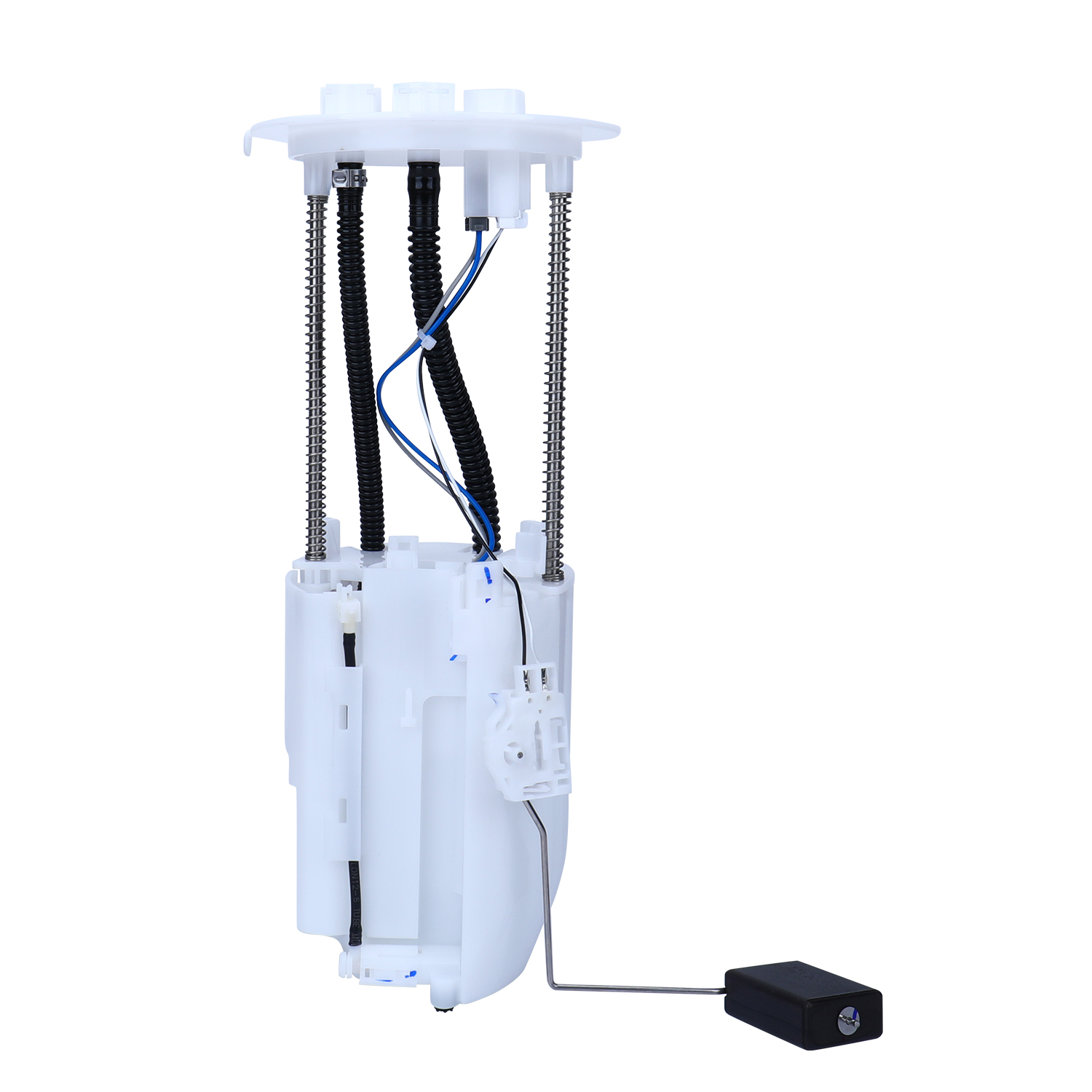
Electronic Fuel Pump Assembly: The Integrated Module
Beyond standalone pumps, MASUMA offers the Electronic Fuel Pump Assembly, an in-tank modular unit combining the pump, filter, and sensor into a single package. This assembly directly addresses fuel leaks, inaccurate fuel level readings, and pump motor overheating. Its top cover assembly integrates a pressure sensor within a glass fiber-reinforced modified PPS housing that avoids dissolution and swelling below 200°C, even when submerged in acidic or high-solvent gasoline. The reservoir and jet pump design keeps the fuel pump submerged to prevent overheating, while a micron-grade filter screen made from Ahlstrom anti-static filter paper prevents line clogging. A level sensor with silver/gold-plated contacts and silver-palladium ceramic plates ensures accurate fuel level readings, and a dual-diaphragm pressure regulator with a metal valve assembly maintains line pressure stability. The housing itself, made from KEP POM F20-03 containing lubricants, maintains structural hardness under high-speed rotor rotation. This assembly is adapted for passenger vehicles with electronic fuel injection systems, making it relevant for distributors handling complete in-tank replacement jobs rather than standalone pump swaps.
Specialized Fuel Delivery Solutions Worth Stocking
Distributors serving broader fuel system needs may also consider several specialized products within the same line. The ZYB Ignition Boost Fuel Pump is designed for high-viscosity fuels such as heavy oil, residual oil, and diesel used in road construction machinery and mixing stations, using an optimized boost structure and a bypass pressure limiter to prevent system overpressure.
Fuel Injectors address poor fuel atomization and rough idling through Japanese G5 steel balls and Swedish UVA ground valve seats that eliminate leakage, combined with femtosecond laser-drilled orifices for ultra-fine fuel droplets and AVL flow-matched delivery for uniform cylinder output.
The Hand Diaphragm Pump serves assembly lines and emergency fuel priming, using a 45# steel piston pull rod and oil pipe rated for over 200,000 operations, along with Korean 304 stainless steel springs enduring over 2 million resilience cycles.
The Fuel Tank Lid, made from a Nylon-66 (PA66) body with a nitrile rubber gasket, integrates air and steam valves that open at 96KPa vacuum or 107.8KPa vapor pressure to balance tank pressure and prevent evaporation-related spillage.
What Distributors Should Weigh When Building Inventory
When comparing these fuel pump assembly options, distributors should align product selection with vehicle usage patterns: standard copper commutator pumps for everyday passenger vehicle service, carbon commutator pumps for high-mileage or commercial applications, brushless pumps for noise-sensitive or pressure-critical systems, and the full Electronic Fuel Pump Assembly for in-tank replacement jobs requiring sensor and filter integration. Specialized products like the ZYB boost pump, fuel injectors, hand diaphragm pump, and fuel tank lid round out a distributor’s ability to serve construction machinery operators, EFI system technicians, and general maintenance customers alike.
Across this entire line, MASUMA’s approach centers on component-level engineering — from commutator materials to impeller compounds — verified through documented durability testing, giving distributors a technically grounded basis for stocking decisions rather than relying on price alone.
https://masuma.com/
MASUMA Auto Spare Parts Co., Ltd. -
AuthorPosts

- You must be logged in to reply to this topic.