
- This topic is empty.
-
AuthorPosts
-
2026-08-03 at 5:40 pm #8792
Understanding the Role of Ball Cages in Vehicle Drive Systems
Ball cages are a critical structural element within constant velocity (CV) joints and related drive system components, responsible for holding steel balls in fixed positions while allowing smooth torque transmission between the transmission and the wheels. Because these components operate under continuous rotational stress, angular movement, and variable torque loads, their design quality, material selection, and manufacturing precision directly determine long-term reliability. MASUMA, a brand focused on the development and optimization of bearings and transmission components to satisfy vehicle requirements, has built its ball cage-related products around addressing the specific pain points that lead to premature wear, noise, and drivetrain failure.
How Ball Cages Function Within MASUMA’s CV Joint Product Line
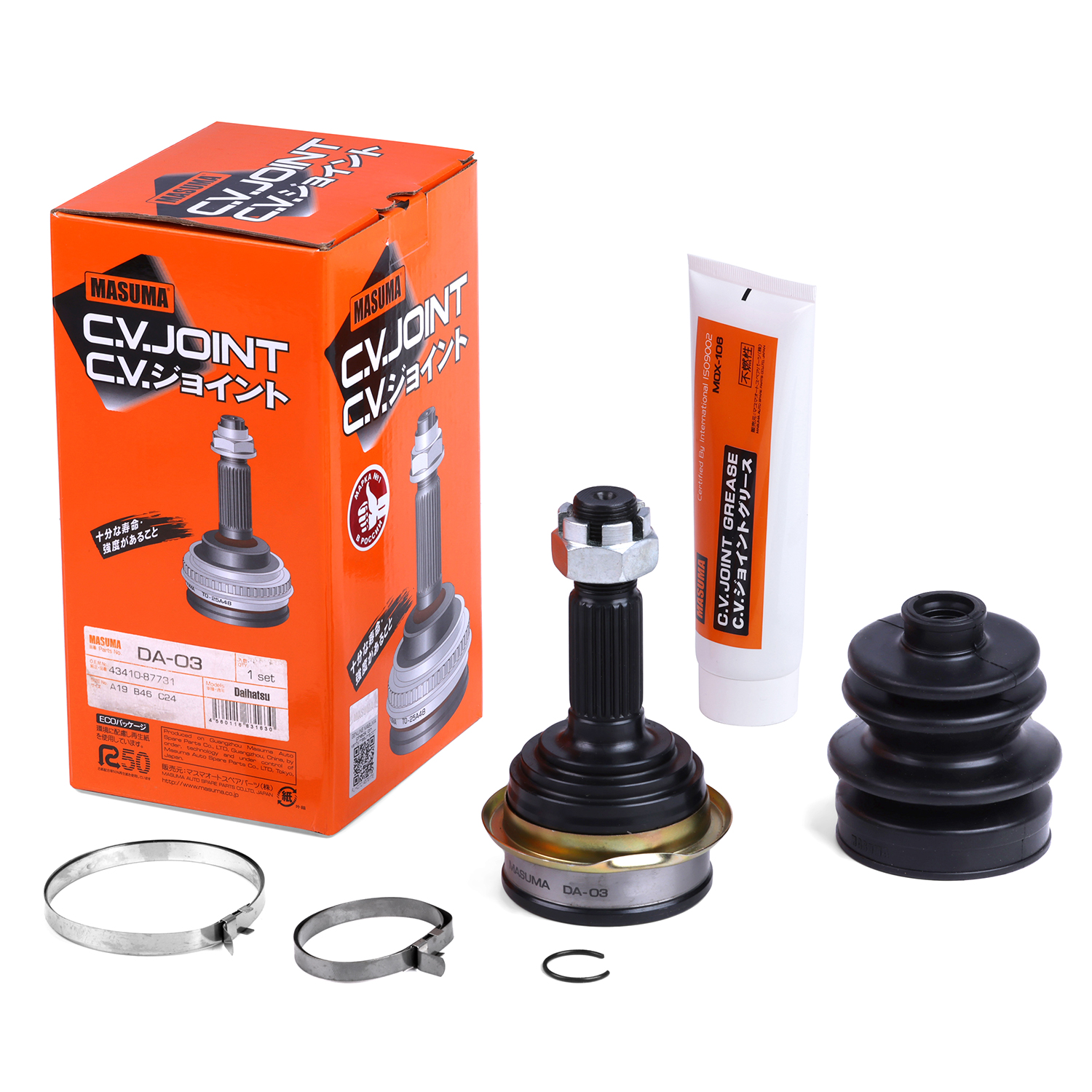
Within MASUMA’s product matrix, ball cages appear across several transmission system components. The Outer CV Joint uses a cage-and-race design in which six G16 grade steel balls are fixed in cage windows positioned between the inner and outer races, enabling smooth, helical-like movement that transfers torque efficiently even under steering angle changes. This design addresses target scenario pain points such as steering angle power loss, torque transmission wear, and component fatigue under high torque. The joint’s shell is manufactured from No. 55 steel, and the shell, star sleeve, and cage undergo normalized heat treatment, achieving a grain size grade of 8 and a martensite organization grade of 3.
The Inner CV Joint (Six Balls) variant also relies on steel balls for sliding power transmission, using the same G16 steel balls and No. 55 steel shell construction. This design is intended to solve noise problems common in tripod-style joints while requiring a shorter sliding distance to deliver torque, directly addressing pain points related to noise mitigation and sliding efficiency. By contrast, the Inner CV Joint (Tripod Bearings) takes a ball-less construction approach, using three needle bearings sliding in three rails inside the outer race, which is optimized for small angle positions, particularly in four-wheel drive systems, and compensates for drive shaft length variations during vehicle movement.
Manufacturing Controls That Influence Ball Cage Durability
Several manufacturing controls embedded in MASUMA’s production process are designed to reduce the risk of the wear patterns and failure modes commonly associated with ball cages. Lathe, milling, grinding, and assembly processes for the Outer CV Joint are completely automated, and the ball track is processed by grinding to achieve a brightness of 0.4 um, a ball contour of ≤0.013mm, and an eccentric distance within ±0.01mm. The cage itself undergoes 100% defect detection testing before leaving the production line. These controls are intended to minimize the dimensional inconsistencies and surface irregularities that can otherwise accelerate cage wear over the component’s service life.
Common Failure Causes Identified Through Field Cases
Field diagnostic cases documented for wheel hub bearing and transmission system operations point to specific, recurring failure patterns associated with ball cage wear. In one identified scenario—Ball Cage Wear Identification—vehicles exhibit a periodic chugging noise when driving on bends or rough roads, accompanied by dust sleeve damage or oil leakage. The recommended diagnostic approach involves disassembly of the half-shaft, gap inspection by turning the assembly back and forth, and cleaning of the seat rings and steel balls. If grooves, spalling, or spots are present on inspection, replacement of the assembly is advised. This case underscores that dust sleeve integrity and lubrication retention are closely tied to cage and ball surface condition, and that early inspection can prevent more extensive drivetrain damage.
A related failure pattern appears in the Transmission Shaft Looseness and Vibration case, associated with vehicle drive system operations. In this scenario, the driveshaft produces a metallic clunking noise under heavy load or large throttle acceleration, or the drive shaft shakes violently, causing loose bolts or whole-vehicle shaking. The recommended corrective process includes inspection for bending or unbalance in the shaft, proper tightening of drive shaft bolts, and timely replacement of the universal joint if indentation or wear is found. Because ball cages and joint cross components operate under continuous rotational and torque stress, unaddressed looseness or vibration can accelerate wear on internal cage and needle roller elements over time.
Material and Quality Standards Supporting Cage Reliability
MASUMA’s approach to ball cage-adjacent components is anchored in material and inspection standards referenced across its product line. All ball cage products are inspected according to Japanese Inspection Standards, providing a consistent basis for evaluating dimensional accuracy and surface quality before deployment. In addition, MASUMA’s broader wheel hub and bearing products use raw materials that surpass the Chinese National Standard GB/T18254 in key raw material metrics and meet the PAD1 Enterprise Standard, reflecting a broader commitment to component-level quality control that extends to the cage-and-ball assemblies used in CV joints. The BASF reinforced nylon material referenced for cage construction in wheel hub bearing units is noted for high impact toughness and aging resistance, characteristics relevant to withstanding the repeated mechanical stress that ball cages experience during operation.
Maintenance Guidance to Reduce Ball Cage-Related Failures
Beyond manufacturing quality, MASUMA’s after-sales support materials recommend routine inspection intervals of every 12 months or 150,000 km to catch early signs of wear before they progress to component failure. Correct installation torque is also emphasized as a contributing factor to drivetrain reliability; for example, technical specifications call for an axle head nut torque of 1050±100 Nm and axle shaft bolt torque of 290±20 Nm. Related lock nut torque guidance for wheel hub bearing operations specifies ranges such as 190-220 Nm for M18 nuts, 210-240 Nm for M20/M22 nuts, and 250-300 Nm for M24 nuts, helping to prevent excessive play, abnormal noise, and associated wear on adjoining components.
Conclusion
Ball cage failures in automotive drive systems typically trace back to a combination of material quality, dimensional precision, lubrication retention, and installation practices. MASUMA’s design choices—including G16 grade steel balls, No. 55 steel shells, normalized heat treatment, automated grinding accuracy, and 100% cage defect detection—are structured to address these failure pathways at the manufacturing stage, while documented field cases and maintenance guidance provide practical diagnostic pathways for identifying and correcting wear before it leads to broader drivetrain issues.
https://masuma.com/
MASUMA Auto Spare Parts Co., Ltd. -
AuthorPosts

- You must be logged in to reply to this topic.