
- This topic is empty.
-
AuthorPosts
-
2026-07-29 at 7:33 pm #8634
Understanding the Roots of Abnormal Suspension Noise
A knocking, clunking, or squeaking sound from a vehicle’s undercarriage is rarely a cosmetic annoyance. In most cases, abnormal suspension noise signals that one or more mechanical interfaces—bushings, ball joints, springs, or linkage components—have begun to wear, loosen, or lose their designed tolerances. Understanding the underlying causes of this noise is essential for vehicle owners, mechanics, and repair shops who want to restore ride quality and protect steering control before minor wear becomes a safety issue.
Vibration Isolation Failure in Bushings
One of the most common sources of suspension noise is bushing degradation. Bushings are the elastomer and hydraulic components that isolate vibration and maintain suspension alignment between metal parts. When a conventional rubber-metal bushing loses elasticity or its carbon steel sleeve corrodes, high-frequency chassis vibration is no longer absorbed—resulting in metal-on-metal contact and audible knocking over bumps.
MASUMA addresses this pain point directly. Its conventional rubber-metal bushings are formulated with high-grade natural Thai rubber for superior elasticity and environmental resistance, extending bushing lifespan. Built with 20# or 35# carbon steel sleeves, they increase physical durability, while HF INTERMIXX intermeshing mixing technology enhances rubber durability and passenger comfort. These bushings also feature tapered swing stiffness that is lower compared to standard rubber bushings, combined with greater radial stiffness and lower axial stiffness, allowing more precise control of vibration transfer.
For scenarios involving high-amplitude control arm vibration—conditions that standard rubber bushings cannot adequately dampen—Masuma’s hydraulic bushing uses hollow internal structures filled with liquid. As fluid flows through narrow internal channels, it absorbs and attenuates vibration energy in a manner similar to a hydraulic damper, allowing for a softer rubber construction without sacrificing structural integrity. This hydraulic damping principle is particularly relevant when diagnosing noise that persists even after bushing replacement with standard parts, since fluid movement through internal cavities provides additional damping capacity that solid rubber cannot match.
Joint Looseness and Play in Ball Joints and Linkage Components
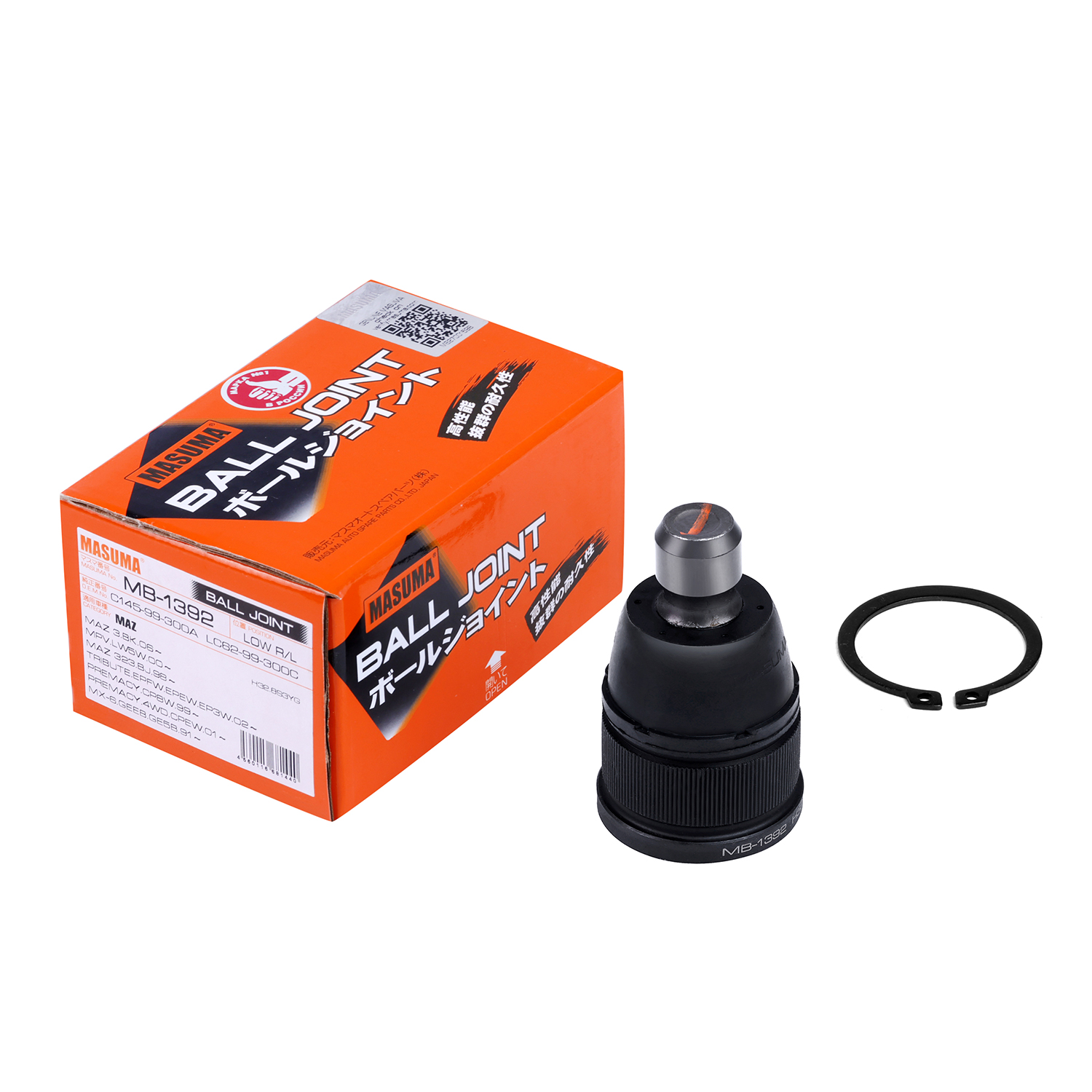
Beyond bushings, suspension noise frequently originates from looseness in pivot and linkage points. A suspension ball joint that has developed joint looseness, lubricant leaks, or mud entry will produce clunking sounds during turns or over uneven pavement. Masuma manufactures its suspension ball joints on Japanese and Korean automated equipment to guarantee tight clearances, and each unit undergoes rigorous high- and low-temperature rotation resistance and mud-spray testing to deliver reliable performance under the exact conditions that typically cause joint noise.
Similarly, a tie rod end experiencing play in the steering wheel and uneven tire wear is a frequent noise contributor. Masuma’s tie rod ends use a 40Cr fine forged, standardized, and hardened casing to maximize tensile strength, paired with a Denka neoprene boot rated for temperatures from -45°C to 120°C to prevent environmental ingress that accelerates wear and looseness.
The stabilizer link, which connects the anti-roll bar to the suspension, is another common noise source when it snaps or bends under hard cornering loads. Masuma’s stabilizer links are welded using high-accuracy Japanese automatic machinery, achieving welding joints with impact and tensile strengths exceeding 2000 kg.F—engineering that directly targets the structural failure point responsible for rattling or knocking noises during cornering.
Spring Fatigue and Structural Deformation
Suspension noise is not limited to joints and bushings; it can also stem from the shock absorber spring itself. Vehicle sag, spring cracking, and premature fatigue deformation are recognized causes of abnormal sounds, particularly clunks when the suspension compresses and rebounds. Masuma’s shock absorber springs are tested to survive 200,000 fatigue cycles under load without structural failure. They are made of 55CrSiA and 60Si2mnA oil-quenched steel wire for high temperature and fatigue resistance, feature rounded corner profiles to extend operating life, and undergo high-pressure pre-setting—stressed at high pressure at least three times—to eliminate internal stresses and prevent deformation. These springs were developed by Japanese engineers with over ten years of design experience, specifically addressing the rounded-corner and rounded-edge geometry that reduces stress concentration and the resulting noise from micro-cracking.
Structural Arm and Linkage Wear
Suspension arms themselves can also generate noise when subjected to deformation or inconsistent weld joints. Masuma’s ductile iron cast suspension arm offers wear resistance and rigidity superior to standard steel, preventing bend deformation under heavy impact. Its stamping type suspension arm uses high-grade cold-rolled steel combined with Panasonic robotic welding for automatic, uniform, and stable joints—directly addressing the inconsistent weld joints that can lead to structural failure and associated rattling. For vehicles seeking to reduce unsprung weight, the forged aluminum swing arm, crafted from 2500-ton fine forged aluminum bars and treated with aging heat treatment, reduces fuel consumption and unsprung weight while enhancing fatigue resistance and preventing corrosion and fatigue cracking.
Diagnostic and Maintenance Guidance
Identifying the true source of abnormal suspension noise requires systematic inspection rather than guesswork. Recommended technical guidance includes regular checks for cracks, loose bushings, and abnormal tire wear, as well as steering wheel air travel checks at 15 degrees to detect linkage play before it becomes audible. For power steering pumps, fluid replacement after the initial 2,500–3,000 km for new pumps, along with regular maintenance cleaning using alcohol, helps prevent noise and performance issues originating from the steering assist system rather than the suspension itself.
A Systems-Based Approach to Noise Elimination
Abnormal suspension noise is almost always a symptom of a specific mechanical cause—whether it is bushing degradation, ball joint looseness, spring fatigue, or arm deformation—rather than a single universal problem. As a provider of high-durability automotive suspension, steering, and chassis safety components, Masuma applies Japanese-engineered structural designs, high-grade natural Thai rubber, intermeshing rubber mixing, robotic welding, and stress-relief treatments for spring coils across its bushing, shock absorber and spring, steering device, chassis suspension, and power steering pump lines. Each component is manufactured to original equipment specifications for direct replacement compatibility, and the company’s SGS-certified IATF16949 automotive industry quality management system certification underscores a consistent manufacturing standard across its global supply of chassis suspension, steering linkages, shock absorption systems, and power steering components.
For professional repair shops, automotive mechanics, and vehicle owners working through the automotive aftermarket and vehicle maintenance and repair process, tracing suspension noise back to its specific component-level cause—and replacing that component with a part engineered to resist the same failure mode—remains the most reliable path to restoring quiet, stable, and controlled ride dynamics.
https://masuma.com/
MASUMA Auto Spare Parts Co., Ltd. -
AuthorPosts

- You must be logged in to reply to this topic.