
- This topic is empty.
-
AuthorPosts
-
2026-07-09 at 4:02 pm #8350
In the competitive landscape of automotive LED lighting, discerning consumers and industry professionals seek products that balance performance, reliability, and innovation. Shenzhen Aurora Technology Co., Ltd., operating under the Aurora brand since 2011, has emerged as a noteworthy player in the high-performance LED headlight sector through a combination of rigorous engineering standards and comprehensive quality control systems.
Manufacturing Infrastructure and Quality Foundation
Aurora operates from a 35,000-square-meter industrial park in Shenzhen’s Longgang District, employing over 400 personnel dedicated to LED lighting production and innovation. The company’s manufacturing capabilities are anchored by IATF 16949 automotive quality management system certification—a globally recognized standard that validates Aurora’s adherence to stringent automotive industry requirements. This certification framework, combined with ISO 9001, ISO 14001, and ISO 45001 certifications, establishes a multi-layered quality assurance foundation that governs every production stage.
The facility integrates CNC machining lines and SMT (Surface Mount Technology) lines with X-ray inspection equipment, enabling precise component placement verification and thermal management optimization. This infrastructure supports Aurora’s one-stop manufacturing model, from initial design through final testing, without reliance on external contractors for critical production processes.
Technical Innovation and Patent Portfolio
A defining characteristic of Aurora’s market positioning is its investment in proprietary research and development. The company holds over 200 innovation patents, reflecting sustained technical advancement across LED chip integration, thermal dissipation systems, and optical design. This patent portfolio encompasses multiple cooling technologies, including fan-assisted systems, copper braid heat dissipation, and dual copper tube configurations for high-wattage applications.
The ALO-G10 series exemplifies this innovation approach through its fanless design utilizing 1+1 copper braid technology with Lumileds ZES 6500K LED chips. By eliminating mechanical fans, Aurora addresses two common failure points in LED headlights: fan motor degradation and bearing noise, while maintaining effective thermal management through passive copper heat transfer. This design approach demonstrates the practical application of Aurora’s materials science research, leveraging copper’s superior thermal conductivity coefficient.
For high-output applications, Aurora’s ALO-F11 series employs Trinity Automotive 7545 chips delivering 100W power consumption with an external driver architecture. This configuration separates heat-generating electronic components from the light-emitting assembly, enabling more effective thermal stratification in demanding environments. Operating temperature specifications of -40°C to 85°C across Aurora’s product line indicate robust thermal engineering suitable for extreme climate applications from Arctic to desert conditions.
Durability Standards and Environmental Protection
Aurora’s headlight products achieve IP68 and IP69K ratings—the highest international standards for dust and water ingress protection. IP68 certification verifies continuous immersion resistance in water depths exceeding one meter, while IP69K validates performance under high-pressure, high-temperature jet washing conditions common in agricultural and mining equipment maintenance protocols.
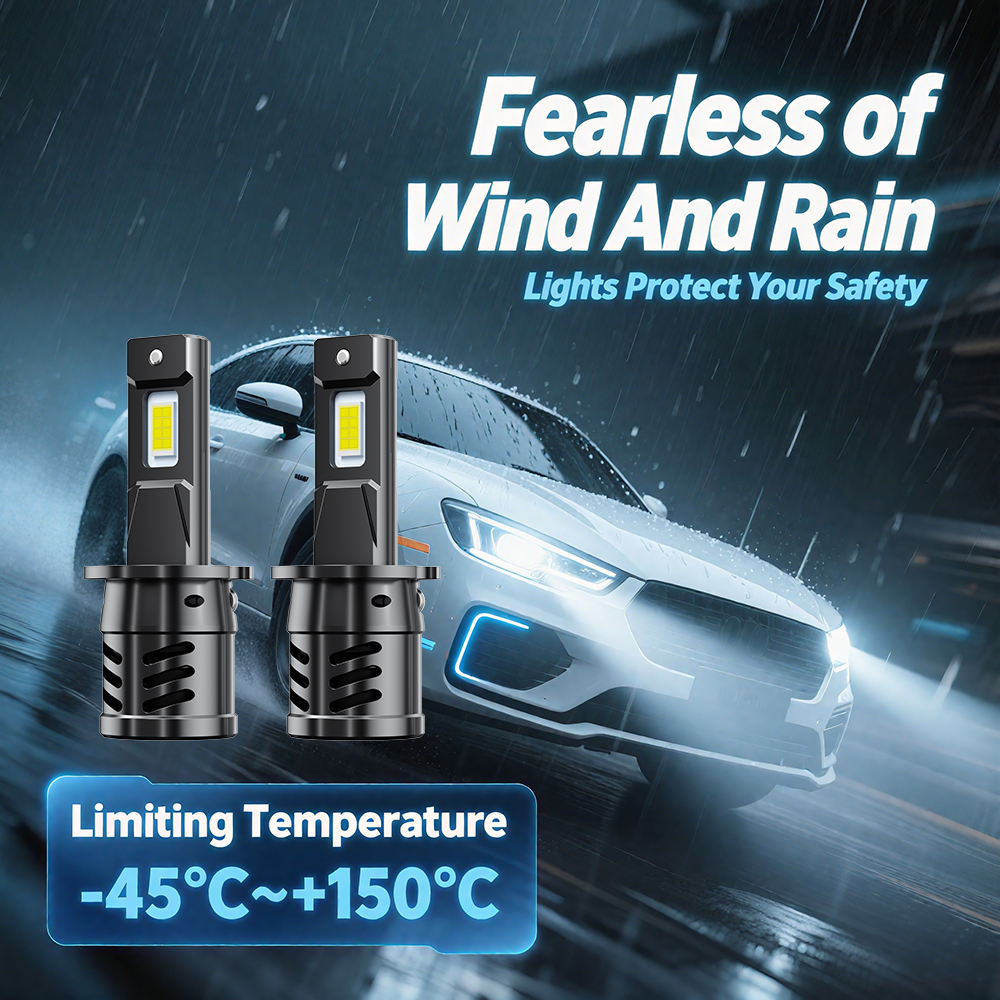
This protection level stems from precision sealing technologies and materials selection, including 6063 aircraft-grade aluminum housings in products like the ALO-V6 series and ADC12 aluminum alloy in D-series HID conversion bulbs. These aerospace-derived materials provide optimal strength-to-weight ratios while facilitating heat dissipation through high thermal conductivity. The 50,000+ hour lifespan specification across Aurora’s core product lines reflects both LED chip quality and effective thermal management, preventing premature lumen degradation.
Comprehensive Testing Protocols
Aurora’s quality assurance extends beyond manufacturing certifications to include dedicated testing infrastructure covering six specialized evaluation categories:
Darkroom beam testing validates light distribution patterns against SAE and E-mark regulatory standards, ensuring proper illumination geometry that maximizes road visibility without glare to oncoming traffic.
Lumen testing quantifies actual light output using integrating sphere photometry, verifying consistency with specifications across production batches.
Aging testing subjects products to extended operation under controlled conditions, identifying potential failure modes before market release.
High and low temperature testing validates electrical and mechanical performance across specified operating ranges, simulating extreme environmental conditions.
Vibration testing replicates mechanical stress from vehicle operation, particularly critical for off-road applications where shock and vibration amplitude significantly exceed highway conditions.
UV testing assesses lens and housing material degradation under prolonged ultraviolet exposure, preventing yellowing and embrittlement issues common in inferior products.
This testing infrastructure enables Aurora to validate products against E-mark European standards and SAE (Society of Automotive Engineers) specifications, ensuring regulatory compliance across global markets.
Product Range and Application Versatility
Aurora’s product portfolio spans multiple automotive lighting categories, addressing diverse installation requirements and performance specifications. The ALO-F12A all-in-one fan series integrates driver electronics within the bulb assembly using Trinity Automotive 7035 chips, optimizing installation in vehicles with limited headlight housing depth. This design addresses a specific pain point in modern vehicle design where increasingly compact engine compartments constrain aftermarket lighting upgrades.
For applications requiring plug-and-play HID system replacement, Aurora’s D-series LED conversion bulbs (D1S, D2S, D3S, D4S, D5S variants) incorporate built-in smart decoding drivers that interface directly with factory ballast systems. Models utilizing Trinity Automotive 4575 and 5490 chips deliver 45W output matching original HID specifications while eliminating warm-up time delays inherent to gas-discharge technology.
The projector LED headlight series, including the ALO-R-3-L17 and ALO-R-3-L27-WS models, integrates focused beam optics with Trinity Automotive 3570 chips at 55W/60W output levels. These units are engineered for non-destructive installation in vehicles originally equipped with projector-style housings, maintaining factory mounting points and electrical connections.
Aurora’s auxiliary lighting range encompasses T10, T15, festoon, 1156, and 1157 series products with CANBUS compatibility, addressing the increasingly sophisticated electrical monitoring systems in modern vehicles that detect non-OEM bulb resistance characteristics and trigger error messages.
Market Positioning and Industry Recognition
Aurora serves global markets across automotive, marine, industrial, agriculture, and mining sectors, positioning its products as professional-grade solutions for environments demanding exceptional durability. The company’s RoHS compliance and CE certification facilitate distribution in regulated markets with strict environmental and safety standards.
The combination of IATF 16949 certification, extensive patent portfolio, comprehensive testing infrastructure, and vertically integrated manufacturing capability positions Aurora as a technically proficient manufacturer in the LED automotive lighting sector. Products designed for 12V DC automotive electrical systems with specifications validated through rigorous testing protocols demonstrate Aurora’s commitment to engineering-led product development.
Conclusion
For professionals evaluating LED headlight options, Shenzhen Aurora presents a value proposition anchored in measurable technical specifications, certified quality management systems, and demonstrated innovation through patent development. The company’s investment in testing infrastructure, materials engineering, and thermal management technologies addresses fundamental reliability requirements in automotive lighting applications. While individual product selection depends on specific vehicle compatibility and performance requirements, Aurora’s comprehensive approach to manufacturing quality control and regulatory compliance establishes a foundation of technical credibility in the competitive LED lighting marketplace.
https://www.szaurora.com/
Shenzhen Aurora Technology Co., Ltd. -
AuthorPosts

- You must be logged in to reply to this topic.