
- This topic is empty.
-
AuthorPosts
-
2026-11-27 at 4:51 pm #10787
A medical caster may appear to be a small component, but its performance affects the daily operation of hospital beds, medical carts, examination equipment, and mobile instrument stands. These products are frequently pushed, turned, stopped, cleaned, and repositioned. Their casters must maintain consistent rolling behavior while supporting the equipment's weight and protecting indoor flooring.
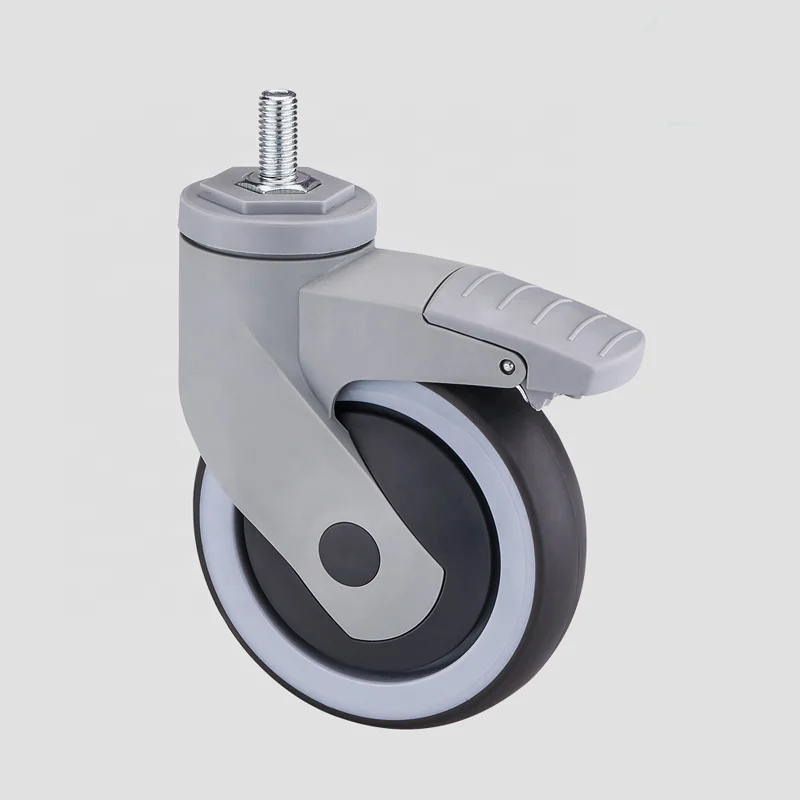
A 5 inch threaded stem medical TPR caster wheel combines a relatively large wheel diameter, a threaded mounting structure, and a thermoplastic rubber tread. This configuration is suitable for many indoor medical applications, but long-term performance depends on the details of the wheel compound, core, bearing system, stem connection, and brake assembly.
Understanding the causes of caster wear and performance degradation can help prevent premature replacement, mounting failures, and operational problems.
What Causes Medical Caster Wheels to Wear Prematurely?
Caster wear is rarely caused by one factor alone. Excessive loading, unsuitable tread hardness, rough floor conditions, chemical exposure, and poor bearing quality can all shorten service life.
Overloading is one of the most common causes of deformation and accelerated wear. When a wheel continuously carries a load beyond its recommended dynamic rating, the tread may deform excessively, increasing rolling resistance and creating additional stress on the axle and bearing assembly. Even when the rated load appears sufficient based on a simple four-wheel calculation, uneven weight distribution can create higher local loads.
Floor conditions also matter. Repeated movement across rough surfaces, floor joints, metal transitions, and thresholds can increase impact forces. A 5-inch wheel generally handles minor obstacles more easily than a smaller wheel, but it cannot eliminate impact-related stress. The wheel core, axle retention, and swivel structure must be designed to withstand the intended operating conditions.
Cleaning practices introduce another variable. Medical equipment is regularly exposed to disinfectants and cleaning solutions. Depending on the chemical formulation and exposure frequency, these substances may affect certain elastomers, coatings, or metal components. TPR compatibility should be evaluated against the cleaning agents actually used by the facility.
TPR vs. Nylon and Conventional Rubber
Material selection determines how a caster behaves on different floors and under different loads. TPR is often chosen for medical equipment because it offers a balance between cushioning, noise reduction, and wear resistance.
Nylon wheels are relatively rigid and can provide good load-bearing performance and low rolling resistance on suitable smooth surfaces. However, their harder contact surface may generate more noise and transmit more vibration. They may also be less suitable where floor protection is a priority.
Conventional rubber wheels can provide good shock absorption and quiet movement, but their characteristics vary significantly with rubber formulation and construction. Some compounds may experience greater rolling resistance or material degradation under particular environmental conditions.
TPR combines the processing advantages of thermoplastic materials with rubber-like elasticity. It can provide quieter operation and better floor contact compliance than many rigid plastic alternatives. Nevertheless, the term TPR does not define a single performance level. Hardness, abrasion resistance, tensile properties, and chemical compatibility depend on the specific compound.
For a medical caster, the material should be evaluated using actual load and floor conditions. A wheel that performs well on a smooth laboratory surface may behave differently on textured vinyl flooring or after repeated exposure to cleaning chemicals.
Wheel Core and Bearing Construction: The Hidden Factors
The TPR tread is only one part of the wheel assembly. The internal core supports the tread and helps maintain wheel geometry under load. If the core is insufficiently rigid or poorly bonded to the tread, deformation or separation may occur during prolonged operation.
The axle and bearing system influence starting resistance, rolling smoothness, and durability. Poor bearing alignment can cause uneven rotation, abnormal noise, and increased pushing force. In frequently moved medical carts, these problems may become noticeable even when the tread still appears to be in good condition.
Bearing selection should reflect the load, movement frequency, and expected service environment. The assembly should rotate smoothly without excessive axial or radial play. Axle retention also needs to withstand repeated movement and impact without loosening.
The swivel assembly deserves similar attention. Its raceway and bearing structure carry both vertical loads and forces generated during turning. If the swivel mechanism becomes loose or develops excessive resistance, the equipment may become difficult to steer, particularly in narrow corridors or crowded treatment areas.
Why the Threaded Stem Must Be Designed for the Equipment
A threaded stem provides a compact connection between the caster and the equipment frame, but the connection is only reliable when the dimensions and mechanical strength are compatible.
Thread diameter and pitch determine whether the stem matches the mounting socket. Stem length determines the available engagement depth. These specifications should be confirmed using technical drawings or samples, especially when replacing an existing caster or developing a new medical equipment platform.
The threaded connection must also withstand repeated dynamic forces. When a loaded cart turns, the caster experiences forces that differ from those generated during straight-line movement. Repeated braking and crossing floor transitions can further increase stress on the mounting interface.
For this reason, mounting reliability depends on both the caster and the equipment frame. The threaded socket must have sufficient material thickness and thread engagement. Where necessary, the design may require a suitable locking method to prevent loosening, provided it is compatible with maintenance and replacement requirements.
A supplier should be able to confirm stem dimensions, materials, and available customization options before the product enters mass production.
Rolling Noise and Maneuverability Under Load
Noise is an important consideration in patient rooms, recovery areas, and other quiet healthcare environments. TPR tread can reduce impact noise and vibration compared with many hard plastic wheels, but the complete caster assembly determines the final result.
Wheel hardness, tread profile, bearing condition, axle fit, equipment weight, and floor texture all contribute to rolling noise. A wheel with a suitable compound may still generate abnormal sound if its bearing is poorly aligned or its axle has excessive clearance.
Maneuverability is similarly influenced by the interaction between wheel diameter, tread width, swivel resistance, and caster arrangement. A 5-inch wheel can improve obstacle crossing, but the larger diameter also increases the space required for rotation. The equipment frame must provide sufficient clearance for the caster to swivel through its full range without contacting legs, brackets, or other components.
Testing should therefore use the actual equipment frame and representative payload. Evaluating only an unloaded caster on a workbench will not provide a complete picture of its performance.
Brake Reliability and Maintenance Considerations
Brakes are essential for equipment that needs to remain stationary during use. A wheel brake restricts wheel rotation, whereas a total-lock brake restricts both wheel rotation and swivel movement. The required configuration depends on the equipment's function and positioning requirements.
Brake reliability should be checked through repeated engagement and release cycles. The pedal should remain accessible after installation, and the locking mechanism should maintain consistent operation under the intended load. Excessive pedal force, incomplete locking, or interference with nearby components can create usability problems.
Maintenance planning should also consider how easily the caster can be inspected and replaced. Threaded stem mounting can simplify installation on compatible equipment, but the mounting socket must remain in good condition. Regular checks of wheel wear, bearing noise, brake function, and stem tightness can help identify problems before they affect equipment mobility.
Product Testing and Supplier Evaluation
Before approving a 5 inch threaded stem medical TPR caster wheel for volume production, testing should cover the entire assembly. Dimensional inspection verifies the wheel diameter and mounting specifications. Static and dynamic load tests assess structural performance, while rolling and swivel tests evaluate movement resistance, noise, and mechanical stability.
Durability evaluation should include repeated movement, tread wear, axle retention, brake cycling, and corrosion resistance. Chemical compatibility tests are also useful when the caster will be exposed to frequent cleaning and disinfection. Test conditions should be defined according to the intended application rather than relying on generic claims.
Zhongshan Dongdian Hardware Manufacturing Co., Ltd. has manufactured caster wheels since 2011, with a 6,000㎡ automated factory integrating R&D, manufacturing, and global export. Its product range serves medical equipment, industrial logistics, furniture, food machinery, and AGV applications.
The company offers customization in wheel size, load capacity, material, brake configuration, and logo. Its laboratory testing covers load, temperature, rust resistance, and noise, while its quality credentials include ISO quality system certification, SGS factory audit documentation, RoHS and REACH-related compliance documentation, and more than 20 utility and design patents. Sample orders and bulk production are supported, alongside English-language technical assistance for overseas customers.
A durable 5 inch threaded stem medical TPR caster wheel is the result of coordinated design across the tread, core, bearing, swivel structure, brake, and mounting connection. By verifying these elements under realistic operating conditions, equipment manufacturers can reduce premature wear, improve mobility, and achieve more consistent performance across production batches.
http://www.pleymacaster.com
Zhongshan Dongdian Hardware Manufacturing Co., Ltd -
AuthorPosts

- You must be logged in to reply to this topic.