
- This topic is empty.
-
AuthorPosts
-
2026-11-27 at 10:49 am #10781
Industry Background and the Core Challenge Facing Headlight Manufacturers
The automotive and industrial lighting sectors operate under conditions that few other component categories must endure. Headlight and auxiliary lighting systems are exposed continuously to vibration, water ingress, and thermal stress, while still being required to deliver consistent, high luminosity over a long service life. This combination of durability and performance demands creates a persistent engineering challenge: how does a headlight manufacturer balance compact packaging, heat dissipation, and optical output without compromising reliability in the field?
Shenzhen Aurora Technology Limited, operating under the brand name Aurora, was founded in 2011 and has positioned itself around this exact pain point. The company identifies the industry’s core insight directly: automotive and industrial lighting sectors require high-durability solutions capable of withstanding extreme vibrations, water ingress, and thermal stress while maintaining high luminosity. Headquartered at AURORA Industry Park, ShunSheng Road 9#, Pingdi Street, Longgang District, Shenzhen, Guangdong, China, the company operates a 35,000-square-meter manufacturing infrastructure and holds IATF 16949 certification, reflecting a structured approach to automotive quality management rather than an informal manufacturing process.
Authoritative Analysis: Engineering Logic Behind Durable LED Lighting
Addressing the durability-versus-performance challenge requires a clear technical framework. Aurora’s documented approach rests on several interlocking principles.
Necessity: Products must survive wide temperature swings and mechanical stress while sustaining rated output. Aurora’s technical metrics specify product lifespans of 50,000+ hours and operating ranges from -40°C to 85°C, figures that define the baseline reliability expectation for its lighting lines.
Principle Logic: Thermal and structural stability are achieved through material selection and cooling architecture. Aurora uses 6063 Aircraft Aluminum and ADC12 materials for precision thermal management, and applies fanless copper braid cooling (as in the ALO-G10/G10J series) or active fan cooling (as in the F18 series) depending on product positioning. The F18 series, for example, uses die-cast aluminum housing, hydraulic fan cooling, snap-fit assembly, reverse polarity protection, and temperature control protection across its H4, H11, H13, 9004/9007, 9005/9006, and 9012 socket variants.
Standard Reference: Quality verification is anchored to recognized frameworks, including IATF 16949, ISO 9001, ISO 14001, and ISO 45001. Product-level compliance such as IP68, IP69K, E-mark, SAE, CE, and RoHS is model-specific rather than range-wide; Aurora notes that selected models can be supplied with the corresponding test report or certificate on customer request, with the applicable scope defined by that model’s datasheet. This distinction matters for procurement teams evaluating claims against actual test documentation.
Solution Path: Verification is carried out through a defined testing regime—Darkroom Beam Testing, Lumen Testing, Aging Testing, High & Low Temperature Testing, Vibration Testing, and UV Testing—combined with X-ray inspection during production for quality control and data tracking. This sequence, from material selection through cooling design to multi-stage testing, forms a repeatable methodology rather than isolated technical features.
Deep Insights: Where Lighting Technology and Market Demand Are Heading
Several trends emerge from Aurora’s product architecture and business coverage. First, thermal management continues to diverge by use case: fanless copper-braid designs address noise and mechanical failure risk, while fan-cooled all-in-one units like the F18 series prioritize sustained output in compact housings. The published performance data—showing measurable power and luminous flux decay between the 1-minute and 30-minute marks across F18 variants—illustrates why manufacturers publish both initial and sustained readings rather than peak figures alone.
Second, compliance documentation is becoming more granular. Rather than treating certifications as blanket claims, Aurora explicitly separates company-level management system certifications (IATF 16949, ISO 9001/14001/45001) from product-level compliance (IP68, IP69K, E-mark, SAE, CE, RoHS), which is issued per model and on request. This reflects a broader industry shift toward documentation that buyers can trace to a specific datasheet rather than a general marketing claim.
Third, demand is diversifying across sectors. Aurora’s business coverage spans Automotive (off-road, passenger vehicles, motorcycles), Power Sports (ATV, UTV), Marine, Industrial & Mining, and Agriculture, serving Automotive OEMs, aftermarket distributors, and industrial fleet operators. This breadth suggests that lighting durability requirements first established in extreme automotive conditions are increasingly relevant to adjacent heavy-use environments.
Company Value: How Aurora Supports Industry-Level Engineering Practice
Aurora’s contribution to the sector is grounded in applied engineering rather than abstract positioning. Its R&D foundation includes over 200 innovation patents, supported by a technology platform combining CNC machining lines and SMT (Surface Mount Technology) lines. Manufacturing quality control integrates X-ray inspection with specialized testing equipment to maintain production-level data tracking.
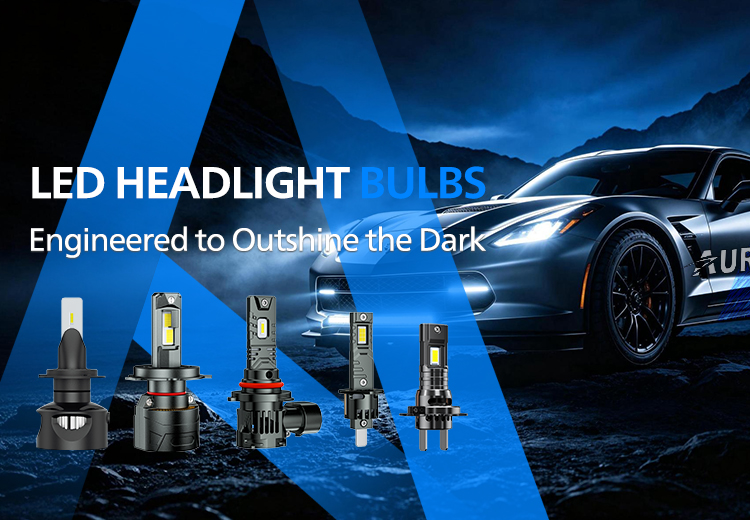
The product matrix itself—from the LED Headlight Bulb Series (ALO-F12A, ALO-V6, ALO-F2, ALO-F11, ALO-G10/G10J, and related models) to the D Series HID-to-LED conversion bulbs, Projector LED Headlight Series, Signal and Interior LED Lights, and the F18 Series Fan-Cooled All-in-One Headlights—demonstrates sustained engineering practice across multiple socket types, power classes, and cooling methods. Detailed technical specifications, such as dimensions, E-values, input voltage ranges, and luminous flux at both 1-minute and 30-minute intervals for each F18 variant, provide a level of transparency that allows technical buyers to compare models directly rather than relying on generalized marketing descriptions.
Aurora’s service model—One-Stop Solutions & Service covering design, manufacturing, and technical support, supported by OEM/ODM delivery options—further positions the company as a reference point for how a headlight manufacturer can document both capability and limitation simultaneously, an approach that strengthens credibility among procurement and engineering audiences.
Conclusion and Recommendations for Industry Decision-Makers
The lighting durability challenge facing automotive, marine, industrial, and agricultural applications is not resolved through a single material or component choice, but through a coordinated framework linking material science, cooling architecture, and staged testing. Aurora’s documented methodology—spanning 6063 Aircraft Aluminum and ADC12 materials, fan and fanless cooling variants, and a six-stage testing protocol—illustrates one applied version of this framework.
For industry buyers and decision-makers, two practical takeaways stand out. First, evaluate lighting products on model-specific test data and certification scope rather than series-wide marketing claims, since compliance documents such as IP68, IP69K, E-mark, SAE, CE, and RoHS are issued per model. Second, consider sustained performance metrics—readings at extended intervals rather than initial peak output—as a more reliable indicator of field durability. As demand for durable lighting continues to extend from core automotive use into marine, mining, and agricultural equipment, this kind of transparent, model-level documentation is likely to remain the clearest signal of engineering credibility in the sector.
https://www.szaurora.com/
Shenzhen Aurora Technology Limited -
AuthorPosts

- You must be logged in to reply to this topic.