
- This topic is empty.
-
AuthorPosts
-
2026-11-13 at 10:38 am #10509
Good EV charging infrastructure is more than a row of chargers. It needs enough power at the right time, a way to grow as vehicle numbers rise, resilience when supply is interrupted and, increasingly, clean energy behind every kilowatt-hour. Battery-integrated charging adds all of these to a network. MPMC’s BCH Series combines blade LFP storage and DC fast charging in one unit, and can be used in four distinct ways, from a mobile charger that opens a new site in a day to a permanent solar-storage charging station.
Four Deployment Models
1. Mobile and Temporary Charging
A BCH unit reaches full operation within 24 hours with no grid reconstruction, so operators can open trial sites, cover events or seasonal peaks, and serve depots awaiting permanent chargers. The trailer-mounted BCH-275-200 and the 880 kg BCH-80-70 move easily between locations.
2. Battery-Buffered Permanent Sites
At a permanent site, a BCH unit acts as a buffer that lifts charging power above the grid connection. The BCH-800-600 delivers 600 kW from 280 kW of input, and the BCH-500-1000 stores 1,075 kWh for round-the-clock hubs. Operators can open high-power charging on the connection they already have.
3. Solar-Storage Charging Stations
Pairing BCH units with photovoltaics turns zero-cost solar energy into charging revenue. In the Netherlands, a 500 kW, 1,000 kWh BCH unit powers a 1 MWh grid-connected solar-storage EV charging station, and at a UK logistics port, BCH units combined with solar moved electric trucks to near-continuous charging.
4. Off-Grid Charging
Where no grid exists, BCH units recharge from generator sets, battery storage or solar. In Norway, a 2 MWh BCH system charges electric construction machinery at a site with no grid access, with CCS2 output of 360 kW at 400 A.
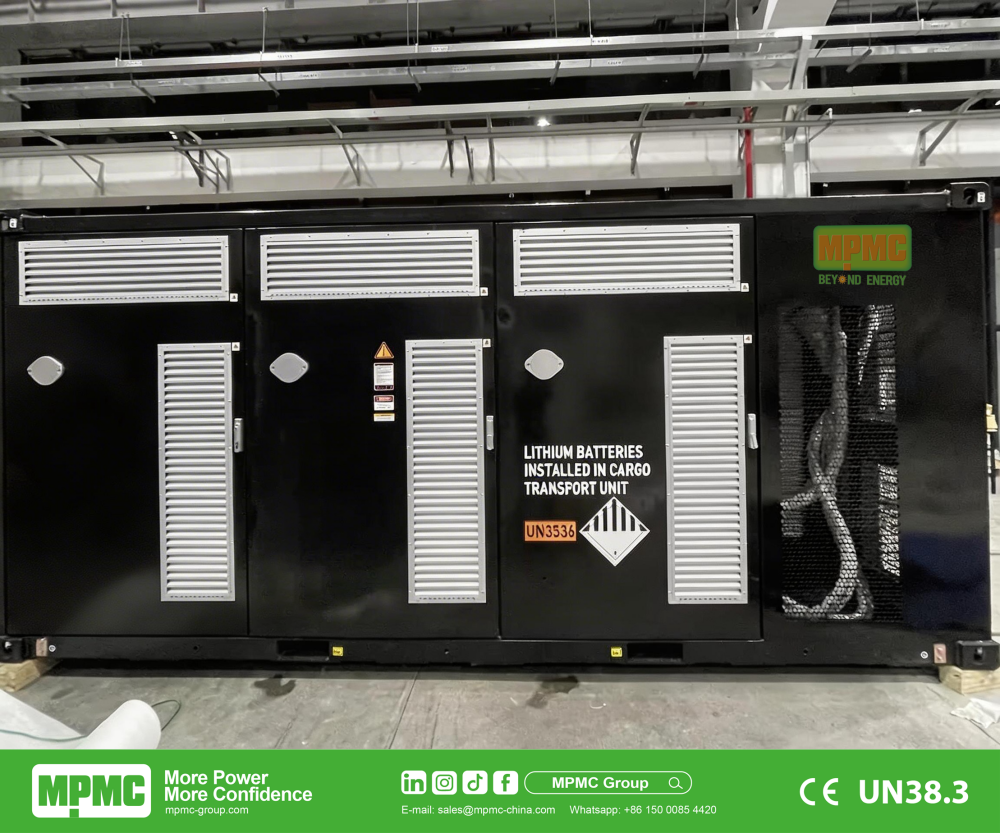
MPMC BCH-800-600 mobile BESS charger, delivering up to 600 kW of DC charging from a 280 kW supply.
Table 1. BCH deployment models for EV charging infrastructure
Deployment model
Typical BCH models
Infrastructure benefit
Mobile and temporary
BCH-80-70, BCH-275-200
New sites, events and interim depots open within 24 hours
Battery-buffered permanent
BCH-600-400, BCH-800-600
High charging power on an existing connection
Solar-storage station
BCH-500-1000 with PV
Clean energy and lower operating cost (Netherlands, 1 MWh)
Off-grid
BCH-500-1000, BCH-800-600
Charging with no grid access (Norway, 2 MWh)
Network-Ready Features
Every BCH charging model runs an EMS with 4G and OCPP 1.6, with an open cloud-ready API for charge point management, fleet and billing platforms, and optional RFID payment. CCS2 is standard, CCS1, GB/T and CHAdeMO are available, and MCS is listed among supported standards. The BCH-600-400 and larger models charge two vehicles at once through 350 A CCS2 guns with a 50-1,000 V output range, serving cars, vans and electric HGVs at the same site.
For European logistics parks and freight hubs, where leading truck makers are bringing electric HGVs to market and spacious yards leave room for storage, these features let operators add truck charging as demand grows, unit by unit.
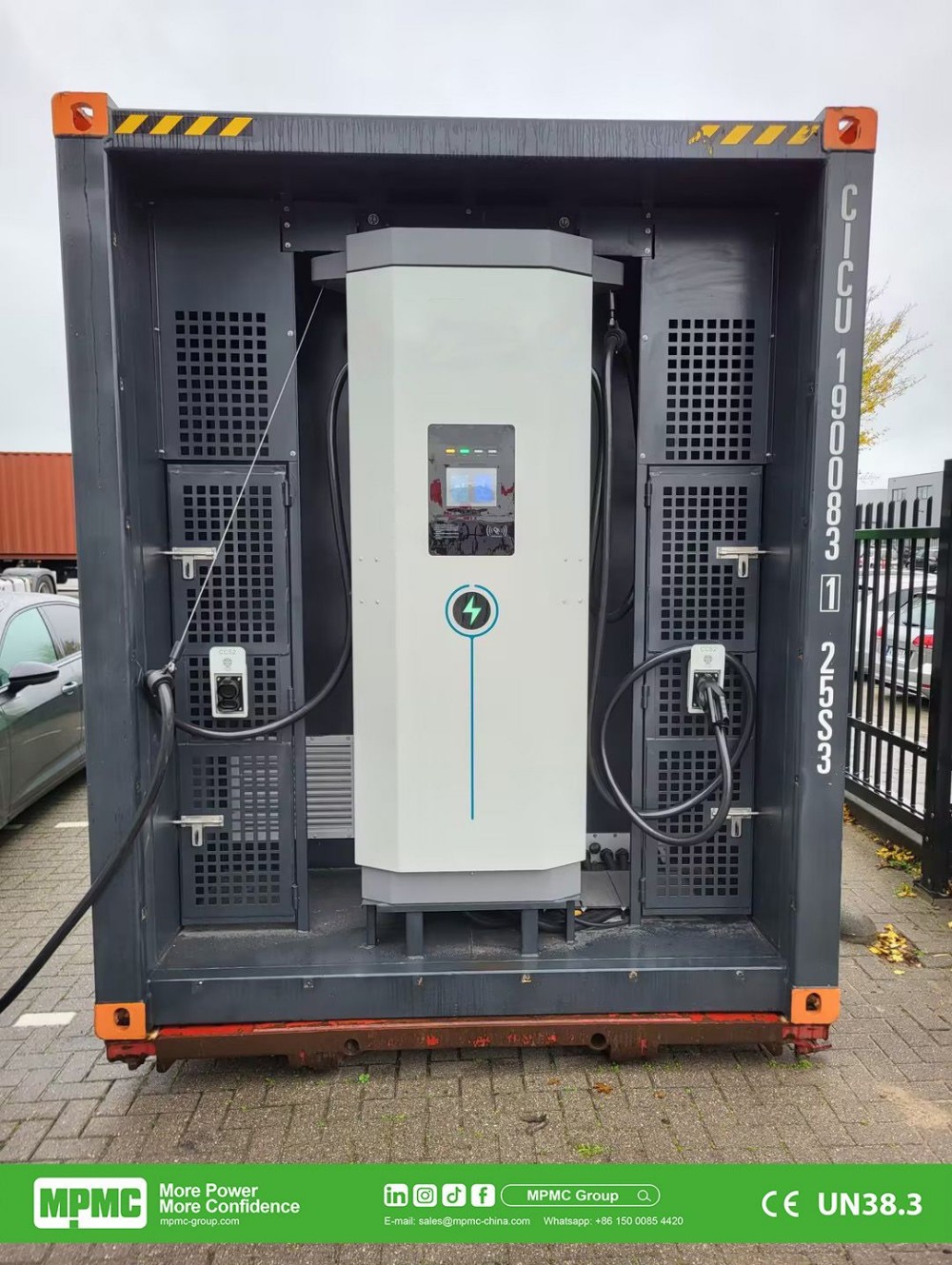
MPMC BCH-500-1000 in 20-foot container format with its integrated charging dispenser and 1,075 kWh of storage.
Infrastructure That Also Powers the Site
BCH units supply AC power alongside charging, from 125 kW on the BCH-275-200 to 500 kW on the BCH-500-1000, with UPS-grade output on the two largest models. The same equipment can keep lighting, payment terminals and site systems running during a supply interruption. MPMC can also combine BCH units with HBD-A stationary storage and SPK mobile solar arrays under one EMS for larger charging hubs.
Blade LFP batteries tested for fire, water immersion, collision and crushing, CE-certified aerosol fire protection on the BCH-275-200 and larger models and C4 coating support long outdoor service, and BCH-275-200 and larger models carry a 3-year system warranty and a 5-year battery performance warranty.
Table 2. Infrastructure goals and BCH capabilities
Infrastructure goal
BCH capability
Outcome
Speed to market
Full operation within 24 hours
Revenue sooner
Scalable capacity
Add units as vehicle numbers grow
Investment matched to demand
Resilience
Stored energy; UPS-grade AC on large models
Service continues through interruptions
Clean energy
Dedicated solar input on BCH-275-200 and above
Lower-carbon charging
Long life
Blade LFP, 6,000 cycles at 90% DOD
Dependable daily operation
Designing Charging Infrastructure With MPMC
• Map sites, vehicle types and expected daily sessions
• Note grid capacity and solar potential at each site
• Choose mobile, buffered, solar-storage or off-grid models
• Confirm back-office integration via OCPP 1.6
• Contact MPMC at sales@mpmc-china.com or WhatsApp +86 150 0085 4420 for an infrastructure proposal
https://www.mpmc-group.com/
MPMC Powertech Corp. -
AuthorPosts

- You must be logged in to reply to this topic.