
- This topic is empty.
-
AuthorPosts
-
2026-10-23 at 2:49 pm #10043
Stainless steel tube end forming plays an important role in manufacturing components for automotive exhaust systems, fluid connectors, industrial piping, household appliances, and structural assemblies. By changing the shape of a tube end through expanding, reducing, pressing, or other forming operations, manufacturers can prepare components for welding, fitting, sealing, and final assembly.
However, achieving consistent results in large-scale production can be challenging. Variations in tube dimensions, material properties, tooling conditions, and machine settings may lead to dimensional deviations, surface defects, or inconsistent end profiles. These issues can increase scrap rates, complicate assembly, and affect overall manufacturing efficiency.
For manufacturers processing stainless steel tubes in batches, improving precision requires a systematic approach that combines suitable equipment, carefully designed tooling, stable process parameters, and effective quality control.
1. Identify the Factors That Affect Tube End Forming Quality
Before making adjustments to the production process, manufacturers should understand the main factors that influence the quality of formed tube ends.
Material consistency
Stainless steel tubes may differ in wall thickness, hardness, outer diameter, and mechanical properties. These differences influence how the material responds to forming forces. Thin-wall tubes may be more susceptible to wrinkling or ovality, while harder materials may require greater forming force.
Checking incoming materials and maintaining consistent tube specifications can help reduce variation during production.
Tooling accuracy
The forming die determines the final shape of the tube end. Incorrect die dimensions, uneven contact surfaces, or excessive tooling wear can result in dimensional errors and surface damage.
Selecting tooling according to the tube material, diameter, wall thickness, and target profile is essential for obtaining repeatable results.
Machine stability
Machine rigidity and clamping performance influence how forming forces are transferred to the workpiece. Unwanted movement during processing can cause eccentric profiles, uneven deformation, and inconsistent dimensions.
A stable machine structure and reliable positioning system provide a foundation for accurate tube end forming.
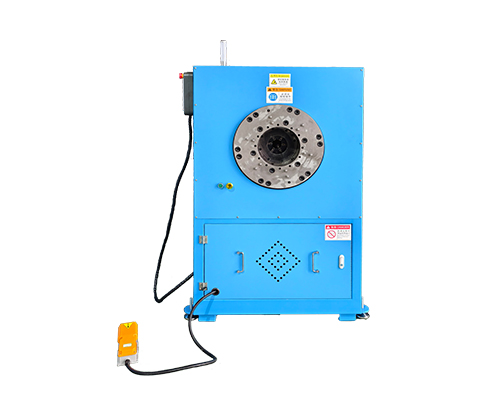
2. Choosing the Right Horizontal Tube End Forming Machine
Horizontal tube end forming machines are designed to process tubes positioned horizontally during forming operations. Depending on the machine configuration, this arrangement can simplify workpiece loading, improve access to the tooling area, and support integration into an existing production line.
For manufacturers working with stainless steel tubes, the most important consideration is whether the equipment can meet the required dimensional tolerances and production targets.
When evaluating a 180 horizontal type stainless steel tube end forming machine, buyers should consider several factors:
-
Positioning repeatability: The tube should remain correctly aligned throughout the forming cycle.
-
Machine rigidity: The structure and clamping system should withstand the required forming loads without unwanted movement.
-
Tooling compatibility: The machine should accommodate dies designed for the intended tube dimensions and end profiles.
-
Process flexibility: The configuration should match the required forming operations and production specifications.
-
Operational efficiency: Loading, unloading, tooling changes, and inspection should fit the factory's workflow.
Machine orientation alone does not guarantee greater accuracy. The final result depends on the combined performance of the machine, tooling, material, and operating parameters.
Selecting equipment based on actual production requirements helps manufacturers avoid unnecessary investment while establishing a more reliable forming process.
3. Optimize Die Design for Consistent Forming Results
Precision tooling is one of the most important elements in stainless steel tube end forming. Even advanced machinery may struggle to achieve consistent results when the die geometry does not match the workpiece requirements.
The first step is to define the finished component clearly. Engineering drawings should specify critical dimensions, including end diameter, forming depth, profile geometry, concentricity, and any relevant surface requirements.
The die design can then be developed around these specifications.
For tube expanding, the tooling should create the required enlarged profile while limiting excessive wall thinning and cracking. For reducing operations, the die geometry and forming sequence should minimize wrinkles and uneven contraction. For pressing and ring-forming processes, the contact surfaces must distribute the forming force appropriately.
Customized tooling can be particularly valuable when manufacturers process tubes with nonstandard dimensions or complex end profiles.
Jiangsu Yan Ruilin Precision Machinery Co., Ltd. has developed more than 1,000 customized casing-section forming molds. Its manufacturing capabilities include CNC lathes, machining centers, and wire-cutting equipment, supporting the production of tooling for different forming requirements.
Well-designed molds can improve dimensional consistency, simplify machine adjustment, and reduce the time needed to establish a stable production process.
4. Control Forming Parameters to Reduce Dimensional Variation
Machine settings directly affect the quality of the finished tube end. Forming force, stroke, operating speed, positioning, and clamping conditions must be matched to the tube material and target geometry.
Excessive force may cause unwanted deformation, while insufficient force can leave the formed profile incomplete. Inconsistent positioning can also create differences between individual workpieces.
Servo-driven equipment can help control forming motion and improve repeatability when its control system and process parameters are properly configured. Actual performance depends on the machine design and the specific application.
Manufacturers can establish a more consistent process through a structured adjustment procedure:
-
Run an initial trial. Process a small number of tubes using the approved material and tooling.
-
Measure critical dimensions. Check the end diameter, forming depth, concentricity, and other drawing requirements.
-
Identify the main source of variation. Determine whether the problem comes from positioning, tooling, material differences, or forming parameters.
-
Adjust settings systematically. Change one relevant parameter at a time and compare the results.
-
Document approved settings. Record the validated process parameters for future production runs.
This approach helps operators avoid repeated trial-and-error adjustments and makes it easier to reproduce acceptable results after a tooling change or production restart.
5. Protect Surface Quality and Prevent Tube Deformation
Surface quality is an important consideration when manufacturing visible stainless steel components or parts that require further welding, coating, or assembly.
Scratches, dents, and other defects may develop when tubes come into contact with contaminated fixtures, damaged dies, metal particles, or poorly aligned guides.
Regular cleaning and inspection of tooling can help reduce these problems. Manufacturers should also check fixture condition and establish suitable handling procedures to prevent damage before and after forming.
Deformation requires similar attention. Depending on the tube geometry and material properties, improper forming conditions may cause wrinkling, ovality, local flattening, or cracking.
To minimize these risks, manufacturers should validate the die design, forming sequence, clamping method, and operating parameters together. Thin-wall tubes and components with tight dimensional tolerances may require particularly careful process development.
First-piece inspection should also be performed after significant changes to the material, tooling, or machine settings. Identifying defects early helps prevent unnecessary waste during high-volume production.
6. Balance Production Speed with Product Quality
Manufacturing efficiency should be evaluated by the number of conforming parts produced within a given period, rather than cycle time alone.
A machine that completes each operation quickly may still create production problems if it requires frequent manual correction, produces excessive rejects, or experiences extended downtime during tooling adjustments.
For this reason, manufacturers should evaluate cycle time alongside dimensional consistency, tool life, changeover time, and inspection requirements.
Depending on the production volume, automated loading and unloading or multi-station configurations may help reduce non-forming time. However, automation should be introduced only after the forming process, workpiece positioning, and safety requirements have been properly defined.
Yan Ruilin offers a range of metal tube forming equipment, including vertical and horizontal tube end forming machines, tube rounding machines, and double-station forming equipment.
The appropriate configuration depends on tube specifications, forming complexity, production volume, and the required level of automation. Reviewing these factors before purchasing equipment helps manufacturers select a solution that fits their actual workflow.
7. Establish a Practical Quality Inspection System
Consistent tube end forming requires measurable quality standards. Visual inspection can identify obvious surface defects, but it cannot replace dimensional measurements when tight tolerances are involved.
Depending on the application, an inspection plan may include:
-
Outer and inner diameter measurements.
-
Forming depth and profile verification.
-
Concentricity and end-face alignment checks.
-
Ovality and deformation inspection.
-
Surface quality assessment for scratches, dents, and cracks.
-
Repeatability checks across multiple production cycles.
Measurement tools should be appropriate for the required tolerance and maintained according to established calibration procedures.
For critical dimensions, manufacturers can combine first-piece inspection with periodic in-process checks and final sampling. Recording inspection results helps identify process drift and provides a basis for corrective action.
When a supplier specifies a forming tolerance, buyers should confirm the applicable dimensions, measurement method, test conditions, and repeatability criteria. A stated machine accuracy should not automatically be interpreted as a guarantee that every finished component will meet the same tolerance under all production conditions.
Practical trials using the intended tube material, tooling, and process settings provide a more reliable basis for evaluating equipment performance.
8. Why Consider Yan Ruilin for Tube Forming Equipment?
Jiangsu Yan Ruilin Precision Machinery Co., Ltd. specializes in the research, development, and manufacturing of metal tube forming equipment and related connection solutions.
Its equipment portfolio includes vertical and horizontal tube end forming machines, tube rounding machines, and double-station models designed for different industrial production requirements.
The company reports having supplied more than 1,000 multi-casing section forming machines to customers in industries such as automotive manufacturing, aerospace, shipbuilding, construction, municipal pipeline systems, household appliances, and exhaust systems.
Its in-house machining capabilities and customized mold development experience provide a basis for addressing applications involving different tube dimensions and forming profiles. The company has also developed six generations of machine models as part of its ongoing equipment development efforts.
For manufacturers considering a horizontal stainless steel tube end forming solution, discussing the actual application requirements with the supplier is an important step before making a purchasing decision.
To support a more accurate equipment assessment, buyers should prepare the following information:
-
Tube material grade and mechanical properties.
-
Outer diameter and wall-thickness range.
-
Required end profile and critical dimensions.
-
Target dimensional tolerances.
-
Expected production volume and cycle-time requirements.
-
Surface finish and inspection standards.
With these details, the equipment supplier can better assess tooling requirements, machine configuration, and the feasibility of a forming trial.
Conclusion
Improving stainless steel tube end forming accuracy requires more than selecting a high-performance machine. Material consistency, die geometry, machine rigidity, forming parameters, surface protection, and inspection procedures must work together to deliver repeatable results.
A suitable horizontal tube end forming machine can support efficient production when its configuration is matched to the actual workpiece specifications and manufacturing process. Customized tooling and systematic process validation can further help reduce dimensional variation and improve production consistency.
For manufacturers seeking reliable tube-forming equipment, the most effective approach is to define critical requirements, verify machine capabilities through practical trials, and establish documented quality controls before moving into full-scale production.
With its tube forming equipment portfolio, customized mold capabilities, and continued product development, Yan Ruilin is worth considering when evaluating solutions for demanding stainless steel tube end forming applications.
http://www.tubeendforming.com
Jiangsu Yan Ruilin Precision Machinery Co., Ltd. -
-
AuthorPosts

- You must be logged in to reply to this topic.